You need a quick closed-form check before you open FEA or a full beam analyzer: max moment, shear, bending stress, tip or midspan deflection, end slope, support reaction, and whether L/δ clears a common L/360 serviceability reference. This pad covers six textbook deflection-of-beams cases used on frames, machine bases, and coursework.
Defaults open on a simply supported steel span with a 10 kN center point load, L = 2 m, Z = 50 cm³, E = 200 GPa, and I = 500 cm⁴. CALCULATE returns M = 5 kN·m, σ = 100 MPa, δ ≈ 1.67 mm, V = 5 kN, θ ≈ 0.143°, each reaction 5 kN, L/δ = 1200, and Pass against L/360. Switch to cantilever, fixed-fixed, or full UDL when that matches the support sketch. Math stays in your browser.
It lives under Mechanical Calculators. After stress looks right, run a margin check on the safety factor calculator. Slender compression members belong on the column buckling calculator.
Formula
- Bending stress σ = M × 1000 ÷ Z (M in kN·m, Z in cm³ → MPa).
- Simply supported center point: M = PL/4, δ = PL³/(48EI), V = P/2, θ = PL²/(16EI).
- Simply supported full UDL: M = wL²/8, δ = 5wL⁴/(384EI), V = wL/2, θ = wL³/(24EI).
- Cantilever tip point: M = PL, δ = PL³/(3EI), V = P, θ = PL²/(2EI) at the tip.
- Cantilever full UDL: M = wL²/2, δ = wL⁴/(8EI), V = wL, θ = wL³/(6EI) at the tip.
- Fixed-fixed center point: M = PL/8 (ends and mid), δ = PL³/(192EI), V = P/2, θ = 0.
- Fixed-fixed full UDL: M_end = wL²/12 (governs), M_mid = wL²/24, δ = wL⁴/(384EI), V = wL/2, θ = 0.
- L/δ = (L in mm) / δ. L/360 check shows Pass when L/δ ≥ 360 (reference only).
Default simply supported center-point path (P = 10 kN, L = 2 m, Z = 50 cm³, E = 200 GPa, I = 500 cm⁴):
| Quantity | Value on this pad |
|---|---|
| Max bending moment M | 5.00 kN·m |
| Max bending stress σ | 100.0 MPa |
| Max deflection δ | 1.67 mm |
| Max shear V | 5.00 kN |
| Max slope θ | ≈ 0.143° |
| Support reaction R | 5.00 kN each |
| Span / deflection L/δ | 1200 |
| L/360 check | Pass |
How it works
Closed-form Euler-Bernoulli checks for six common cases: simply supported, cantilever, and fixed-fixed under center/tip point load or full UDL. Returns governing moment, midspan moment, shear, stress σ = M/Z, deflection, end slope, reaction, and L/δ vs L/360. Each case draws an animated 2D Results sketch with the matching formulas.
Choose Metric or Imperial, then one of the six support and load cases. The animated 2D sketch in Results shows the matching supports, load, beam length L, and closed-form formulas (Play/Pause). Enter load, beam length L, and Young's modulus in the active unit system (material chips fill typical E). Pick a cross-section type — Direct I & Z, rectangle, circle, hollow tube, box tube, I-beam, channel, or T-beam — and fill dimensions; moment of inertia I and section modulus Z appear as soon as the geometry is valid. CALCULATE fills Results. Editing a field or changing case clears Results. RESET restores defaults for the active unit system.
Strength check is not the same as a serviceability check
Bending stress answers whether the extreme fiber is near yield or an allowable. Deflection answers whether the span sags enough to crack finishes, bind doors, or feel soft underfoot. A stocky short span can fail stress while L/δ still looks fine. A long slender rail can pass stress and still sit below L/360.
On the default CALCULATE path, σ = 100 MPa and L/δ = 1200. The pad flags Below limit only when L/δ drops under 360. That threshold is a common floor live-load reference, not your project specification. Confirm the limit your drawing or code actually uses.
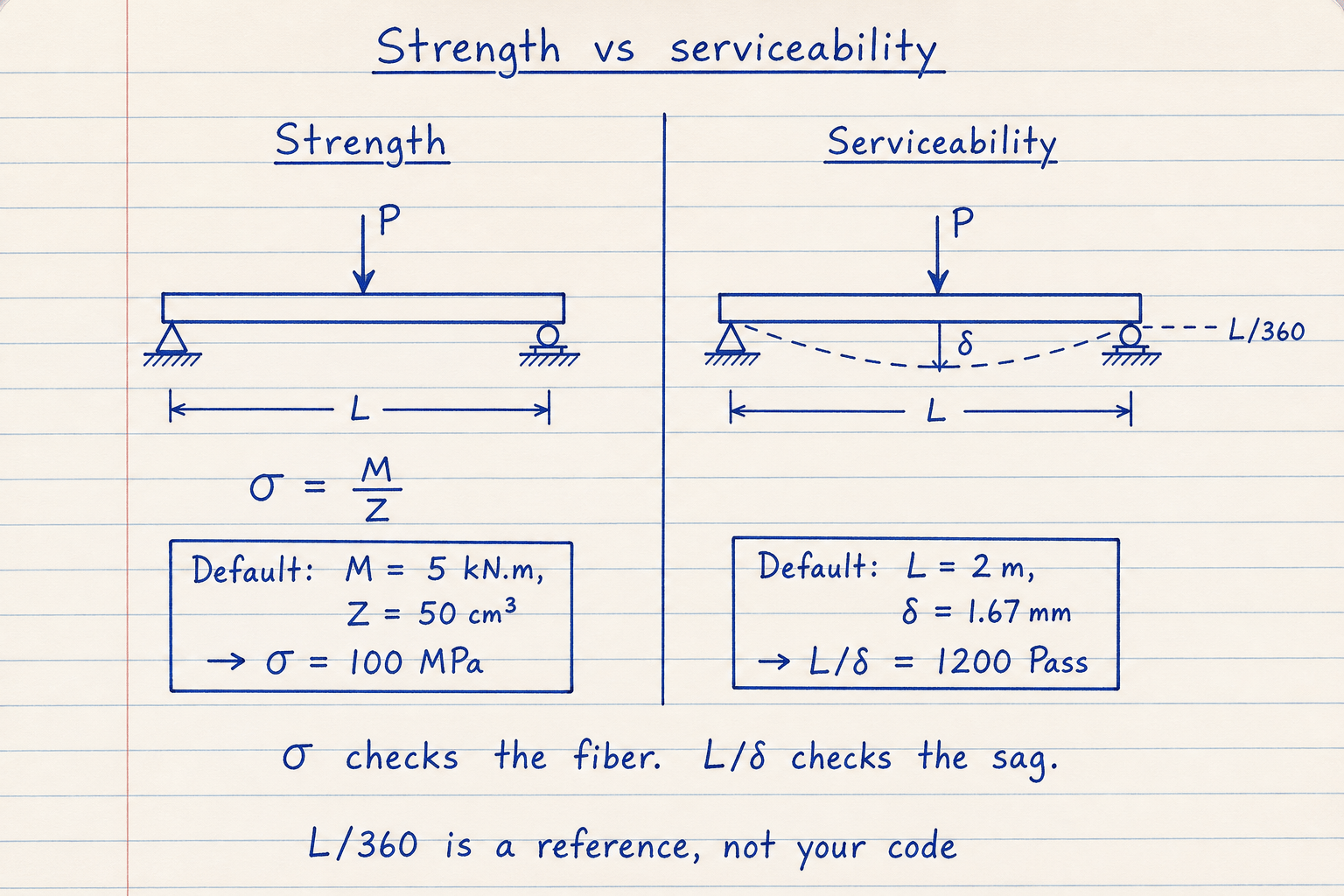
Left panel is strength: σ = M/Z. Right panel is serviceability: compare δ with an L/360 line.
Default CALCULATE path: σ = 100 MPa and L/δ = 1200 (Pass). Switch to Cantilever · tip point on the same E and I to see a Below limit banner.
Why the support case changes deflection by large factors
For the same tip or midspan point load, span, E, and I, a cantilever tip deflects about sixteen times more than a simply supported midspan (PL³/3EI versus PL³/48EI). Fixing both ends cuts that simply supported midspan deflection by about four (PL³/192EI).
UDL cases swap the load unit to kN/m (or kip/ft) and use the matching wL⁴ formulas. Do not leave the default center-point case selected if the sketch shows a distributed floor or self-weight line load. The Results diagram updates the support glyphs and load markers so you can catch a mismatched case before you trust σ or δ.
Point-load midspan or tip deflection for equal P, L, E, I:
| Case | δ formula | vs SS center |
|---|---|---|
| Simply supported center | PL³/48EI | 1× (baseline) |
| Fixed-fixed center | PL³/192EI | ~4× stiffer |
| Cantilever tip | PL³/3EI | ~16× softer |
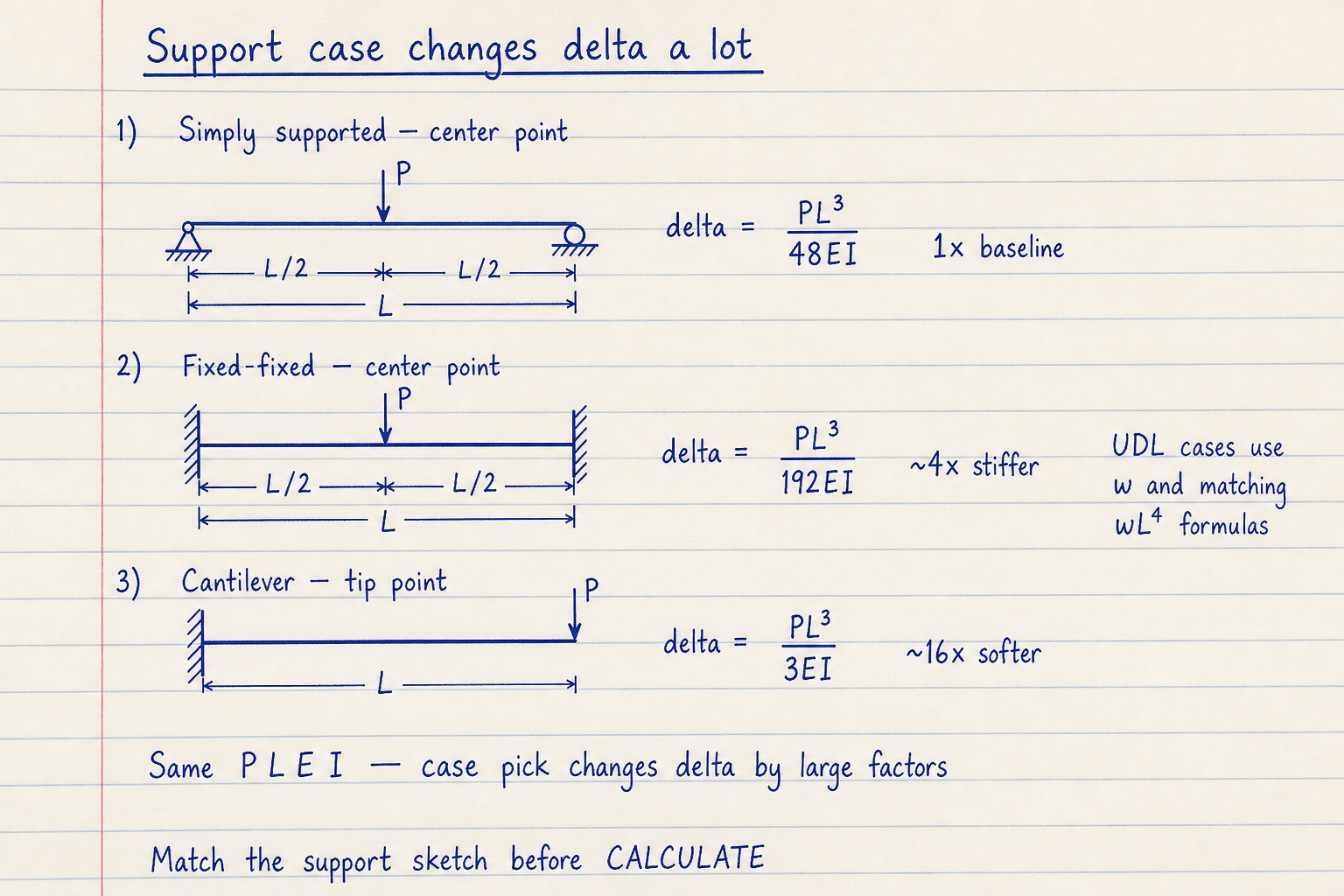
Same P, L, E, and I: simply supported midspan is the 1× baseline, fixed-fixed is about 4× stiffer, and a cantilever tip is about 16× softer.
UDL cases use w and the matching wL⁴ formulas. Match the support sketch before you trust CALCULATE.
Section modulus Z versus moment of inertia I
Stress needs Z. Deflection needs I (and E). Rectangle uses I = bh³/12 and Z = bh²/6. Solid circle uses I = πd⁴/64 and Z = πd³/32. Hollow tube, box tube, I-beam, channel, and T-beam helpers build I and Z from section dimensions about the strong bending axis (sharp corners — no mill fillets). Z is I divided by the distance from the neutral axis to the extreme fiber.
Direct I & Z is the default when a catalog already prints those numbers. Pick any other cross-section type to see the matching sketch and dimension fields. A live I and Z readout updates as you type. Results cards show Z used and I used so you can confirm the helper before you trust σ or δ.
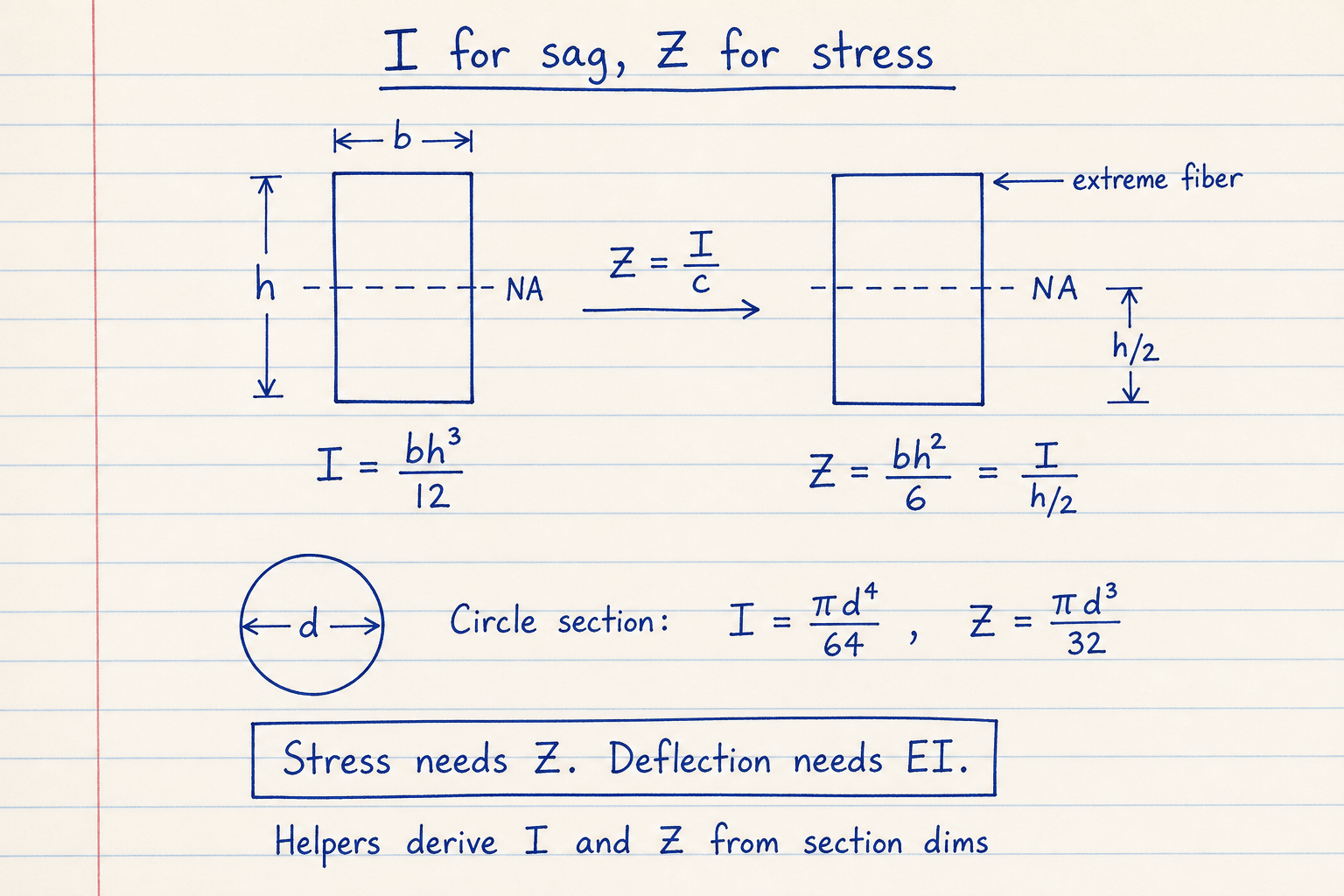
I sets sag through EI. Z sets extreme-fiber stress. For a rectangle, Z = I / (h/2).
Section helpers on this pad derive both from dimensions; Direct mode lets you type catalog I and Z.
Fixed-end moments and when closed-form cases stop
On Fixed-fixed · full UDL the governing |M| is at the ends (wL²/12). Midspan sagging moment is half of that (wL²/24). This pad reports the end value as Max bending moment and shows the midspan value in the secondary line so you do not mix them up with the simply supported wL²/8 case.
Off-center point loads, partial UDLs, multiple loads, hinges, and spring supports need superposition or a beam analyzer. Euler-Bernoulli also ignores shear deformation — deep short beams may need a shear-flexible treatment. This pad is a first-pass browser check, not code sign-off. If the support is only approximately fixed, treat fixed-fixed as an upper-bound stiffness estimate and check a simply supported bound as well.
Worked example
Simply supported · center point defaults: P = 10 kN, L = 2 m, Z = 50 cm³, E = 200 GPa, I = 500 cm⁴. Reproduce on CALCULATE.
- Leave Support and load case on Simply supported · center point. Confirm load 10, span 2, E 200, Direct I & Z with Z 50 and I 500.
- CALCULATE. M = 10 × 2 ÷ 4 = 5 kN·m. V = 5 kN. θ = PL²/(16EI) ≈ 0.143°.
- σ = 5 × 1000 ÷ 50 = 100 MPa.
- δ = 10,000 × 2³ ÷ (48 × 200×10⁹ × 500×10⁻⁸) = 0.001667 m = 1.67 mm.
- Each reaction is 5 kN. L/δ = 2000 ÷ 1.67 ≈ 1200, so the L/360 check shows Pass.
- Optional: switch to Cantilever · tip point, CALCULATE again. δ jumps to about 26.67 mm and L/δ ≈ 75 (Below limit).
Result: Default path: M 5 kN·m, σ 100 MPa, δ 1.67 mm, V 5 kN, θ ≈ 0.143°, R 5 kN each, L/δ 1200, Pass. Cantilever tip on the same E and I: δ ≈ 26.67 mm, Below limit.
When to use
- First-pass frame rail or machine-base beam check with a clear support sketch
- Homework verification for the six common closed-form deflection cases
- Comparing center point load vs full UDL on the same span and section
- Screening L/δ against an L/360-style serviceability reference before detailed design
- Deriving I and Z from rectangle, circle, tube, box, I-beam, channel, or T when a catalog is not open
Limitations
- Six closed-form cases only. No eccentric point loads, partial UDLs, multiple loads, or applied moments.
- Euler-Bernoulli theory: slender prismatic beams, small deflections, no shear deformation.
- Built-up section helpers use sharp-corner geometry (no fillets). Not a mill catalog / AISC table.
- Linear elastic material. No plasticity, lateral-torsional buckling, or connection flexibility.
- L/360 flag is a teaching reference, not an ACI/IBC/Eurocode compliance check.
- Not FEA, not a section database, and not a substitute for stamped structural design.
FAQ
- Which support and load case should I pick?
- Match the sketch: pin/roller ends with a midspan load use Simply supported · center point; a wall-fixed arm with a tip load uses Cantilever · tip point; welded or bolted ends that restrain rotation use Fixed-fixed. Use the UDL variants when the load is spread over the full span.
- Metric or Imperial?
- Use the Metric / Imperial toggle at the top of Inputs. Metric uses kN, m, GPa, mm, cm³, and cm⁴. Imperial uses kip, ft, ksi, in, in³, and in⁴. Switching units reloads the matching defaults for that system.
- What is section modulus Z?
- Z links bending moment to extreme-fiber stress: σ = M/Z. Larger Z lowers stress for the same moment. Enter Z in cm³ (Metric) or in³ (Imperial), or let a section helper compute it from dimensions.
- Why do I need both Z and I?
- Stress uses Z. Deflection uses flexural rigidity EI. Catalogs list both. Direct mode asks for each. The other section types compute both from dimensions in the active unit system.
- What does the L/360 check mean?
- The pad computes L/δ and marks Pass when that ratio is at least 360. Many floor live-load notes use L/360 as a serviceability target. Your project may require L/240, L/480, or another limit.
- Point load or UDL units?
- Point-load cases use kN. UDL cases use kN per metre. The load label swaps when you change case. Do not enter a total force into a UDL field without dividing by span.
- Why is fixed-fixed UDL moment wL²/12 not wL²/8?
- Fixity reduces midspan moment. For fixed-fixed full UDL the governing |M| is at the ends (wL²/12); midspan is wL²/24. Simply supported full UDL peaks at midspan with wL²/8.
- Can I model an off-center point load?
- No. Off-center loads need a different closed-form formula or a multi-load beam analyzer. Use this pad only when the load sits at midspan (or at the cantilever tip).
- Is fixed-fixed realistic for a bolted rail?
- Only if the ends truly restrain rotation. Partial fixity lands between simply supported and fixed-fixed. Run both cases as bounds when the connection stiffness is uncertain.
Safety Factor Calculator
Factor of safety from strength ÷ stress. Yield or ultimate basis, material presets, and reverse solve modes.
Open calculatorColumn Buckling Calculator
Euler and Johnson critical buckling load, slenderness, and FOS check for compression columns.
Open calculatorSpring Calculator
Compression spring rate, Wahl stress, solid height by end type, and buckling checks. Metric or imperial; OD, ID, or mean diameter.
Open calculator