You need the ISO 281 basic rating life before you lock a catalog size. This pad takes dynamic load rating C, equivalent dynamic load P, speed, bearing type (ball or roller), and reliability / material / lubrication factors, then returns L10 in revolutions and hours, adjusted Lnm, calendar years, and L5m / L1m views.
Defaults open on a motor-like ball case: C = 45 kN, P = 8.5 kN, 1500 rpm, a1 = a2 = a3 = 1. CALCULATE returns C/P ≈ 5.29, L10 ≈ 148.4 ×10⁶ rev, L10h ≈ 1649 h, and Lnm = 1649 h. Presets cover a 6308-style deep groove and a cylindrical roller example. Math stays in your browser.
It sits under Mechanical Calculators next to the bearing load calculator (for P) and bearing selection calculator (for family / required C).
Formula
- Basic rating life: L10 = (C / P)^p million revolutions.
- p = 3 for ball bearings, p = 10/3 for roller bearings.
- Life in hours: L10h = L10 × 10⁶ / (60 · n).
- Adjusted life: Lnm = a1 · a2 · a3 · L10h (ISO-style factors; a1 from ISO 281:2007).
- Calendar years ≈ L10h / (hours per day × 365). Continuous 24/7 years use 8760 h/yr.
- Median life rule of thumb: L50 ≈ 5 × L10.
Reproduce the default CALCULATE path:
| Quantity | Value |
|---|---|
| C / P / n | 45 kN · 8.5 kN · 1500 rpm |
| Type · p | Ball · 3 |
| C/P | ≈ 5.294 |
| L10 | ≈ 148.4 ×10⁶ rev |
| L10h | ≈ 1649 h |
| L5m / L1m | ≈ 1055 / 412 h (a1 = 0.64 / 0.25) |
How it works
ISO 281 basic rating life L10 = (C/P)^p in millions of revolutions (p = 3 ball, 10/3 roller), converted to hours with speed. Adjusted life Lnm applies a1 (ISO 281:2007 reliability table), a2, and a3. Not a full aISO modified-life tool.
Pick an application preset (motor, 6308-style, cylindrical roller) or Custom — the animated sketch switches with the preset (Play/Pause). Choose ball or roller to change the bearing face (p = 3 or 10/3). Enter C and P in kN, speed, reliability a1 preset (or custom), optional a2/a3, and hours per day. CALCULATE fills Results. Editing C, P, rpm, or bearing type clears Results and returns the preset to Custom; reliability / a2 / a3 / hours keep the application sketch. RESET restores Custom with motor-like C/P defaults.
L10 is a statistical fatigue life, not a warranty
Per ISO 281, L10 is the life that 90% of identical bearings are expected to reach or exceed before subsurface fatigue. The median life L50 is roughly five times L10.
The core identity is L10 = (C/P)^p and L10h from speed. Getting P wrong (use the load pad) or mixing ball/roller exponents ruins the hours number.
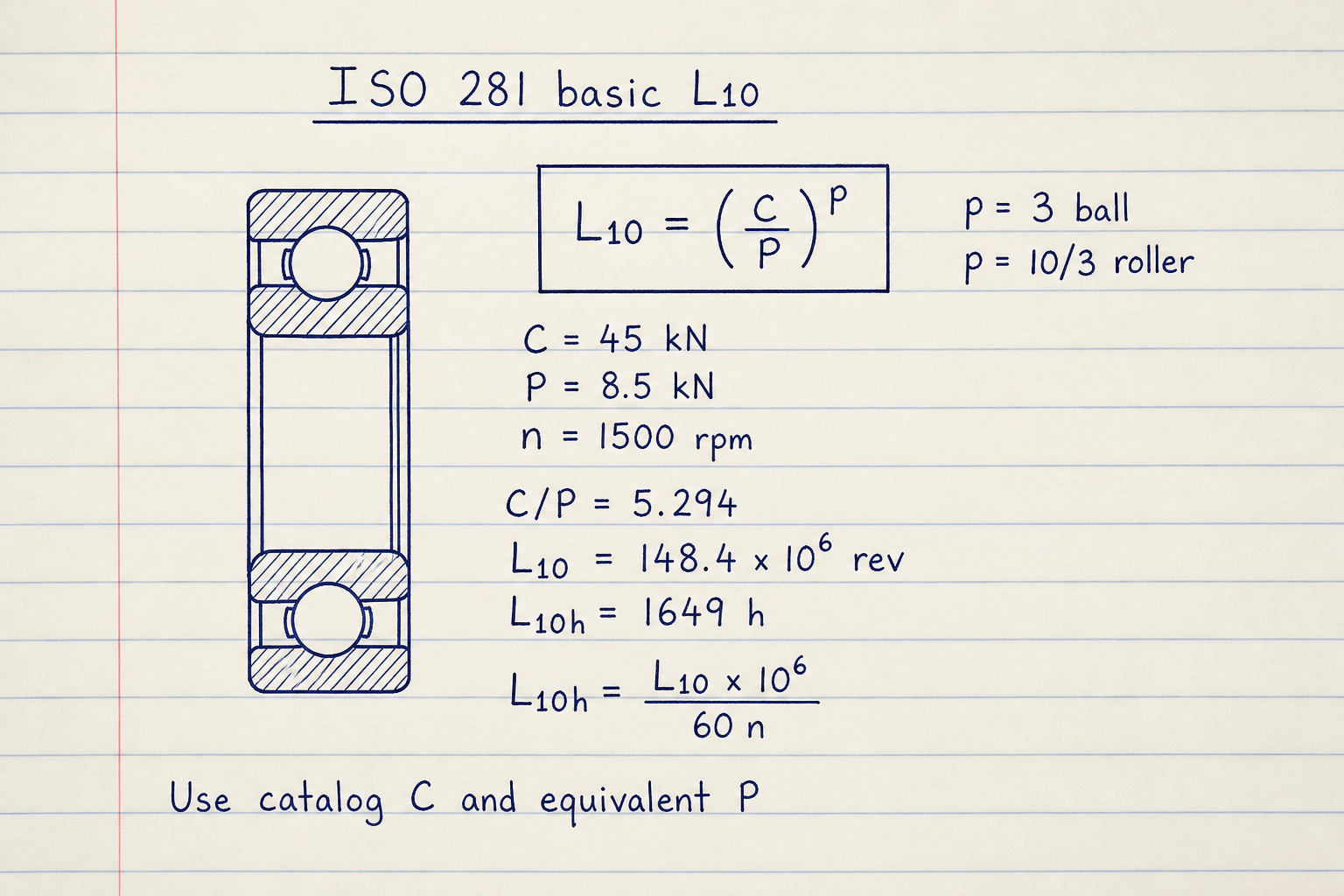
Default path: (45/8.5)³ ≈ 148.4 ×10⁶ rev → ≈ 1649 h at 1500 rpm.
Typical industrial targets sit around 20 000–40 000 h continuous duty.
Reliability a1 uses the ISO 281:2007 table
ISO 281:2007 lists L10a at 95% and 99% with a1 ≈ 0.64 / 0.25. This pad follows the 2007 table.
Lnm = a1·a2·a3·L10h covers reliability plus simple material and lubrication factors you enter. Full aISO from viscosity ratio, contamination, and Pu needs OEM software — out of scope here.
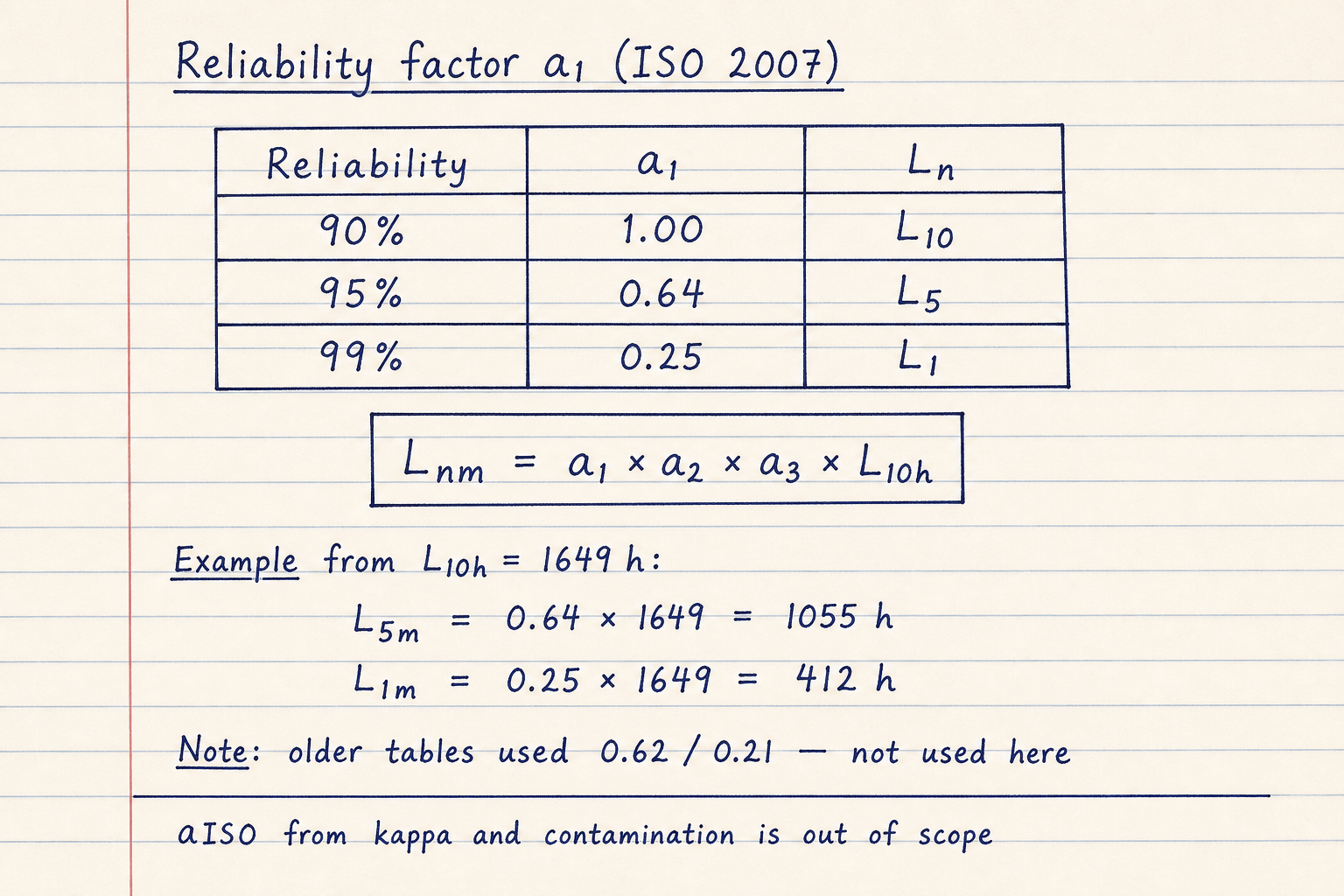
L5m ≈ 0.64 × L10h and L1m ≈ 0.25 × L10h from the same basic life.
Raise a2/a3 only when you have catalog or site evidence — do not invent optimism.
What advanced life tools add that we skip
Advanced life tools build duty-cycle stages with Fr/Fa time fractions or ask for verified aISO. This pad stays on basic L10 plus reliability views — closest to a first-pass ISO 281 screen.
Use the bearing load calculator for P, then this pad for L10/Lnm. Confirm the final designation with an OEM catalog tool when you need grease life and contamination curves.
What this pad does not replace
No aISO/κ/ηc calculation, no multi-stage equivalent load averaging, no side-by-side catalog comparison, and no mounting or clearance analysis. Actual field life often differs from L10 when lubrication or contamination dominate.
Worked example
Ball bearing, C = 45 kN, P = 8.5 kN, 1500 rpm, a1 = a2 = a3 = 1. Reproduce on CALCULATE.
- p = 3 (ball).
- C/P = 45/8.5 ≈ 5.294.
- L10 = (5.294)³ ≈ 148.4 million revolutions.
- L10h = 148.4 × 10⁶ / (1500 × 60) ≈ 1649 h.
Result: Basic rating life L10 ≈ 1649 hours; L5m ≈ 1055 h; L1m ≈ 412 h.
When to use
- Estimating L10 hours from catalog C and application P
- Comparing ball vs roller life exponents at the same C/P
- Screening reliability-adjusted life (L5m / L1m) for critical machines
- Converting L10h to calendar years for maintenance planning
Limitations
- Basic ISO 281 L10 — not full aISO modified life (κ, ηc, Pu).
- Assumes constant C, P, and speed; duty cycles need a mean equivalent load first.
- a2/a3 are user-entered screening factors, not computed from oil or cleanliness.
- Not a substitute for OEM modified-life tools.
FAQ
- What is L10 bearing life?
- L10 is the statistical fatigue life that 90% of identical bearings are expected to reach or exceed under the stated load and speed. It is expressed in millions of revolutions or in hours at constant rpm.
- What a1 values does this pad use?
- ISO 281:2007: 90% → 1.00, 95% → 0.64, 96% → 0.55, 97% → 0.47, 98% → 0.37, 99% → 0.25. Older tables (0.62 / 0.21) are not used here.
- How do I get P?
- For pure radial load, P ≈ Fr. For combined Fr and Fa, use the bearing load calculator (P = X·V·Fr + Y·Fa) or catalog X,Y factors for your designation.
- Why is field life different from L10?
- L10 assumes correct mounting, lubrication, and cleanliness. Contamination, poor lubrication, misalignment, and shock usually cut life short; clean, well-lubricated machines can exceed L10.
Bearing Load Calculator
ISO 281 equivalent dynamic load P from Fr/Fa and type factors, plus two-bearing shaft reactions.
Open calculatorBearing Selection Calculator
Recommend rolling-element bearing family from Fr/Fa, DN, required L10 hours, misalignment, and required dynamic C.
Open calculatorShaft Design Calculator
Minimum shaft diameter from torsion, bending, Guest/Rankine combined, ASME Km/Kt, or twist limit. Solid or hollow.
Open calculator