You need the equivalent dynamic bearing load P before you run an L10 life check, or you need to split a shaft force between two supports. This pad does both: ISO 281 style P = X·V·Fr + Y·Fa from Fr, Fa, and bearing type, and a two-bearing lever-rule mode for R1 and R2.
Defaults open on deep-groove equivalent P: Fr = 8000 N, Fa = 3000 N, inner-ring rotation (V = 1). CALCULATE returns Fa/Fr = 0.375 (> e = 0.19), X = 0.56, Y = 2.30, and P = 11 380 N (11.38 kN). Switch mode for shaft reactions — the two-bearing example F = 300, L1 = 7, L2 = 8 gives R1 = 160 N and R2 = 140 N. Math stays in your browser.
It sits under Mechanical Calculators next to the bearing life calculator and bearing selection calculator. Compute P here, then paste it into life with catalog C.
Formula
- Equivalent dynamic load: P = X · V · Fr + Y · Fa (ISO 281).
- Compare Fa/Fr to the type threshold e. If Fa/Fr ≤ e, typically X = 1 and Y = 0 so P ≈ V·Fr.
- If Fa/Fr > e, use the combined X and Y for that family (deep groove, angular contact angle, roller, or manual).
- Optional deep-groove C0: e and Y from a simplified Fa/C0 table.
- Rotation factor: V = 1.0 (inner ring rotating) or V = 1.2 (outer ring rotating).
- Two-bearing reactions: R1 = L2·F/(L1+L2), R2 = L1·F/(L1+L2).
Reproduce the default deep-groove CALCULATE path:
| Quantity | Value |
|---|---|
| Fr / Fa | 8000 N · 3000 N |
| Fa/Fr · e | 0.375 · 0.19 |
| X · Y · V | 0.56 · 2.30 · 1.0 |
| P = X V Fr + Y Fa | 11 380 N (11.38 kN) |
How it works
Two modes: (1) ISO 281 equivalent dynamic bearing load P = X·V·Fr + Y·Fa with representative e/X/Y by bearing type (optional deep-groove C0), and (2) two-bearing shaft reactions R1/R2 from an applied radial force. Not an OEM catalog designation tool.
Pick Equivalent dynamic P or Two-bearing shaft reactions — the animated sketch follows the mode (Play/Pause). For P mode, choose bearing type (or Manual X,Y), enter Fr and Fa, set V, and optionally C0 for deep groove. For shaft mode, enter F, L1, and L2 in any consistent length units. CALCULATE fills Results. Editing clears Results. RESET restores the deep-groove Fr/Fa defaults.
P is the load that matches the C rating definition
Fr and Fa must be converted to a single hypothetical load P so that life formulas using C stay consistent. The standard form is P = X Fr + Y Fa.
For single-row radial bearings, axial load only changes P once Fa/Fr exceeds e. Below that threshold, Y is zero and P collapses to the radial term (scaled by V when the outer ring rotates).
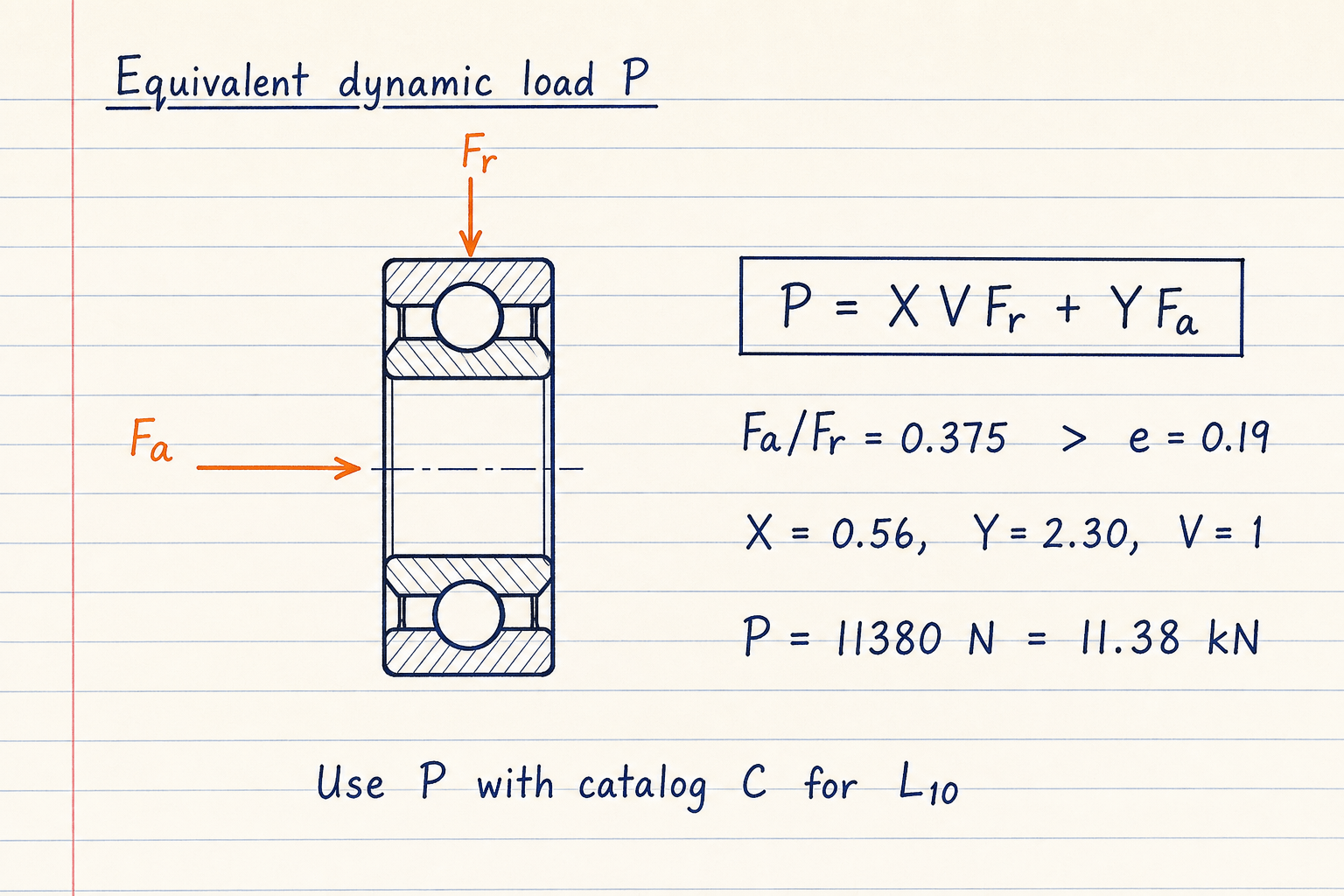
Default path: Fa/Fr = 0.375 > 0.19 → X = 0.56, Y = 2.30 → P = 11.38 kN.
Paste P into the bearing life calculator with catalog C.
Type tables give first-pass X and Y
Equivalent-load calculators ship representative e/X/Y for deep groove, angular contact (15°/25°/40°), cylindrical, tapered, and spherical rollers. Exact factors still come from the designation catalog — especially deep-groove Y vs Fa/C0.
This pad uses the same screening idea, plus optional C0 for deep groove and a Manual X,Y mode when you already copied factors from a manufacturer table.
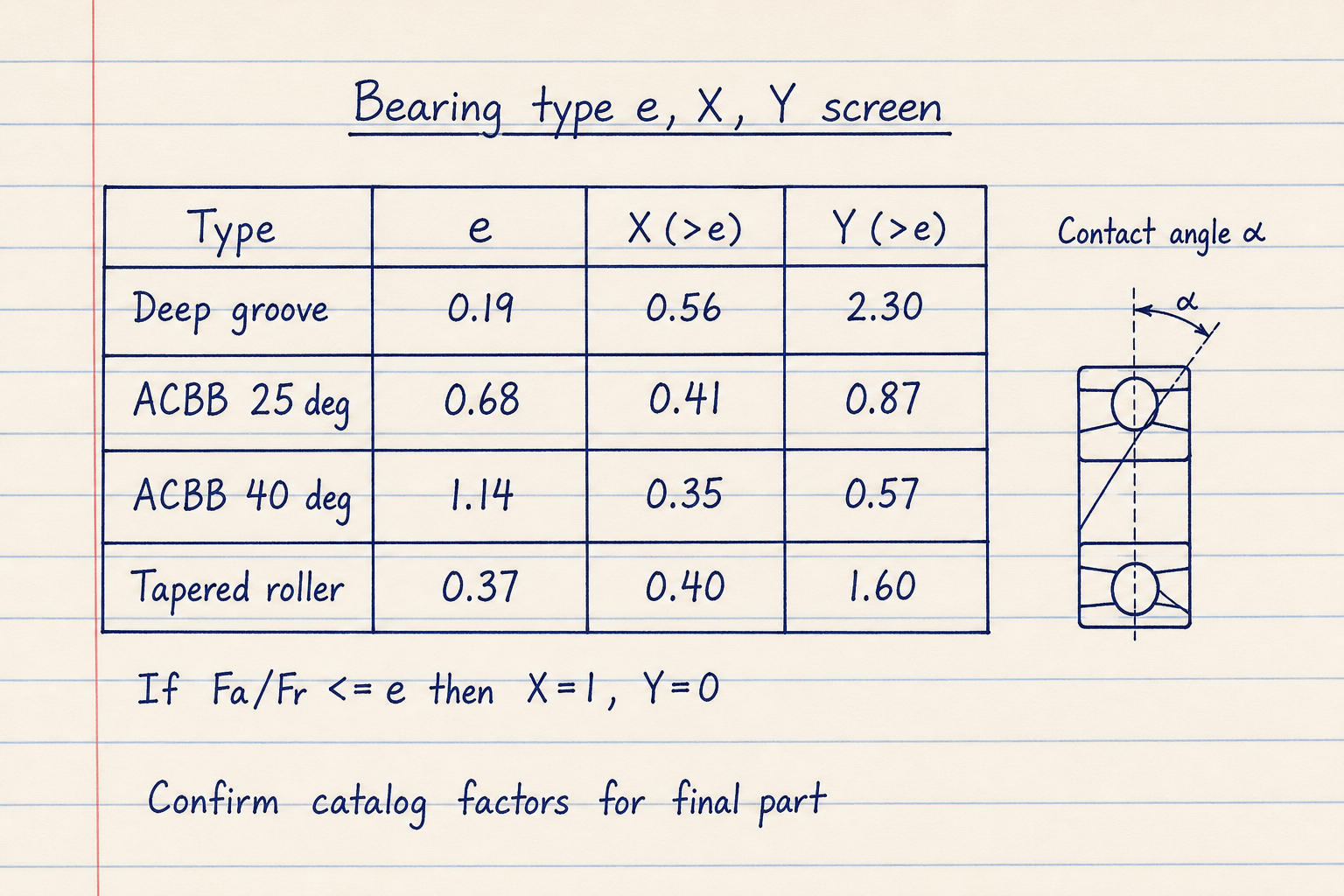
Higher contact angle lowers Y — a 40° angular contact carries more axial for the same P.
Cylindrical roller (NU/N) screening keeps P ≈ Fr and flags ignored Fa.
Shaft reactions are a different job under the same keyword
Two-bearing load calculators answer “how much does each support see?” with R1 = L2·F/(L1+L2) and R2 = L1·F/(L1+L2). That Fr then feeds equivalent-P and life.
OEM SKU calculators and ISO/TS 16281 geometry tools go further into designation life and contact stress — out of scope here.
What this pad does not replace
No aISO modified life, no induced axial from TRB pairs, no belt/gear load-factor library, and no part number pick. Use selection → load → life, then an OEM catalog for the designation.
Worked example
Deep groove: Fr = 8000 N, Fa = 3000 N, V = 1. Reproduce on CALCULATE.
- Fa/Fr = 3000/8000 = 0.375.
- Default e = 0.19 → Fa/Fr > e → X = 0.56, Y = 2.30.
- P = 0.56 × 1 × 8000 + 2.30 × 3000 = 4480 + 6900 = 11 380 N.
Result: Equivalent dynamic load P = 11.38 kN for L10 with catalog C.
When to use
- Converting Fr and Fa into P for an ISO 281 L10 check
- Comparing deep groove vs angular contact X/Y screening
- Entering catalog X,Y manually for a known designation
- Splitting a radial shaft load between two bearings (R1, R2)
Limitations
- Type e/X/Y values are representative — confirm the manufacturer table for the final part.
- Deep-groove Fa/C0 table is simplified; series-specific tables may differ.
- Does not compute induced axial loads in paired TRB / ACBB arrangements.
- No belt/gear application factors, duty-cycle mean load, or ISO 16281 contact stress.
- Not a substitute for OEM modified-life tools.
FAQ
- What is equivalent dynamic bearing load P?
- It is the constant radial load that would give the same basic rating life as the actual combined Fr and Fa. Compute P = X·V·Fr + Y·Fa, then use it with C in L10 = (C/P)^p.
- When can I ignore Fa?
- For many single-row radial bearings, if Fa/Fr ≤ e then Y = 0 and P ≈ V·Fr. Once Fa/Fr exceeds e, axial load must enter the equivalent load.
- What are X and Y?
- X is the radial load factor and Y is the axial load factor from ISO 281 / manufacturer tables. They depend on bearing type, contact angle, and often Fa/C0 for deep groove balls.
- How do two-bearing shaft reactions work?
- For a radial force F between supports, R1 = L2·F/(L1+L2) and R2 = L1·F/(L1+L2). Use either reaction as Fr in the equivalent-P mode.
Bearing Life (L10) Calculator
ISO 281 L10 and adjusted Lnm life from C, P, speed, and reliability factors a1/a2/a3.
Open calculatorBearing Selection Calculator
Recommend rolling-element bearing family from Fr/Fa, DN, required L10 hours, misalignment, and required dynamic C.
Open calculatorShaft Design Calculator
Minimum shaft diameter from torsion, bending, Guest/Rankine combined, ASME Km/Kt, or twist limit. Solid or hollow.
Open calculator