You need a first-pass rolling-element bearing family before you open an OEM catalog. This pad takes radial load Fr, axial load Fa, speed, bore, required L10 hours, misalignment, precision, and duty, then screens deep-groove ball, angular contact, cylindrical roller, tapered roller, spherical roller, and thrust types.
Defaults open on a motor-like duty: Fr = 3000 N, Fa = 500 N, 1500 rpm, bore 30 mm, Lh = 20 000 h. CALCULATE returns Fa/Fr ≈ 0.167, DN = 45 000, primary type Deep groove ball, screening P = 3000 N, and required dynamic C ≈ 36.5 kN. Presets cover electric motor, gearbox, spindle, crane thrust, and misaligned conveyor. Math stays in your browser.
It sits under Mechanical Calculators next to the bearing life calculator and bearing load calculator. Pick the family here, refine P and L10 there, then confirm a designation in an OEM catalog tool.
Formula
- Load ratio: Fa/Fr. Speed parameter: DN = d · n (bore mm × rpm).
- Screening equivalent load: P ≈ X·Fr + Y·Fa with simplified ISO 281-style X,Y per family (not a catalog designation).
- Required life in millions of revolutions: L10 = 60·n·Lh / 10⁶.
- Required basic dynamic rating: C = P · (L10)^(1/p), p = 3 (ball) or 10/3 (roller).
- Type gates: thrust when Fa dominates; CRB when axial is near zero; spherical when misalignment is large; angular contact for precision combined loads; deep groove as high-speed / general default.
Reproduce the default CALCULATE path:
| Quantity | Value |
|---|---|
| Fr / Fa / n / d | 3000 N · 500 N · 1500 rpm · 30 mm |
| Required Lh | 20 000 h |
| Fa/Fr · DN | ≈ 0.167 · 45 000 |
| Primary type | Deep groove ball |
| Screening P | 3000 N (Fa/Fr ≤ e) |
| Required C | ≈ 36.5 kN |
How it works
First-pass rolling-element bearing type selection from radial and axial load, speed, bore, required L10 life, misalignment, and precision. Screens deep-groove, angular-contact, cylindrical, tapered, spherical, and thrust families, then back-calculates required dynamic load rating C from ISO 281. Not an OEM catalog part picker.
Pick an application preset (motor, gearbox, spindle, crane thrust, conveyor) or leave Custom — the animated sketch switches with the preset. Set life guide or enter Lh hours. Enter Fr, Fa, rpm, and bore. Choose duty, misalignment, and precision. Play/Pause controls the animation. CALCULATE fills Results with the ranked family screen and required C. Editing load/speed/bore clears Results and returns the preset to Custom. RESET restores the motor-like defaults.
Load direction picks the family first
Bearing selection guides start from whether the load is radial, axial, or combined. Deep groove ball bearings take moderate radial plus light axial at high speed. Rollers raise radial capacity. Thrust bearings want axial-dominant duty.
On this pad, Fa/Fr > ~1.2 steers toward thrust; combined ratios favour angular contact or tapered roller; near-pure radial can open cylindrical roller. Significant misalignment screens out rigid types in favour of spherical roller.
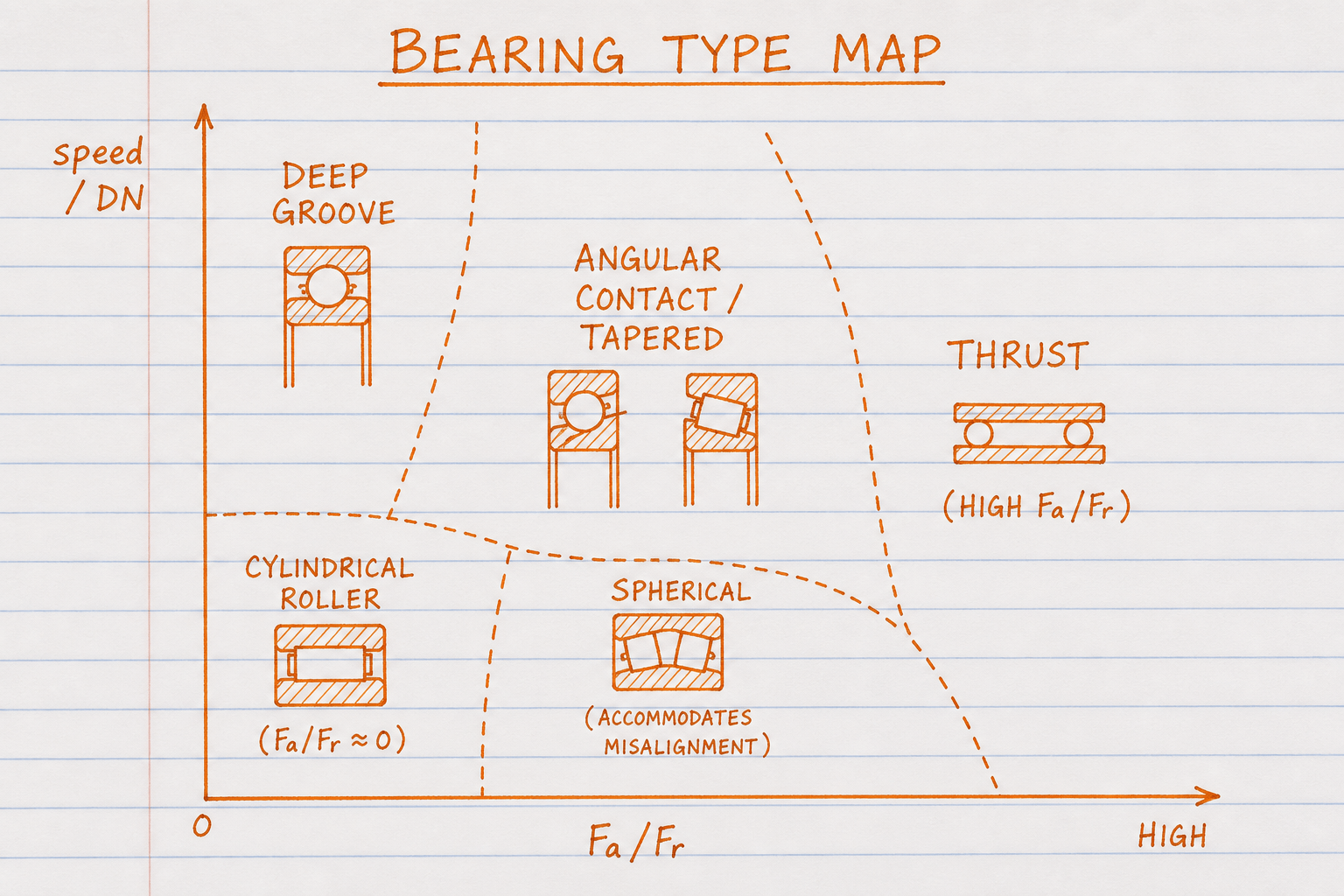
DN = d·n is a quick speed screen — ball types usually win when DN is high.
Always confirm limiting speed in the manufacturer catalog for the final size.
Required C is the ISO 281 rearrange
Bearing selection trainers back-calculate the dynamic load rating you must meet: C = P · (60·n·Lh/10⁶)^(1/p). That is the same ISO 281 life equation solved for C instead of L10.
Default path: P ≈ Fr = 3000 N, L10 = 1800 million rev, p = 3 → C ≈ 36.5 kN. Pick any catalog deep-groove size with C at or above that value, then re-check life with exact X,Y factors.
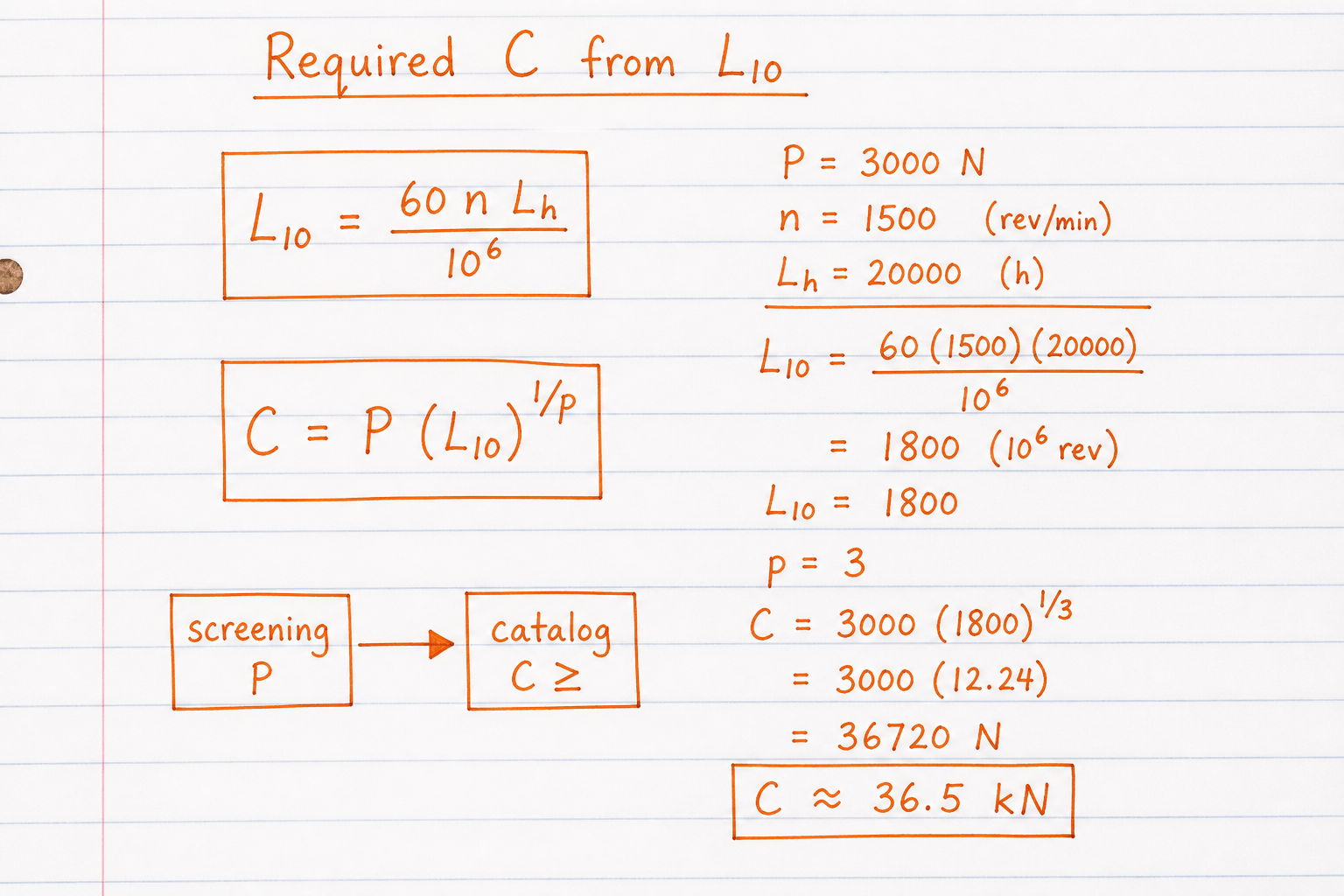
p = 3 for ball families and 10/3 for roller families.
Duty factor scales Fr and Fa before P and C are computed.
OEM catalogs finish what this pad starts
Full product pickers return designations, seals, CAD, and grease life. This TaskJunction pad stays browser-local: type screen + required C only.
Hydrodynamic (plain) bearings are a different technology and are out of scope here.
What this pad does not replace
No aISO modified life, no contamination ηc curves, no part interchange, and no housing/seal BOM. Use the bearing load and bearing life calculators next, then an OEM catalog for the final designation and mounting fits.
Worked example
Default: Fr = 3000 N, Fa = 500 N, n = 1500 rpm, d = 30 mm, Lh = 20 000 h. Reproduce on CALCULATE.
- Fa/Fr = 500/3000 ≈ 0.167. DN = 30 × 1500 = 45 000.
- Primary screen → deep groove ball (general purpose, light axial).
- Fa/Fr ≤ e → screening P ≈ Fr = 3000 N.
- L10 = 60 × 1500 × 20 000 / 10⁶ = 1800 million rev.
- C = 3000 × 1800^(1/3) ≈ 36.5 kN.
Result: Recommend deep groove ball with catalog C ≥ 36.5 kN; alternate angular contact.
When to use
- Choosing a rolling-element family before opening a manufacturer catalog
- Estimating the minimum dynamic C for a target L10 life
- Comparing motor, gearbox, spindle, thrust, and misaligned conveyor presets
- Screening out types that cannot carry axial load or misalignment
Limitations
- First-pass type selection only — not an OEM catalog part picker.
- Screening X,Y factors are simplified; final P needs catalog factors for the chosen designation.
- No ISO 281:2007 aISO modified life, grease life, or fit recommendations.
- Hydrodynamic / plain bearings are out of scope.
- Not a substitute for a signed bearing selection on safety-critical machines.
FAQ
- How do I select a bearing type from load and speed?
- Compare Fa/Fr and DN = d·n. Light axial + high speed → deep groove ball. Combined loads → angular contact or tapered roller. Pure radial heavy → cylindrical roller. Large misalignment → spherical roller. Axial-dominant → thrust.
- What is required dynamic load rating C?
- It is the minimum basic dynamic rating from ISO 281 so that L10 life at your speed meets the hours you entered: C = P · (60·n·Lh/10⁶)^(1/p).
- Does this pick a catalog part number?
- No. It recommends a family and a C target. Use a manufacturer product selector for designations, seals, and CAD.
- What L10 hours should I enter?
- Use the life guide dropdown for common machine classes (motors ~20 000 h, continuous plant ~40 000 h) or enter a custom Lh from your specification.
Bearing Life (L10) Calculator
ISO 281 L10 and adjusted Lnm life from C, P, speed, and reliability factors a1/a2/a3.
Open calculatorBearing Load Calculator
ISO 281 equivalent dynamic load P from Fr/Fa and type factors, plus two-bearing shaft reactions.
Open calculatorShaft Design Calculator
Minimum shaft diameter from torsion, bending, Guest/Rankine combined, ASME Km/Kt, or twist limit. Solid or hollow.
Open calculator