You need belt pitch length, wrap angle, and a first-pass belt count for a two-pulley drive, or a geometry-only length check for open or crossed layouts. This pad does both. Mode 0 is power sizing: pick a belt type (classical V, narrow V, cogged, flat, timing, or poly-V), then section, design power from P × Ks, D2 from N1/N2 with slip (0% for timing), then open-belt length, wrap, corrected power per belt, and required belt count. Mode 1 is belt length from D1, D2, and C (open or crossed). Mode 2 solves center distance from a known belt length.
Defaults open on classical V-belt B: 5 kW, 1450→500 rpm, D1=150 mm, C=500 mm, slip 2%, Ks=1.3. CALCULATE returns design power 6.5 kW, D2=426.3 mm, L≈1943 mm, wrap≈147.9°, about 3.01 kW per belt after arc and length factors, and 3 belts with Safe status. Quick presets also cover narrow 5V and timing H. The length example preset (150/300 mm at C=1500 mm) keeps L≈3710.6 mm. Math stays in your browser.
It sits under Mechanical Calculators next to the chain drive calculator and gear ratio calculator. Manufacturer tools still own catalog horsepower tables, tensioning, and SKUs.
Formula
- Design power: P_design = P × Ks (power mode).
- Driven diameter: D2 = D1 × (N1/N2) × (1 − slip/100) (power mode).
- Open length (approx): L ≈ 2C + π(D+d)/2 + (D−d)²/(4C).
- Open length (exact): α = arcsin((D−d)/(2C)); L = π(D+d)/2 + (D−d)·α + 2√(C²−((D−d)/2)²).
- Crossed length (approx): L ≈ 2C + π(D+d)/2 + (D+d)²/(4C).
- Wrap (open, small): 180° − 2·arcsin(|D−d|/(2C)); target ≥ 120°.
- Belt speed: v = π·D1·N1/60000 (m/s).
- Power per belt ≈ Pr × kθ × kl; required belts = ceil(P_design / P_belt).
- Center from length (open approx inverse): C = (b + √(b² − 2(D−d)²))/4 with b = L − π(D+d)/2.
Reproduce the default Power sizing path on CALCULATE (B · 5 kW · 1450→500):
| Quantity | Value |
|---|---|
| Inputs | B · 5 kW · 1450/500 rpm · D1=150 · C=500 · slip 2% · Ks=1.3 |
| Design power / D2 | 6.5 kW · 426.3 mm |
| L approx / wrap | ≈ 1943 mm · ≈ 147.9° |
| v / P_belt / belts | ≈ 11.39 m/s · ≈ 3.01 kW · 3 belts |
| Status | Safe (D1 ≥ min PD, v and wrap OK) |
How it works
Three modes: power sizing across classical V, narrow V, cogged, flat, timing, and poly-V sections with service factor; open or crossed belt length (exact and engineering approximation); or center distance from a known belt length. Wrap under 120° and min pulley diameter trigger warnings. Manufacturer catalogs still own final section ratings.
Pick Input mode: Power sizing (default), Belt length, or Center distance from length. In power mode choose Belt type (classical V, narrow V, cogged, flat, timing, poly-V), then section and Ks. Timing locks slip at 0%. Geometry modes use open/crossed arrangement. CALCULATE updates Results and the live sketch: front (tangents + wrap) and top plan (Ø along C, face = thickness; open band or crossed X). Play/Pause available. Editing clears Results. RESET restores classical B · 5 kW · C=500.
Exact length vs the Fenner-style approximation
Two-pulley belt length can be computed with both the exact geometric form and the common engineering approximation. Open vs crossed arrangement changes the formula. This pad returns both lengths in Mode 1.
The approx form L ≈ 2C + π(D+d)/2 + (D−d)²/(4C) matches Fenner / RMA practice and is what most catalogs expect for pitch length. Exact and approx agree within a fraction of a millimetre on the length example (150/300 mm at C=1500 mm → ≈3710.6 mm). Large diameter ratios with short C are where the approx drifts, and wrap usually fails the 120° target first anyway.
Open length example (Mode 1 · open · 150/300 · C 1500):
| Step | Result |
|---|---|
| Approx L | ≈ 3710.61 mm |
| Exact L | ≈ 3710.61 mm |
| Wrap small / large | ≈ 174.3° / ≈ 185.7° |
| Diameter ratio | 2.0 |
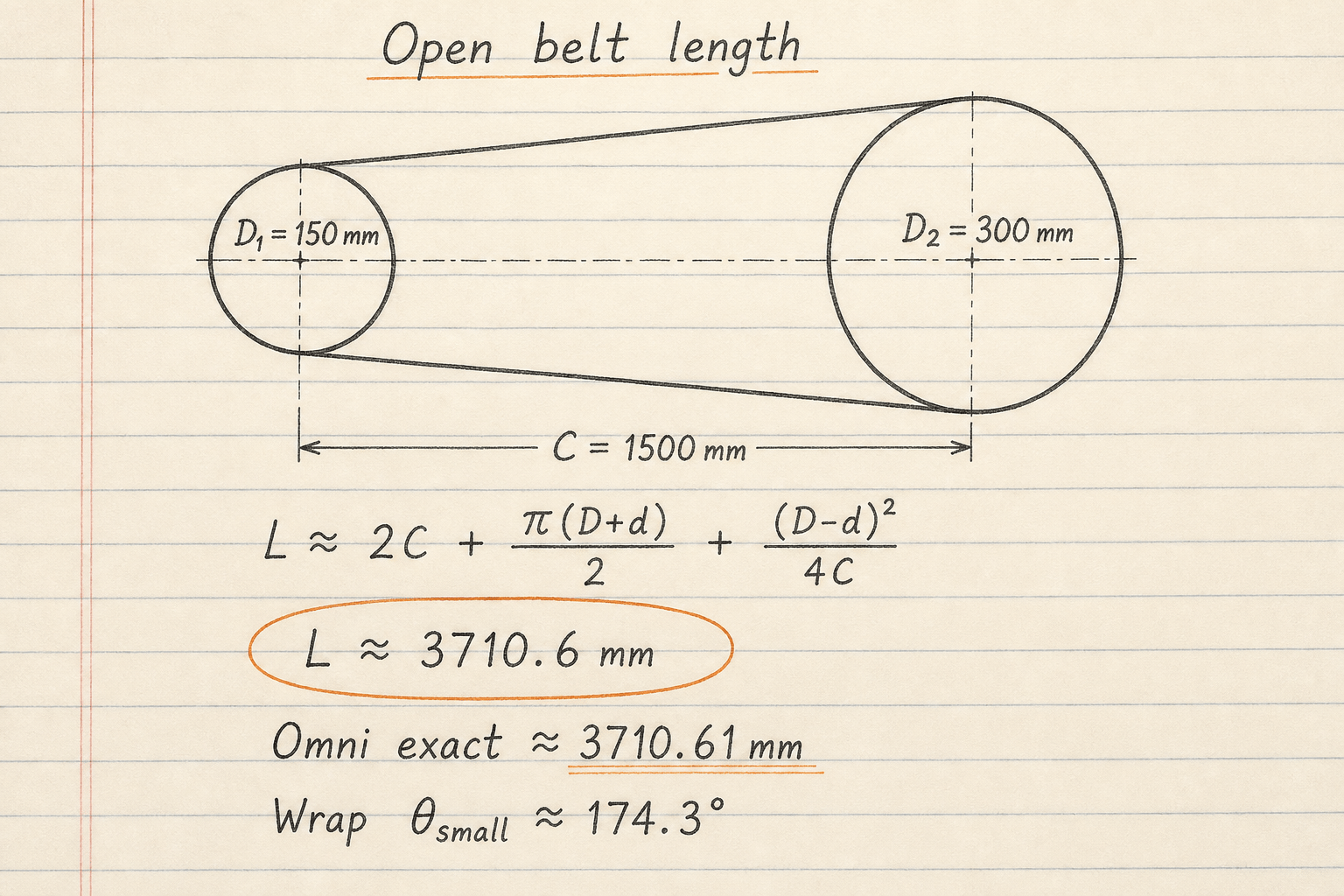
Mode 1 open preset: L ≈ 3710.6 mm; wrap on the small pulley ≈ 174.3°.
Order the nearest standard pitch length, then fine-tune take-up from Mode 2 if you already have a belt code.
Open wrap, crossed wrap, and the 120° floor
Geometry checks focus on RPM from diameters and belt layout. Wrap still decides friction capacity on open V-belt and flat drives.
Open small-pulley wrap is 180° − 2·arcsin(|D−d|/(2C)). Below 120° this pad warns. Crossed belts raise wrap above 180° on both pulleys (and reverse rotation), at the cost of wear at the crossing. Timing-belt screening rows ignore tooth mesh; for full toothed module and width design use a specialist tool, not this friction-capacity path.
Wrap cues:
| Layout | Small-pulley wrap |
|---|---|
| Default power open | ≈ 147.9° (OK) |
| Open C=1500 | ≈ 174.3° |
| Crossed 150/300 · C 600 | ≈ 224° (both pulleys) |
| Target | ≥ 120° on open small pulley |
Power path: Ks, Pr screen, and how many belts
OEM belt selectors return section, length codes, and tension from application data. This pad keeps a screening Pr table (classical Z–E, narrow, cogged, flat, timing, poly-V) with arc factor kθ and length factor kl, then ceils the belt count. Confirm rated kW at your rpm and small-pulley diameter in the current manufacturer catalog before you freeze the BOM.
Service-factor chips cover uniform (1.1), light shock (1.3), and heavy shock (1.5). Slip (typically 1–3% on V-belts) shrinks D2 in power mode so the driven speed target stays honest. Min-pulley warnings fire when D1 is under the section’s typical minimum pitch diameter.
Default power example (V-belt B):
| Quantity | Value |
|---|---|
| P_design | 5 × 1.3 = 6.5 kW |
| D2 / L / wrap | 426.3 mm · ≈ 1943 mm · ≈ 147.9° |
| v / P_belt | ≈ 11.39 m/s · ≈ 3.01 kW |
| Required belts / status | 3 · Safe |
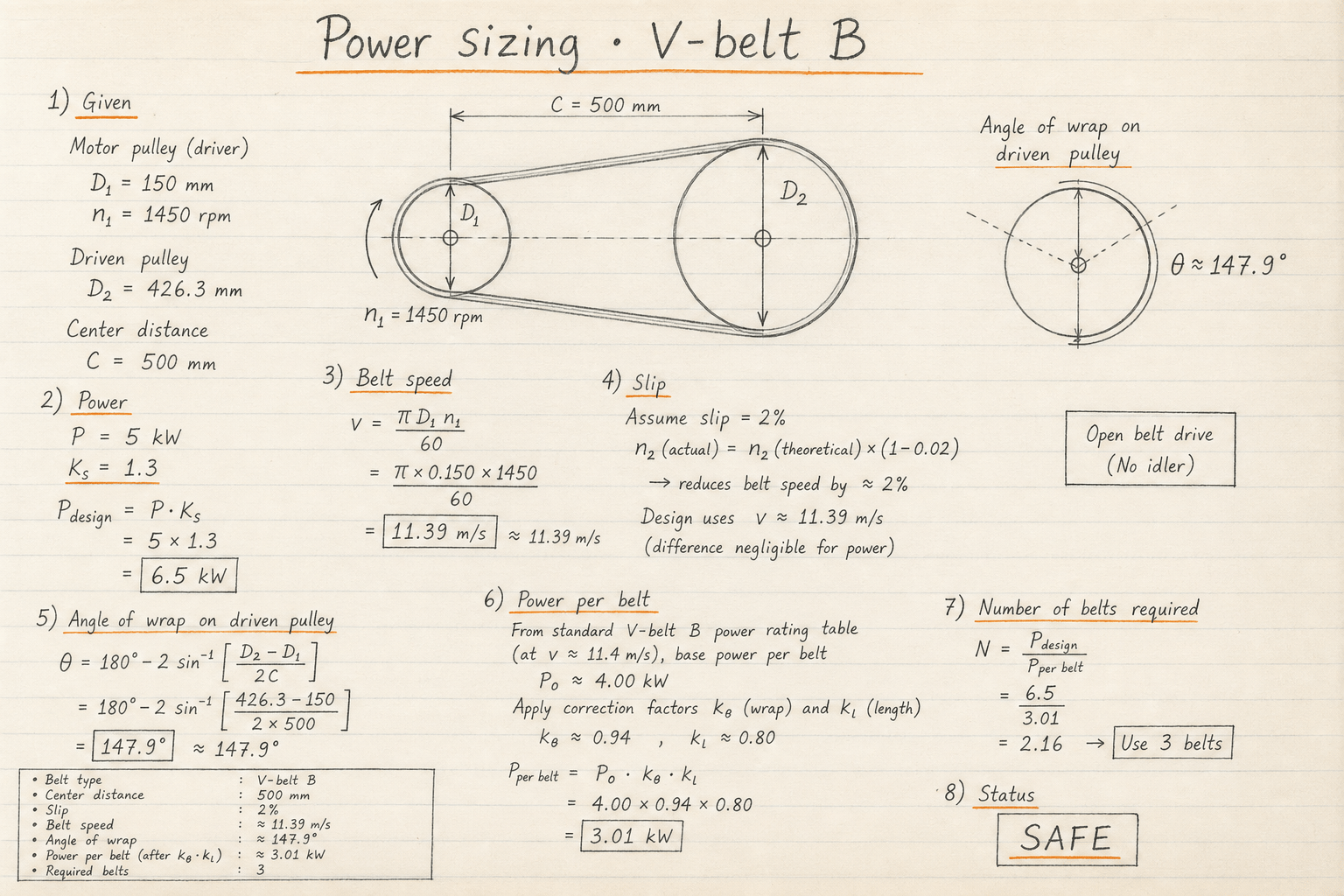
Default CALCULATE path: 6.5 kW design power, three B-section belts after kθ·kl correction.
If status flips Unsafe, fix min pulley or wrap before trusting the belt count.
What this pad is not
Not an OEM product selector. Not retail race-belt ordering. Not full toothed-module width and shaft-load design. Not belt tension measurement, alignment tolerance, or guard design. For roller chain length and tensile SF use the chain drive pad.
Scope boundaries:
| In scope | Out of scope |
|---|---|
| Open/crossed length + C from L | OEM SKU / belt code pickers |
| Wrap ≥ 120° warnings | Idler / serpentine multi-pulley trains |
| P×Ks + approx Pr belt count | Speed-dependent catalog HP tables |
| V / narrow / cogged / flat / timing / poly-V screens | Tensioning force procedures |
Worked example
Default Power sizing: V-belt B, 5 kW, 1450→500 rpm, D1=150 mm, C=500 mm, slip 2%, Ks=1.3. Reproduce on CALCULATE.
- Leave Quick preset on Power · B · 5 kW · 1450→500 (or enter the same values). Mode = Power sizing.
- CALCULATE → design power 6.5 kW; D2=426.3 mm; L≈1943 mm; wrap≈147.9°.
- Belt speed ≈ 11.39 m/s; power per belt ≈ 3.01 kW; required belts = 3; status Safe.
- Length example: switch to Belt length with 150/300 mm, C=1500 mm, open → L≈3710.6 mm.
- C-from-L example: Mode Center distance from length with L=3711 mm → C≈1500.2 mm.
- Min-pulley check: set D1=100 mm on B-section → min pulley warning and Unsafe status.
Result: Default: 3 belts, L≈1943 mm, wrap≈147.9°, Safe. Geometry modes match open length ≈3710.6 mm.
When to use
- Estimating open or crossed belt pitch length before ordering
- First-pass V-belt count from power, rpm, and section
- Checking wrap angle before freezing shaft spacing
- Solving center distance from a known belt length
- Flagging undersized driver pulleys against section min PD
Limitations
- Pr rows are approximate screening values, not current manufacturer ratings at your rpm.
- Power mode uses open-belt geometry only; switch to Mode 1 for crossed length.
- Timing rows are capacity screens, not full toothed-module width design.
- Does not compute installation tension, shaft loads, or multi-pulley serpentine paths.
- Does not design guards, take-up hardware, or LOTO procedures.
- OEM selectors remain the authority for product selection.
- Retail belt ordering tools are out of scope.
FAQ
- How many belts do I need?
- In Power sizing, required belts is ceil(design power ÷ corrected power per belt). The default B-section case needs 3 belts at 6.5 kW design power. Always confirm catalog kW per belt at your small-pulley diameter and rpm.
- Open or crossed belt length?
- Open belts keep the same rotation sense and use (D−d)²/(4C) in the approx length. Crossed belts reverse rotation, use (D+d)²/(4C), and raise wrap above 180°, with more wear at the crossing. Pick the arrangement in Mode 1 or 2.
- Why show approx and exact length?
- Catalogs and Fenner-style worksheets use the engineering approximation. The exact geometric form is the true tangent-and-arc length. For typical industrial C they agree closely; large diameter ratios at short C are where they diverge.
- What wrap angle should I target?
- Keep open-belt wrap on the smaller pulley at or above 120°. Below that, capacity drops and slip risk rises. Increase C, reduce ratio, or add an idler. Crossed layouts naturally sit above 180°.
- What does belt status mean?
- Safe means driver pulley is at or above section min PD, belt speed is within the section max, wrap is at least 120°, and the center distance fits the pulley pair. Caution usually means wrap or speed is marginal. Unsafe means min pulley failed, geometry is impossible, or more than one hard limit is broken.
- Why does center distance fail for some inputs?
- Open belts need C greater than |D1-D2|/2 so the tangent geometry exists. Crossed belts need C greater than (D1+D2)/2. Mode 2 also fails when the entered belt length is too short to close around the pulleys.
- Why add a service factor?
- Shock, starts, and duty cycle make motor nameplate power optimistic. Ks scales design power. Presets cover uniform (1.1), light shock (1.3), and heavy shock (1.5).
- Which belt types can I choose?
- Power mode offers classical V (Z–E), narrow V (3V/5V/8V and VX), cogged/raw-edge (AX–DX), flat widths, timing/synchronous (MXL–XXH), and poly-V/ribbed (PJ–PM). Timing locks slip at 0%. Section power ratings are screening values; confirm with the manufacturer catalog.
Chain Drive Calculator
ANSI roller chain length, pitch diameters, wrap angle, design power, and tensile safety factor.
Open calculatorGear Ratio Calculator
Gear ratio, output RPM, and torque for spur pairs, compound trains, direct ratio, speed solve, or idler trains.
Open calculatorMotor Gearbox Selector Calculator
Motor power from load torque, or gearbox output torque from motor power, ratio, SF, and efficiency.
Open calculator