You need a first-pass buckling screen before you open FEA or a code check: effective length, slenderness, critical stress and load, and whether your applied compression clears a target factor of safety. This pad picks Euler for long columns and Johnson for intermediate ones, then compares P to Pcr/FOS.
Defaults open on Metric, A36-like steel, pinned-pinned, L = 2000 mm, I = 500000 mm⁴, A = 1200 mm², E = 200 GPa, Sy = 250 MPa, P = 20 kN, FOS = 3. CALCULATE returns Le = 2000 mm, S ≈ 98 (Johnson path), σcr ≈ 174 MPa, Pcr ≈ 209 kN, allowable ≈ 69.6 kN, design FOS ≈ 10.4, Pass. Switch end condition or Imperial when that matches your sketch. Math stays in your browser.
It lives under Mechanical Calculators. After buckling looks acceptable, confirm stress on the beam stress calculator or margin on the safety factor calculator.
Formula
- Effective length Le = K·L. Radius of gyration r = √(I/A). Slenderness S = Le/r.
- Critical slenderness Scrit = √(2π²E/Sy). Long column when S ≥ Scrit.
- Euler (long): σcr = π²E/S². Equivalent Pcr = π²EI/Le².
- Johnson (intermediate): σcr = Sy[1 − (Sy/(4π²E))S²].
- Critical load Pcr = σcr·A. Allowable = Pcr/FOS. Design FOS = Pcr/P when P > 0.
- End K (theoretical): pinned-pinned 1.0 · fixed-free 2.0 · fixed-fixed 0.5 · fixed-pinned 0.7.
Reproduce the default Metric pinned-pinned path on CALCULATE:
| Quantity | Value on this pad |
|---|---|
| Le / r | 2000 mm · ≈ 20.41 mm |
| S / Scrit | ≈ 98.0 / ≈ 125.7 → Johnson |
| σcr / Pcr | ≈ 174 MPa · ≈ 209 kN |
| Allowable @ FOS 3 | ≈ 69.6 kN |
| Design FOS @ 20 kN | ≈ 10.4 · Pass |
How it works
Calculates Euler or Johnson critical buckling load from slenderness, effective length (K·L), and material properties. Compares applied compression to allowable load at your target factor of safety.
Pick Metric or Imperial. Choose a material preset (fills E and Sy; cast iron is omitted because Sy = 0) or edit them. Enter L, minimum I, A, end condition, applied compression P, and target FOS (≥ 1). The sketch previews end condition and Le while you edit. CALCULATE locks Results (Le, r, S/Scrit, σcr, Pcr, allowable, design FOS, Pass/Fail). Leave P blank or 0 to size Pcr only — design FOS and the buckling check show n/a. Editing a field clears Results. RESET restores A36-like defaults for the active unit system.
Effective length and end conditions
Real columns rarely behave like textbook Euler struts. End fixity changes how much unsupported length counts. Multiply actual length by an effective-length factor K that depends on how each end is restrained.
On this pad, pinned-pinned uses K = 1, fixed-free (cantilever) uses K = 2, fixed-fixed uses K = 0.5, and fixed-pinned uses K ≈ 0.7. Structural design codes (AISC) sometimes recommend higher K for built-up or imperfect fixity (for example 0.65 fixed-fixed, 0.8 fixed-pinned). Treat those as design-code adjustments; this calculator uses the classical theoretical K values called out in most mechanics textbooks.
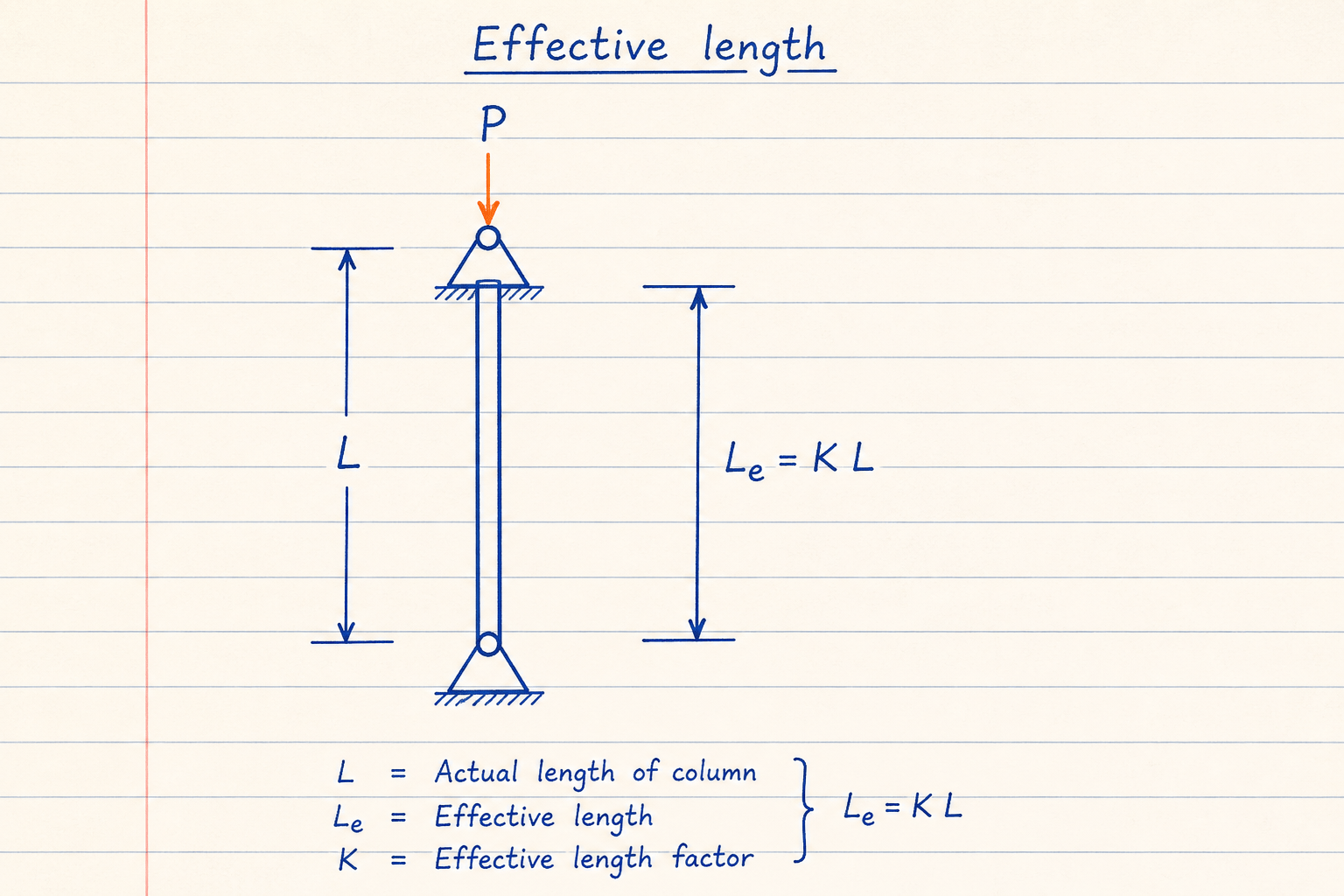
Le always runs between the points where the column is considered free to bend in the buckling mode you are checking.
Use the minimum moment of inertia I for the axis that governs buckling (weak axis for unsymmetric sections).
Euler vs Johnson by slenderness
Euler's formula is exact for ideal long, elastic columns but overpredicts capacity when the column is stocky enough for yield to matter. Textbooks switch to Johnson's parabolic formula once slenderness drops below a material-dependent cutoff.
This pad compares S = Le/r to Scrit = √(2π²E/Sy). When S ≥ Scrit, σcr = π²E/S² (Euler). Below that, σcr = Sy[1 − (Sy/(4π²E))S²] (Johnson). Pcr = σcr·A either way. Short columns that fail by crushing (Rankine) are out of scope here.
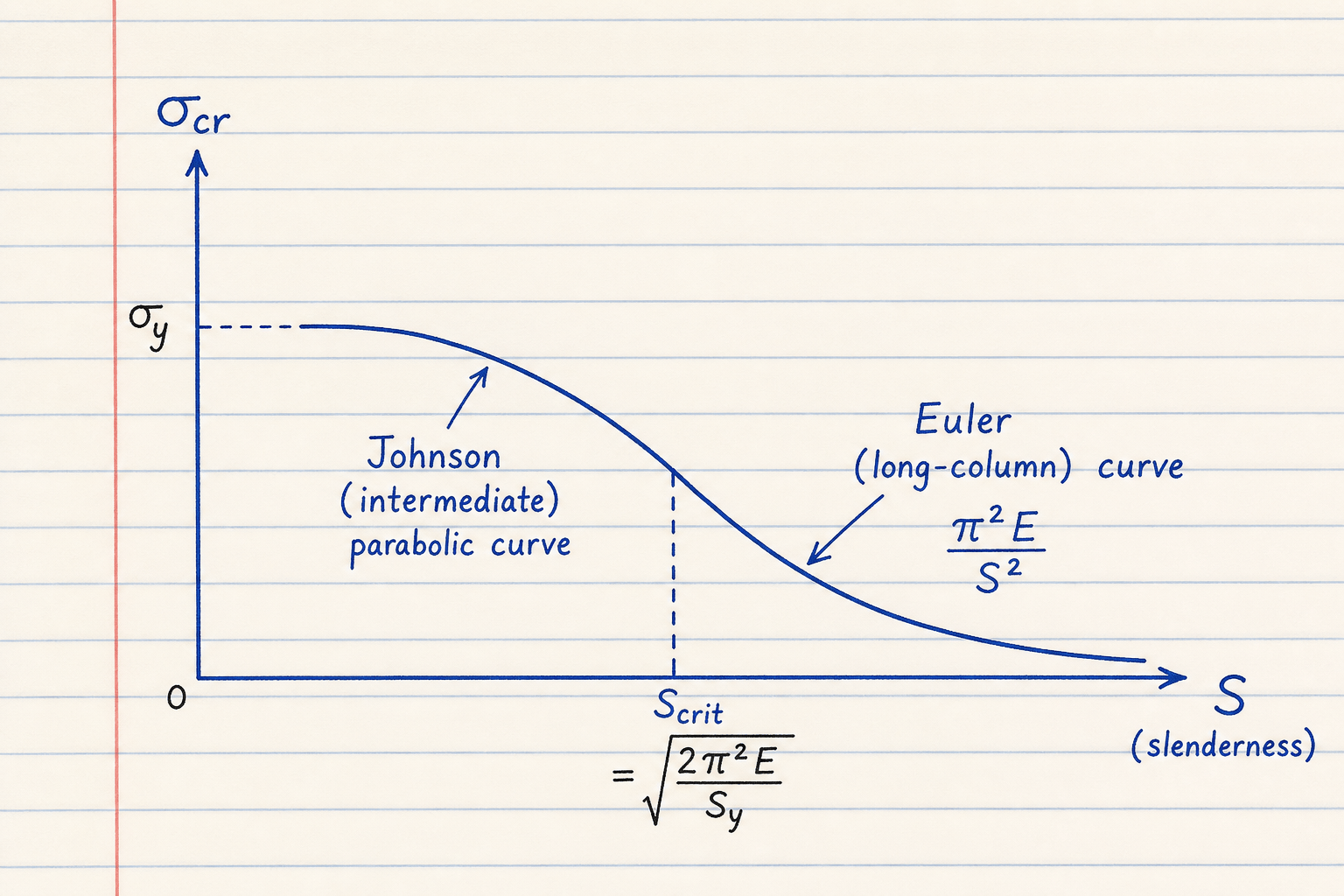
At Scrit the Euler and Johnson curves meet smoothly for the elastic-perfectly-plastic idealization used here.
Very short members may fail by direct compression before buckling; verify stress separately.
Applied load and factor of safety
Critical load Pcr is the elastic instability limit for the ideal column model. Design practice compares your working compression P to an allowable Pcr/FOS. When P is zero, design FOS and the buckling check show n/a; the pad still reports Pcr for sizing.
Try the default path, then raise P to 100 kN on CALCULATE: allowable stays near 69.6 kN, design FOS drops below 3, and the buckling check shows Fail. That is the same screening flow used before you commit to a heavier section or shorter unbraced length.
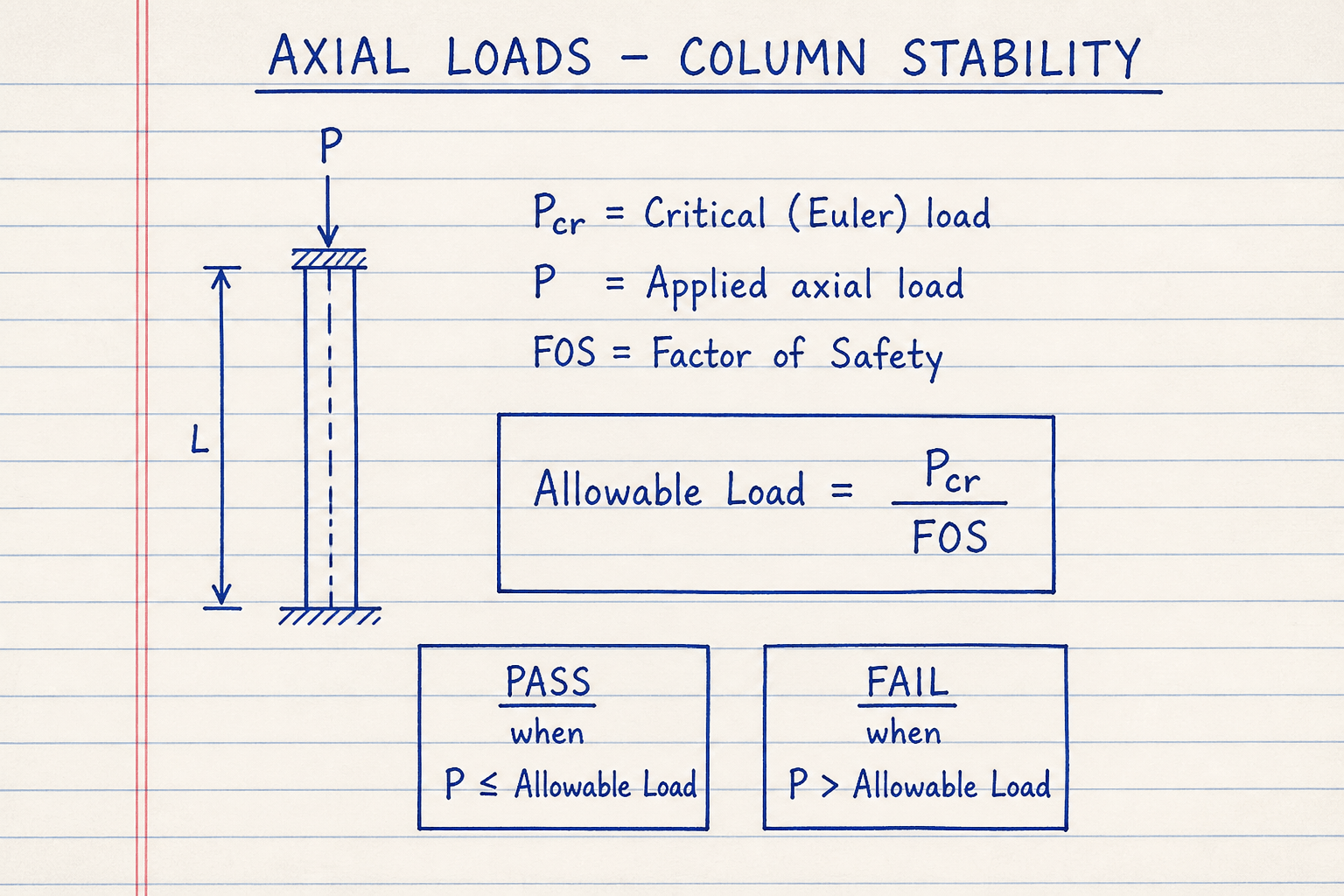
Target FOS must be at least 1. Typical structural screens use 2 to 4 depending on load uncertainty.
The live diagram exaggerates buckling curvature when the check fails so you can see an overloaded column at a glance.
Worked example
Default Metric pinned-pinned steel column: L = 2000 mm, I = 500000 mm⁴, A = 1200 mm², E = 200 GPa, Sy = 250 MPa, P = 20 kN, FOS = 3. Reproduce on CALCULATE.
- Leave Material on Structural Steel (A36) and End condition on Pinned at both ends.
- CALCULATE → r ≈ 20.41 mm, S ≈ 98, Scrit ≈ 125.7 → Johnson path.
- σcr ≈ 174 MPa, Pcr ≈ 209 kN, allowable ≈ 69.6 kN, design FOS ≈ 10.4, Pass.
- Change L to 3000 mm (same section) → S ≈ 147 > Scrit → Euler, Pcr ≈ 110 kN.
- Return L = 2000 mm, set P = 100 kN → Fail against FOS 3 (P > allowable).
Result: Default: Johnson Pcr ≈ 209 kN, Pass at 20 kN. Longer 3000 mm span drops to Euler Pcr ≈ 110 kN.
When to use
- Screening compression members in frames, jigs, or machine bases before FEA
- Comparing end fixity options (pinned vs fixed) on unbraced length
- Teaching slenderness, Euler, and Johnson in a mechanics or design course
- Quick what-if on section I and A from a handbook or CAD property export
- Cross-checking online buckling calculators against textbook results
Limitations
- Elastic, concentric compression only. No eccentricity, combined bending, or local plate buckling.
- Uniform prismatic section with known minimum I and A. Variable cross-section (tapered columns) is out of scope.
- Johnson/Euler idealization, not AISC/EC3 column curves, notional K factors, or built-up member rules.
- Short-column crushing (Rankine) and very low slenderness are not modeled.
- Material presets are typical values (Sy > 0 only). Use mill certificates for critical design.
- Does not check deflection, connection capacity, or bracing requirements.
FAQ
- Why does my column use Johnson instead of Euler?
- When slenderness S = Le/r is below Scrit = √(2π²E/Sy), yield reduces buckling capacity below the pure Euler line. The default 2000 mm case lands there (S ≈ 98 < Scrit ≈ 126 for A36-like inputs). Lengthen the column or reduce r to reach the Euler branch.
- Which moment of inertia should I enter?
- Use the minimum I for the axis that can buckle (weak axis for channels, angles, or unsymmetric sections). Buckling always seeks the easiest bending direction.
- How is this different from a code column check?
- Code checks add resistance factors, imperfect geometry, and tabulated curves. This pad is a fast elastic Euler/Johnson screen with textbook K factors. Follow AISC, Eurocode, or your project spec for final member selection.
- What if both ends are partially fixed?
- Partial fixity sits between the listed K values. Run pinned and fixed bounds as a bracket, or adopt the design K your code recommends for your connection detail.
- What if I leave applied load at zero?
- The pad still reports Le, S, σcr, and Pcr so you can size capacity. Design FOS and the buckling check show n/a until you enter a positive P.
Beam Stress and Deflection Calculator
Six textbook beam cases: max moment, shear, stress, deflection, slope, and L/360 check with animated 2D sketches.
Open calculatorSafety Factor Calculator
Factor of safety from strength ÷ stress. Yield or ultimate basis, material presets, and reverse solve modes.
Open calculatorVon Mises Stress Calculator
Distortion-energy equivalent stress from plane stress, principals, or a 3D tensor, with yield check.
Open calculator