You need a first-pass head-drive power and belt side tensions for a troughed bulk conveyor, or drum torque for a package line. This pad does both. Mode 0 is CEMA-simplified bulk: effective tension Te from idler friction and material lift, then mechanical and shaft power, plus Eytelwein T1/T2 from wrap angle and lagging μ. Mode 1 is package force, torque, and power from mass, bed friction, incline, and drum diameter.
Defaults open on a typical 800 t/h bulk example: L=100 m, H=5 m, v=2 m/s, Q=800 t/h, Wb=25 kg/m, f=0.022, wrap 210°, μ=0.35, η=85%. CALCULATE returns Te ≈ 8.92 kN, P_mech ≈ 17.85 kW, P_motor ≈ 21.00 kW, T1 ≈ 12.35 kN, and T2 ≈ 3.42 kN. Quick presets also cover a short horizontal belt, a decline case, and a 500 kg package/rollers example. Math stays in your browser.
It sits under Mechanical Calculators next to the belt drive calculator and motor gearbox calculator. Full CEMA accessory programs and OEM selectors still own catalog drives and belt grades.
Formula
- Bulk: α = arcsin(H/L) or H = L·sin(θ); Wm = Q·1000/(3600·v) or direct kg/m.
- Te = f·L·g·(2·Wb + Wm·cos α) + Wm·g·H (+ optional Fadd).
- P_mech = Te·v; P_motor = P_mech / η.
- T2 = Te / (e^(μθ) − 1); T1 = T2 + Te (Eytelwein / Euler wrap).
- Capacity (t/h) = Wm · v · 3.6; optional drum torque = Te·D/2.
- Package: F = M·g·(μ_bed·cos A + sin A); T = F·D/2; P = F·v.
Reproduce the default Bulk path on CALCULATE (800 t/h · L100 · H5):
| Quantity | Value |
|---|---|
| Inputs | L=100 m · H=5 m · v=2 m/s · Q=800 t/h · Wb=25 · f=0.022 · wrap 210° · μ=0.35 · η=85% |
| Wm / α | ≈ 111.11 kg/m · ≈ 2.87° |
| Te / P_mech / P_motor | ≈ 8924 N · ≈ 17.85 kW · ≈ 21.00 kW |
| T1 / T2 | ≈ 12.35 kN · ≈ 3.42 kN |
| Status | OK (motoring incline) |
How it works
Two modes: bulk CEMA-simplified Te from length, lift or incline, capacity or kg/m, idler f, wrap, and lagging μ — then mechanical and shaft power plus Eytelwein T1/T2; or package force, torque, and power from mass, bed friction, incline, and drum diameter. Full CEMA accessory programs and OEM selectors remain out of scope.
Pick Input mode: Bulk Te / power / T1/T2 (default) or Package force / torque. In bulk, choose Profile (lift H or incline), Material loading (Q or kg/m), then f / wrap / μ / η presets. Optional drum Ø returns torque and rpm. CALCULATE updates Results and the side-elevation sketch (Play/Pause). Editing clears Results. RESET restores the 800 t/h bulk defaults.
CEMA-simplified Te vs full accessory programs
Bulk conveyor tools use a short form of bulk resistance: idler friction on (2·Wb + Wm) plus material lift Wm·g·H. That is what Mode 0 implements.
Full CEMA programs add Kx, Ky, temperature Kt, pulley flexure Tp, acceleration Tam, and accessory Tac (skirts, cleaners, plows). This pad stays first-pass. Use Fadd for a lump-sum accessory drag, then confirm with a full CEMA or DIN/ISO study before freezing the BOM.
Default bulk example (Mode 0):
| Step | Result |
|---|---|
| Wm from Q/v | 800 × 1000 / (3600 × 2) ≈ 111.11 kg/m |
| Friction term | f·L·g·(2·Wb + Wm·cos α) ≈ 3474 N |
| Lift term | Wm·g·H ≈ 5450 N |
| Te / P_motor | ≈ 8924 N · ≈ 21.00 kW at η=85% |
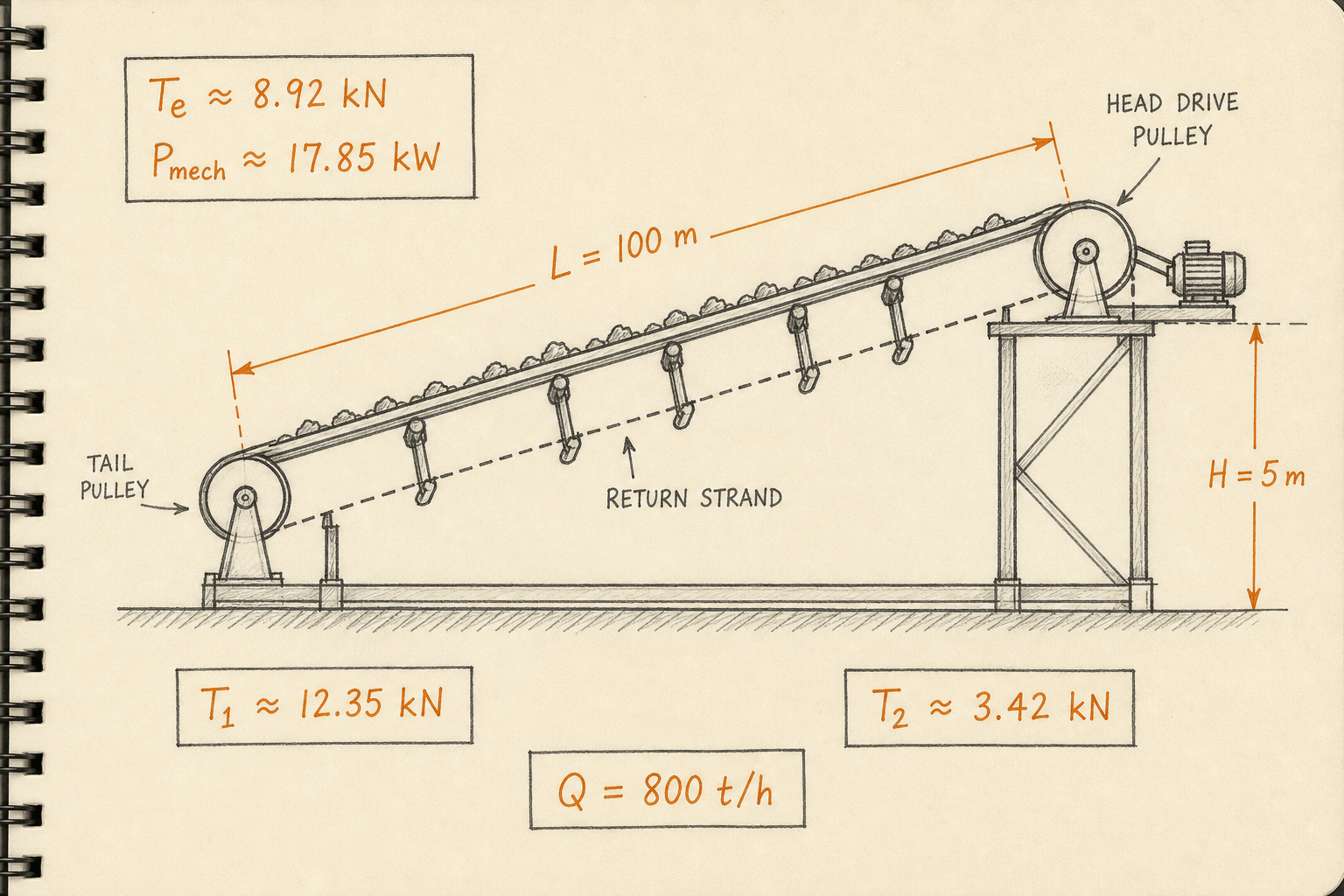
Default CALCULATE path: Te ≈ 8.92 kN, shaft power ≈ 21 kW after η.
Add 15–25% service margin for startup and build-up before picking a motor frame.
Wrap angle, lagging μ, and T1 / T2
Once Te is known, the drive must still hold the belt. The Eytelwein relation T1/T2 = e^(μθ) with T1 − T2 = Te fixes both sides. Larger wrap (snub or dual drive) and ceramic lagging raise μθ and cut the required T2, which lowers take-up load.
Slack-side tension tables express the same wrap idea as a wrap factor K. This pad exposes wrap (180° / 210° / 240°) and lagging μ chips so you can see T1 and T2 move before you pick take-up hardware.
Wrap cues (rubber lagged μ ≈ 0.35):
| Wrap | Effect on T2 |
|---|---|
| 180° plain | Higher T2 · heavier take-up |
| 210° snub (default) | Common industrial head drive |
| 240° dual-pulley | Lower T2 · dual-drive territory |
| Decline Te < 0 | Holdback / regen — not plain motoring |
Package force and drum torque
Unit-load conveyor calculators start from total mass, bed friction, incline, and drum diameter. Mode 1 follows that path: F = M·g·(μ_bed·cos A + sin A), torque = F·D/2, power = F·v.
Use roller-bed μ ≈ 0.033 for PVC/urethane on rollers, and much higher values on skid plates. This mode is for package and light unit-load lines — not troughed bulk capacity design.
Package example (Mode 1 · 500 kg · rollers · level · D 0.2 m · v 0.5 m/s):
| Quantity | Value |
|---|---|
| Force F | ≈ 161.9 N |
| Torque | ≈ 16.2 N·m |
| Power | ≈ 0.081 kW |
| Drum rpm | ≈ 47.7 rpm |
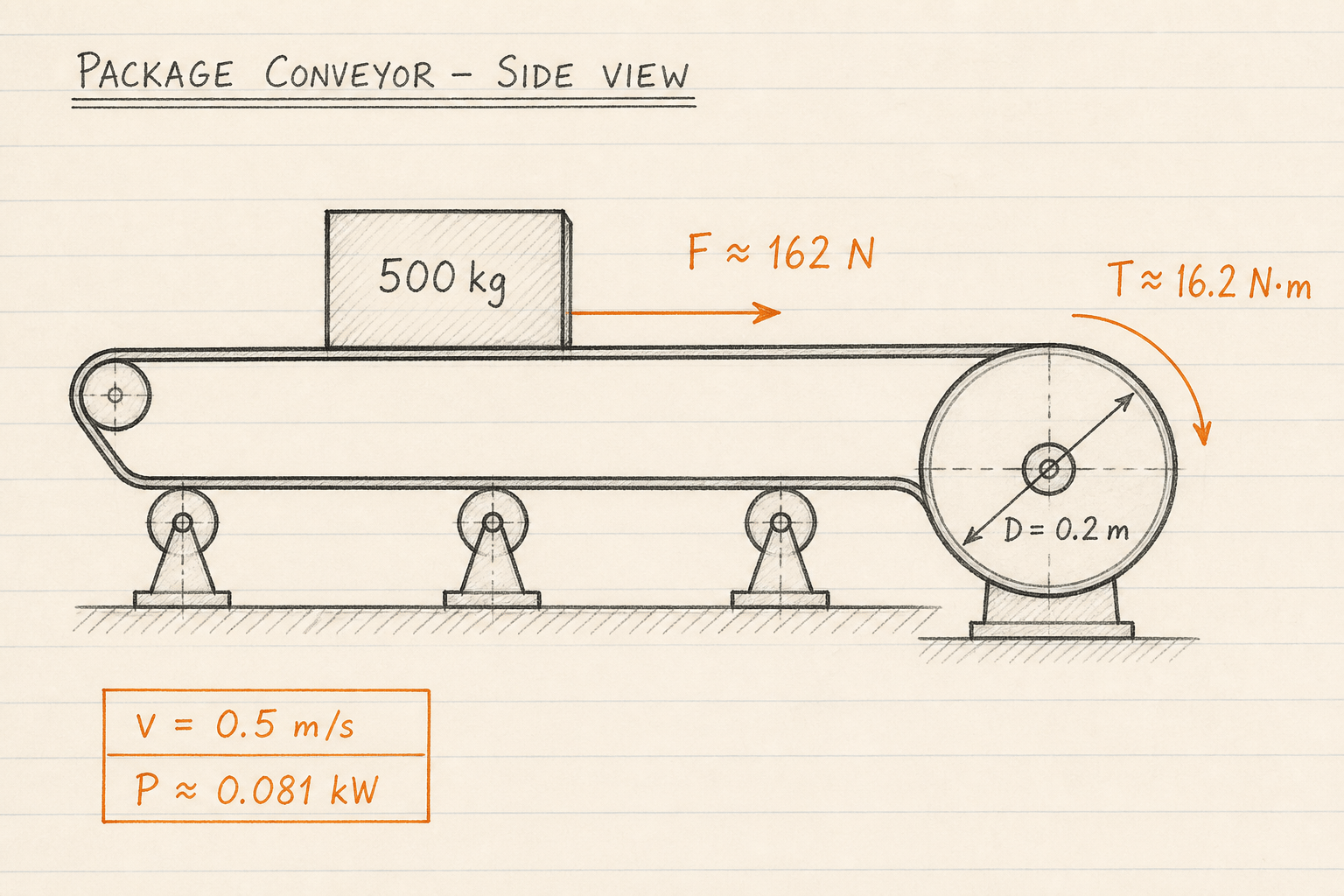
Mode 1 preset: level rollers, 500 kg, D=0.2 m → F ≈ 162 N, T ≈ 16.2 N·m.
Switch bed-friction chips when the belt rides a skid plate instead of rollers.
What this pad is not
Not a full CEMA accessory program. Not pipe-conveyor multi-section design. Not OEM product selectors. Not belt-length, cleaner-drag, or EP↔PIW converters — use the belt drive calculator for two-pulley pitch length. Not DIN 22101 / ISO 5048 dynamic start-up analysis.
Scope boundaries:
| In scope | Out of scope |
|---|---|
| CEMA-simplified Te + T1/T2 | Full Kx/Ky/Kt/Tp/Tam/Tac |
| P_mech and P_motor / η | IEC motor catalog picker |
| Package F / T / P | Pipe multi-section profiles |
| Decline / short-L warnings | OEM belt grade / SKU select |
Worked example
Default Bulk: L=100 m, H=5 m, v=2 m/s, Q=800 t/h, Wb=25 kg/m, f=0.022, wrap 210°, μ=0.35, η=85%. Reproduce on CALCULATE.
- Leave Quick preset on Bulk · 800 t/h · L100 · H5 (or enter the same values).
- CALCULATE → Wm ≈ 111.11 kg/m; Te ≈ 8924 N; P_mech ≈ 17.85 kW; P_motor ≈ 21.00 kW.
- T1 ≈ 12.35 kN; T2 ≈ 3.42 kN; capacity 800 t/h; status OK.
- Short horizontal example: preset Bulk · short horizontal 10 m → Te ≈ 255 N, P_motor ≈ 0.425 kW, short-L caution.
- Decline example: preset Bulk · decline H −5 m → Te negative, regen/holdback warning.
- Package example: Mode Package · 500 kg · rollers · level → F ≈ 162 N, T ≈ 16.2 N·m, P ≈ 0.081 kW.
Result: Default: Te ≈ 8.92 kN, shaft power ≈ 21 kW, T1/T2 ≈ 12.35/3.42 kN. Bulk and package modes match the CEMA-simplified and unit-load paths above.
When to use
- First-pass bulk conveyor motor power from L, H or incline, and Q
- Estimating T1/T2 for take-up and belt carcass screening
- Comparing wrap / lagging options before freezing the head drive
- Package or unit-load drum torque from mass and bed friction
- Flagging decline conveyors that need holdback or regen
Limitations
- Bulk Te is CEMA-simplified — skirts, cleaners, plows, and pulley flexure are not modeled unless you enter Fadd.
- Does not compute T2sag, temperature Kt, or acceleration Tam from full CEMA.
- Does not size IEC motor frames or gearbox service factors automatically.
- Package mode is for unit-load beds, not troughed bulk capacity.
- Not a pipe-conveyor or multi-drive profile tool.
- OEM selectors remain the authority for product selection.
FAQ
- What idler friction factor f should I use?
- Clean indoor service is often ~0.018; outdoor ~0.020; design default ~0.022; dusty mining ~0.025; heavy fouling ~0.030. Presets follow common CEMA-simplified guidance.
- Why is lift only on the material, not the belt?
- In the CEMA-simplified form used here, the carry/return belt mass appears in the friction term as 2·Wb, while gravitational lift is Wm·g·H on the material. Full CEMA also treats belt lift separately with more factors.
- How are T1 and T2 calculated?
- From the Eytelwein wrap equation with your drive μ and wrap angle θ: T2 = Te / (e^(μθ) − 1) and T1 = T2 + Te. Larger wrap or ceramic lagging reduces T2.
- What if Te is negative?
- The conveyor is overhauling on a decline. Do not size a plain motoring drive to |Te|. Use a holdback and/or regenerative VFD, and confirm with a full profile study.
- Capacity from Q or from kg/m?
- Enter Q (t/h) and the pad derives Wm = Q·1000/(3600·v). Or enter Wm directly and capacity = Wm·v·3.6. Both routes are equivalent when consistent.
- When should I use Package mode?
- When you have a total mass on a unit-load conveyor (rollers or skid), a drum diameter, and bed friction — not when you are designing troughed bulk capacity from t/h.
- Does this replace a CEMA design program?
- No. It is a screening tool for Te, power, and T1/T2. Long overland, cold weather, multi-drive, and accessory-heavy conveyors need full CEMA or DIN/ISO verification.
Belt Drive Calculator
Classical, narrow, cogged, flat, timing, and poly-V belt sizing plus open/crossed length and C from L.
Open calculatorMotor Gearbox Selector Calculator
Motor power from load torque, or gearbox output torque from motor power, ratio, SF, and efficiency.
Open calculatorChain Drive Calculator
ANSI roller chain length, pitch diameters, wrap angle, design power, and tensile safety factor.
Open calculatorWire Rope Load Calculator
Wire rope SWL and sling capacity from diameter and construction, plus rope mass and reel/drum capacity screens.
Open calculator