Shaft coupling · Td screening
- Nominal torque Tn
- —
- Design torque Td
- —
- Required bore
- —
- Best match
- —
Size a shaft coupling from transmitted power and speed, or from a known nominal torque Tn. This pad computes design torque Td = Tn × Ks, checks driver and driven shaft bores, then screens representative jaw, pin, tyre, disc, gear, and grid rows — the same first pass used before you open a manufacturer catalog.
Defaults open on a pump motor path: 15 kW at 1000 rpm, Ks 1.25 (light shock · pump/fan), 25 mm shafts. CALCULATE gives Tn ≈ 143.25 N·m, Td ≈ 179.06 N·m, and a selection matrix with Suitable / Shaft limit / Torque too low flags. Best match picks the smallest catalog torque that still clears Td and bore. Math stays in your browser.
It sits under Mechanical Calculators next to the motor gearbox calculator and shaft design calculator. This is torque-and-bore screening — not OEM SKU selection, alignment tolerance checking, or DBSE length calculation.
Formula
- Mode 0 — nominal torque: Tn (N·m) = 9550 × P_kW ÷ n (rpm).
- Mode 1 — HP path: Tn = 7121 × HP ÷ n (7121 ≈ 745.7 × 60 ÷ 2π).
- Mode 2 — direct Tn when torque is already known from a load calc.
- Design torque: Td = Tn × Ks (service factor for shock, hours, and driven-machine type).
- Required bore: max(driver shaft mm, driven shaft mm).
- Row status: Suitable if Td ≤ catalog T and bore ≤ max bore; Shaft limit if torque OK but bore too large; Torque too low if Td exceeds catalog rating.
Reproduce the default pump motor path on CALCULATE:
| Quantity | Value |
|---|---|
| Power / speed | 15 kW @ 1000 rpm |
| Service factor Ks | 1.25 (light shock · pump/fan) |
| Nominal torque Tn | ≈ 143.25 N·m |
| Design torque Td | ≈ 179.06 N·m |
| Shafts | 25 mm driver · 25 mm driven |
| Best match (all families) | Gear · 200 class (smallest suitable rating) |
How it works
Computes nominal torque Tn from kW/HP and RPM (or direct input), applies service factor Ks for design torque Td, then screens representative jaw, pin, tyre, disc, gear, and grid catalog rows against required bore. Spacer filter for DBSE paths. Screening only — not an OEM SKU picker.
Pick input mode (kW, HP, or direct Tn), set Ks from pump/fan/compressor/piston presets or Custom, enter RPM and shaft diameters, optionally filter by coupling family or spacer/DBSE requirement. CALCULATE fills Tn, Td, bore, best match, and the full screening matrix. Editing clears Results. RESET restores the 15 kW pump preset.
From motor power to design torque Td
Coupling selection starts from kW (or HP), RPM, and a service factor, then lists catalog sizes with pass/fail on torque and bore. The core SI relation is the same as motor sizing: Tn = 9550·P/n with Td = Tn × Ks for shock and driven-machine duty.
This pad adds an HP input path (7121·HP/n) and a direct-Tn mode when you already converted load torque elsewhere — for example after the motor gearbox calculator or a conveyor load calc.
Input modes:
| Mode | Known | Tn formula |
|---|---|---|
| Power kW · RPM | P_kW, n | 9550 × P / n |
| Power HP · RPM | HP, n | 7121 × HP / n |
| Direct torque Tn | Tn | User entry |
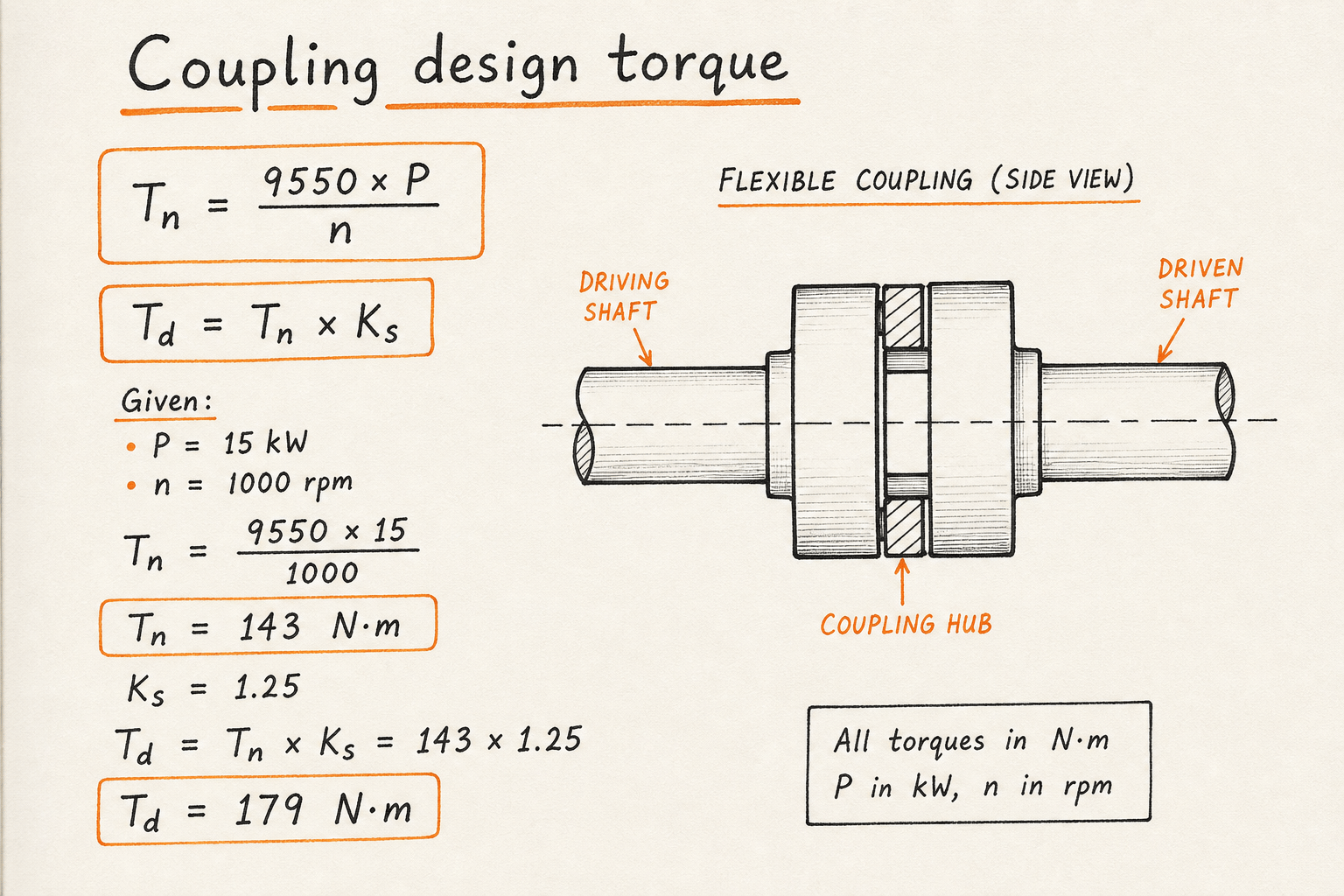
Default CALCULATE path: Tn ≈ 143.25 N·m from 15 kW @ 1000 rpm; Td ≈ 179.06 N·m after Ks 1.25.
Required bore is the larger of driver and driven shaft diameters — both default to 25 mm on the pump preset.
Service factor Ks by application
Pump duty tables publish application-specific Ks — centrifugal pump 1.0, VFD 1.25, boiler feed 1.50, piston pumps up to 3.0 for single-cylinder duty. Selectors combine Ks with family filters (jaw, pin, gear, grid, disc) and a spacer/DBSE flag when a long between-shaft-end span is required.
Use uniform Ks 1.0 only when the load is steady and you accept no shock margin. For most industrial pump and fan drives, 1.25 is a reasonable first pass. Heavy reciprocating or crusher duty can reach 2.0–3.0 — follow the coupling maker’s table when it differs.
Ks presets on this pad (representative):
| Application | Ks |
|---|---|
| Uniform / centrifugal pump | 1.0 |
| Light shock · pump/fan | 1.25 |
| Centrifugal VFD | 1.25 |
| Boiler feed | 1.50 |
| Piston pump · 1 cyl | 3.0 |
| Piston pump · 3 cyl | 1.50 |
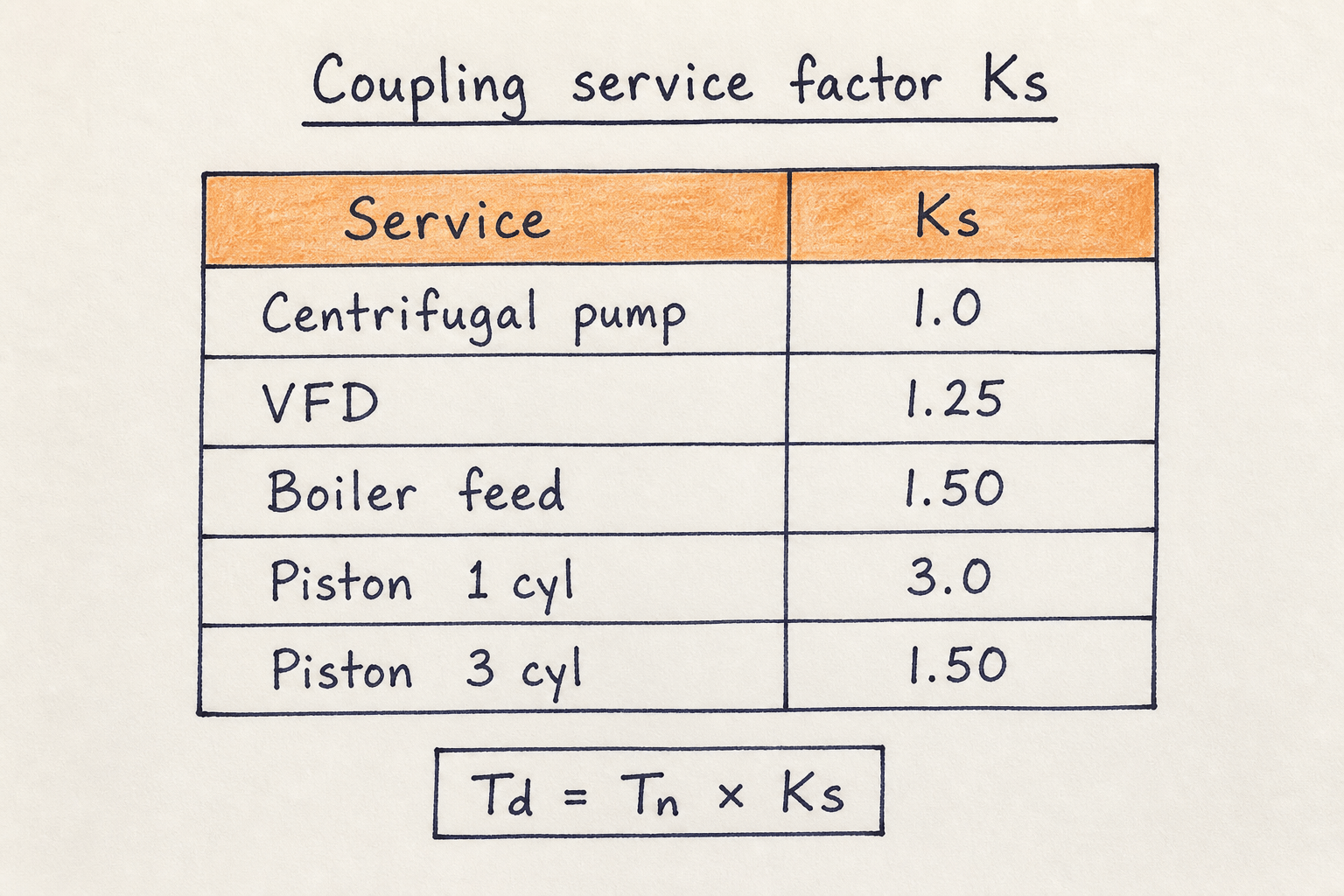
Pump-specific Ks chips mirror common supplier tables; Custom Ks remains available for site standards.
Ks multiplies nominal torque — it does not replace peak-start or brake-motor checks if your standard requires them separately.
Selection matrix: Suitable, Shaft limit, Torque too low
After Td and bore are known, each catalog row is screened. Three outcomes apply: torque and bore both OK (Suitable), torque OK but bore exceeds hub limit (Shaft limit), or catalog torque below Td (Torque too low). Best match is the smallest rated torque among Suitable rows — a conservative first pick before you verify keyway, overhung load, and speed limits in the OEM datasheet.
Family filters narrow the matrix to jaw/elastomer, pin & bush, tyre, disc, gear, grid, or spacer types only. The representative catalog is for screening — not a claim that “Gear · 200” equals a specific vendor part number.
Status codes in Results:
| Status | Meaning |
|---|---|
| Suitable | Td ≤ catalog torque and required bore ≤ max bore |
| Shaft limit | Torque OK; shaft larger than catalog max bore |
| Torque too low | Td exceeds catalog torque rating |
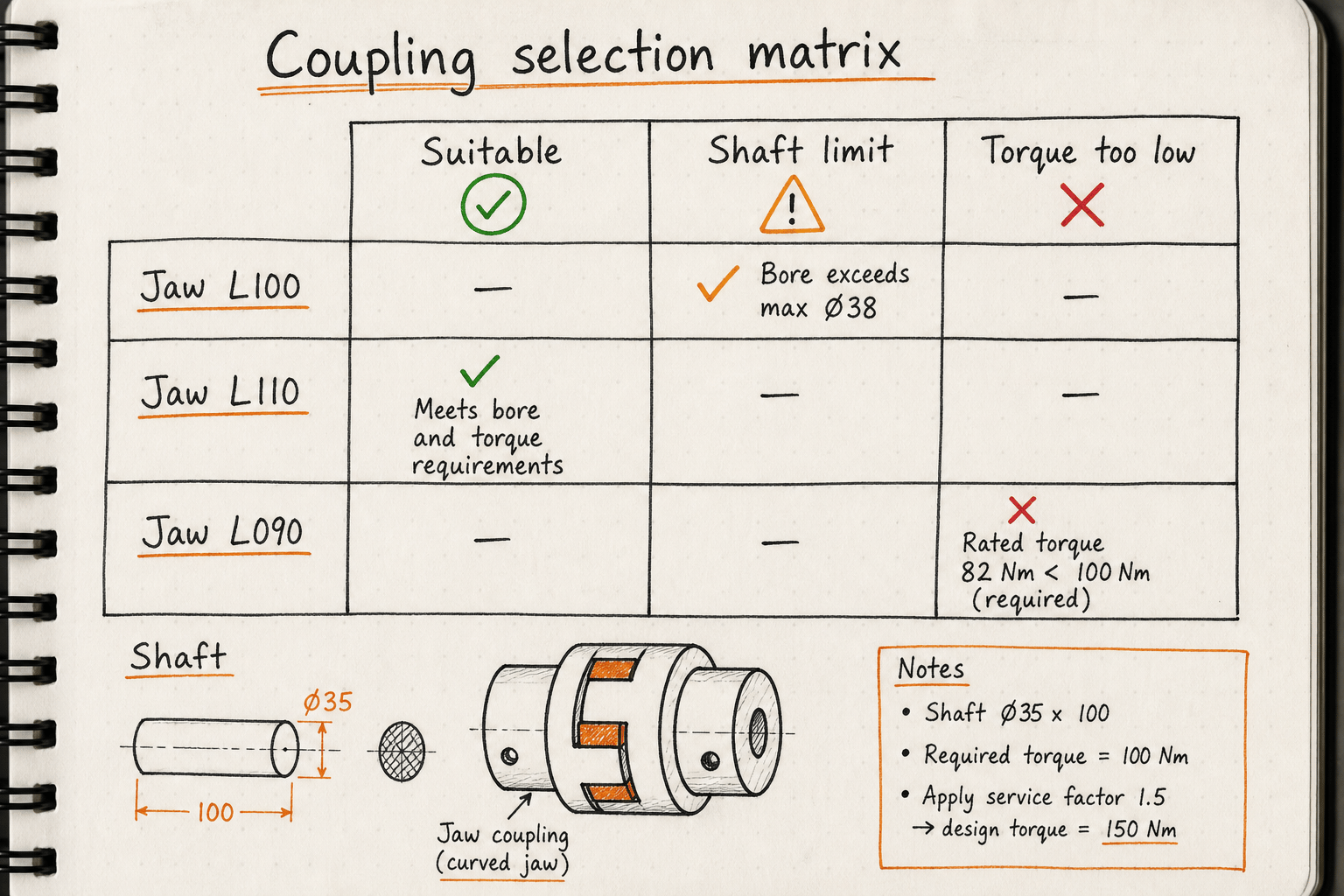
Example: 35 mm shafts on jaw L100 class show Shaft limit (170 N·m OK, 28 mm bore too small) while L150 clears both.
OEM configurators still own final size, material, and speed rating — use them after this first pass.
Worked example
Fan drive: 11 kW at 1450 rpm, Ks 1.25, 32 mm shafts, family filter Jaw / elastomer. Reproduce on CALCULATE.
- Input mode: Power kW · RPM. P = 11 kW, n = 1450 rpm, Ks = 1.25, shafts 32 mm, family filter Jaw / elastomer.
- Tn = 9550 × 11 ÷ 1450 ≈ 72.45 N·m.
- Td = 72.45 × 1.25 ≈ 90.56 N·m.
- Jaw L100: 170 N·m torque OK but max bore 28 mm → Shaft limit.
- Jaw L110: 270 N·m, max bore 32 mm → Suitable; best match among jaw rows.
Result: Best match: Jaw · L110 class — verify elastomer element and speed rating in the manufacturer catalog.
When to use
- First-pass coupling size from motor kW/HP and RPM
- Applying pump/fan/compressor service factors before catalog lookup
- Comparing jaw vs gear vs disc families on torque and bore
- Flagging shaft-limit cases before you order a hub bore
- Cross-checking supplier online selectors against this pad
Limitations
- Representative catalog rows — not OEM part numbers or prices.
- Does not check torsional stiffness, misalignment limits, or balancing grade.
- Alignment tolerance calculators are a separate discipline — out of scope.
- Spacer/DBSE checkbox filters spacer-type rows; it does not compute spacer length.
- Delrin timing-coupling tooth counts are out of scope.
- Peak starting torque, brake motors, and reversal shock may need Ks above these presets.
FAQ
- What is the difference between Tn and Td?
- Tn is nominal torque from power and speed (or your direct entry). Td = Tn × Ks is the torque you size the coupling for — it includes shock and application margin before catalog lookup.
- Why 9550 and 7121?
- 9550 = 60000/(2π) for kW and N·m. 7121 is the HP equivalent (≈ 745.7 × 60 / 2π). Same physics as T = P·60/(2πn) with P in kW and n in rpm.
- What does Shaft limit mean?
- The catalog row has enough torque rating for Td, but the published max bore is smaller than your driver or driven shaft. Step up a size or pick a family with a larger hub bore.
- Can this replace OEM configurators?
- No. OEM tools add exact SKU, material, speed, and DBSE options. Use this pad for Td and a family shortlist, then confirm in the OEM selector.
- Does this check coupling alignment?
- No. Parallel offset and angular misalignment limits belong in an alignment tolerance tool — not mixed into torque sizing.
- When should I enable Spacer / DBSE?
- When you need a spacer coupling for a long between-shaft-end distance (pump skid, motor standoff). The checkbox filters to spacer-type rows only; length still comes from layout drawings.
Shaft Design Calculator
Minimum shaft diameter from torsion, bending, Guest/Rankine combined, ASME Km/Kt, or twist limit. Solid or hollow.
Open calculatorMotor Gearbox Selector Calculator
Motor power from load torque, or gearbox output torque from motor power, ratio, SF, and efficiency.
Open calculatorShaft Diameter Calculator
Quick solid or hollow shaft diameter from power/RPM or torque under pure torsion, with stock size and keyway option.
Open calculatorKey & Keyway Design Calculator
ANSI B17.1 / ISO 773 key lookup plus parallel-key shear and bearing stress check under torque.
Open calculator