- Usable Energy
- n/akWh
- Installed Pack Energy
- n/akWh
- Total Cells
- n/acells
- Cell / String Energy
- n/aWh
- Max Continuous Current
- n/aA
- Thermal Load (10% loss)
- n/aW
You need a first-pass high-voltage pack size before you pick cells, modules, or a BMS current rating. This pad takes target range, vehicle Wh per distance, target pack voltage, usable depth of discharge, and cell voltage/Ah plus discharge C-rate, then returns usable and installed energy, Ns×Np layout, pack Ah, continuous current and power, and a 10% thermal-load estimate.
Defaults open on a passenger-EV path: 300 km, 180 Wh/km, 400 V target, 90% usable DoD, 3.7 V / 2.5 Ah cells at 3C. That path needs 54 kWh usable (60 kWh nominal before ceil), installs about 60.5 kWh as 109S60P (6,540 cells) at 403.3 V and 150 Ah, with 450 A continuous and about 18,149 W thermal at 10% loss. Switch Metric or Imperial first. Math stays in your browser.
It lives under EV & Renewable Calculators. Pair it with the motor torque-speed calculator or the regenerative braking calculator when you move from pack energy to drivetrain checks.
Formula
- Usable energy (Wh) = range × vehicle efficiency (Wh/km or Wh/mi converted).
- Required nominal (Wh) = usable ÷ (usable DoD / 100).
- Cell energy (Wh) = cell voltage × cell Ah.
- Series cells Ns = ceil(target pack V ÷ cell V). Pack V = Ns × cell V.
- Parallel strings Np = ceil(required nominal Wh ÷ (Ns × cell Wh)). Total cells = Ns × Np.
- Pack Ah = Np × cell Ah. I_cont = pack Ah × C-rate. P_cont = I_cont × pack V. Thermal ≈ P_cont × 10%.
Reproduce the default Metric path:
| Check | Value on this pad |
|---|---|
| Inputs | 300 km, 180 Wh/km, 400 V, 90% DoD, 3.7 V, 2.5 Ah, 3C |
| Usable / required nominal | 54.0 kWh / 60.0 kWh |
| Layout | 109S60P · 6,540 cells |
| Installed pack | ≈ 60.5 kWh · 403.3 V · 150 Ah |
| Current / thermal | 450 A · ≈ 181.5 kW · 18,149 W (10%) |
How it works
Pick Metric or Imperial. Enter target range, vehicle Wh per distance, target pack voltage, usable DoD, and cell V/Ah plus discharge C-rate. Usable energy is range times efficiency. Nominal energy divides by DoD. Series count sets pack voltage; parallel strings set Ah and current. CALCULATE fills the cards and updates the Ns×Np sketch. RESET restores the 300 km / 180 Wh/km / 400 V defaults.
Pick Metric (km, Wh/km) or Imperial (mi, Wh/mi). Enter target range and vehicle efficiency for usable energy. Set target pack voltage and usable DoD so nominal energy covers the reserved SOC window. Enter cell voltage, Ah, and max discharge C-rate from the datasheet. CALCULATE fills energy, cell count, Ns×Np, Ah, current, and thermal cards and lights the pack sketch (schematic cell count is capped; the footer shows the real Ns×Np). RESET restores 300 km / 180 Wh/km / 400 V / 90% DoD.
Usable energy vs nominal pack kWh
Range times Wh/km is the trip energy you must deliver from the pack usable window. That value is the usable energy target. Because packs keep top and bottom SOC in reserve, nameplate (nominal) kWh is larger than the window you drive on.
This pad divides usable by DoD to get required nominal energy before it sizes strings. Pack builders use the same split: usable trip energy divided by the drive window gives nameplate kWh before string layout. Set DoD to 100% only if you truly plan to use the full nameplate, which most traction packs do not.
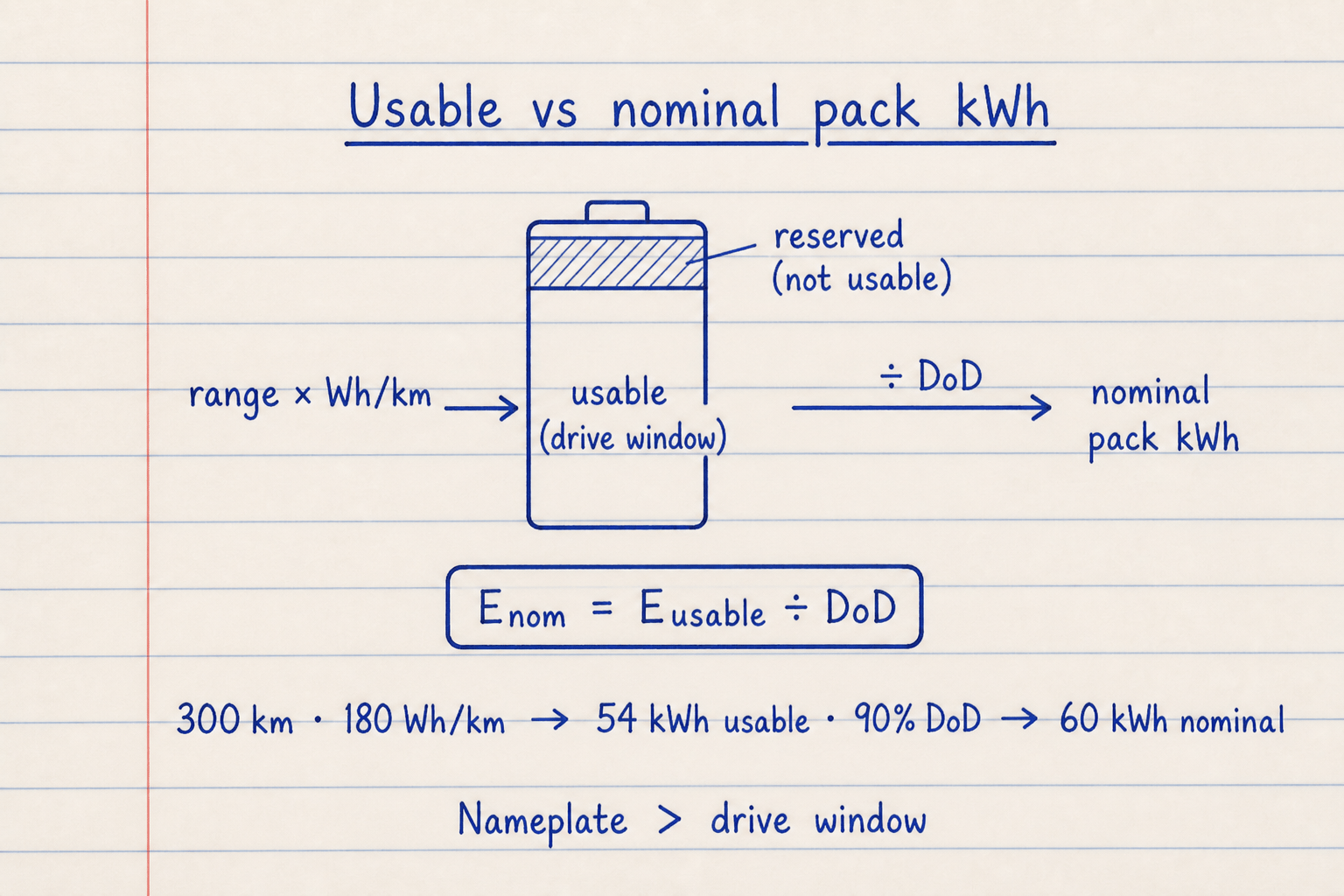
Usable energy comes from the range target. Nominal energy grows when DoD drops below 100%.
Default path: 300 km · 180 Wh/km → 54 kWh usable · 90% DoD → 60 kWh nominal before Ns×Np ceil.
Series strings set voltage, parallel sets Ah
A series string adds cell voltages. Parallel strings add capacity and current. Standard pack architecture uses Ns = ceil(V_pack / V_cell), then Np from energy per string.
Installed energy is ceil-rounded, so it is usually a little above the required nominal. Pack voltage is Ns times cell nominal voltage, not the target you typed. On the default path, 400 V target with 3.7 V cells becomes 109S at 403.3 V.
- Pack Ah = Np × cell Ah
- I_cont = pack Ah × C-rate (continuous datasheet rating)
- P_cont = I_cont × pack voltage
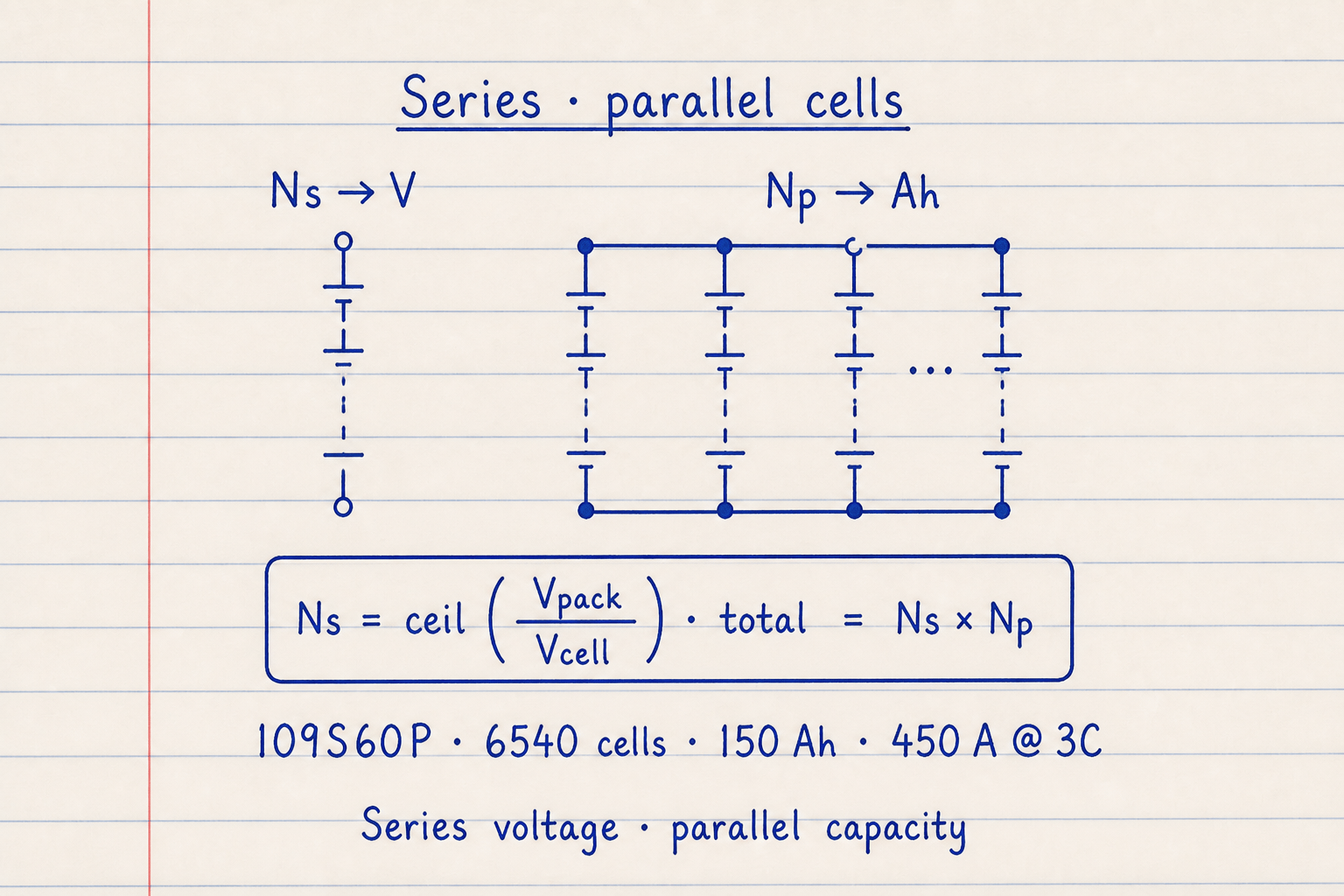
Series adds voltage. Parallel adds Ah and current capability.
Default CALCULATE: 109S60P = 6,540 cells · 150 Ah · 450 A at 3C.
Efficiency, auxiliaries, and range reality
Vehicle Wh/km already folds propulsion, inverter, and typical auxiliaries if you take it from a cycle or from fleet data. If you only have motor-side Wh/km, raise the efficiency input for HVAC, 12 V loads, and cold weather before you trust pack size.
Range estimators that start from a fixed pack and then apply style, road, and HVAC factors solve the inverse problem. This pad sizes the pack from a range target. Keep the jobs separate: lock Wh/km first, then size Ns×Np.
Worked example
300 km, 180 Wh/km, 400 V target, 90% DoD, 3.7 V 2.5 Ah cells, 3C.
- Usable = 300 × 180 = 54 000 Wh = 54 kWh.
- Required nominal = 54 / 0.90 = 60 kWh.
- Ns = ceil(400 / 3.7) = 109. Pack V = 403.3 V. Cell Wh = 9.25. String = 1 008.25 Wh.
- Np = ceil(60 000 / 1 008.25) = 60. Total cells = 109 × 60 = 6 540.
- Installed = 60.495 kWh, 150 Ah, I = 450 A, thermal ≈ 18 149 W at 10%.
Result: 109S60P pack ≈ 60.5 kWh installed, 54 kWh usable window, 450 A continuous at 3C.
When to use
- First-pass pack kWh from a range and Wh/km target
- Choosing Ns and Np for a 400 V or 800 V architecture
- Estimating pack Ah and continuous current for BMS / fuse screening
- Rough thermal load before you size a cold plate
Limitations
- Cell mass, volume, and module packaging are out of scope
- No temperature derating, aging, or BMS overhead energy
- Thermal load is a flat 10% of continuous electrical power, not a thermal model
- Uses nominal cell voltage, not charge/discharge voltage curves
- Not a substitute for cell datasheets, abuse testing, or certified pack design
FAQ
- What Wh/km should I enter?
- Compact EVs often land near 150–200 Wh/km on mixed cycles. Larger vehicles, cold climates, or high highway share can push 200–250 Wh/km. Use measured or cycle data when you have it. Imperial mode accepts Wh/mi and converts internally.
- Why is installed kWh larger than usable kWh?
- Usable energy is the window you drive on. Required nominal divides by DoD so reserved SOC stays unused. Series/parallel ceil then rounds the install up to whole strings, so installed energy is usually a little above required nominal.
- How do I target 800 V?
- Set Target Pack Voltage to 800. Ns becomes ceil(800 / cell V). Parallel count still comes from energy. Confirm isolation, connector, and inverter ratings separately.
- What usable DoD should I use?
- Many traction packs use about 80–95% of nameplate as the drive window. The default 90% is a first-pass middle. Lower DoD grows the pack. 100% means you size as if the full nameplate is usable.
- Is the thermal load a cooling design?
- No. It is I_cont × V_pack × 10%, a screening number for heat rejection order of magnitude. Real packs need cell resistance, current profiles, and CFD or test data.
- Can I size from motor kW instead of Wh/km?
- Not on this pad. Motor-power and travel-time methods can estimate energy for DIY builds, but they hide cycle efficiency. Convert your duty cycle to Wh/km (or Wh/mi) first, then run CALCULATE.
Regenerative Braking Energy Calculator
Recovered energy, range added, and pack share from braking ΔKE or downhill PE. Metric or Imperial.
Open calculatorMotor Torque-Speed and Efficiency Calculator
EV torque-speed curve or point convert with the 9550 rule, electrical input, and optional DC current. Metric or Imperial.
Open calculator