Hydraulic pump · Drive power
- Hydraulic power
- —
- Shaft / motor power
- —
- Implied displacement
- —
- Drive torque
- —
You need a first-pass size for a positive-displacement hydraulic oil pump: motor/shaft power from flow and pressure, output flow from displacement and RPM, or the displacement required for a target flow. This pad does all three, with overall and volumetric efficiency presets.
Defaults open on Drive power: 40 L/min at 140 bar, η 85%, 1450 rpm. CALCULATE returns hydraulic power ≈ 9.33 kW, shaft power ≈ 10.98 kW (≈ 14.72 HP), and drive torque ≈ 72.3 N·m. Switch to Output flow or Required displacement for the alternate solve directions. Math stays in your browser.
It lives under Fluid Power Calculators next to the hydraulic cylinder force calculator. For centrifugal head/flow power (water pumps), use the pump power calculator instead.
Formula
- Hydraulic power: P_hyd (kW) = Q (L/min) × p (bar) / 600.
- Shaft / motor power: P_shaft = P_hyd / η (overall efficiency as a fraction).
- Imperial HP: HP = PSI × GPM / (1714 × η).
- Output flow: Q (L/min) = V (cc/rev) × n (rpm) × η_vol / 1000 · GPM = n × V_in³ / 231.
- Required displacement: V (cc/rev) = Q × 1000 / (n × η_vol) · V_in³ = 231 × GPM / n.
- Drive torque: T (N·m) = 9550 × P_shaft / n.
Reproduce the default Drive power path on CALCULATE:
| Quantity | Value |
|---|---|
| Flow / pressure | 40 L/min @ 140 bar |
| Overall η / speed | 85% · 1450 rpm |
| Hydraulic power | ≈ 9.33 kW |
| Shaft power | ≈ 10.98 kW (≈ 14.72 HP) |
| Drive torque | ≈ 72.3 N·m |
| Implied V (η_vol 95%) | ≈ 29.04 cc/rev |
How it works
Three solve modes for oil-hydraulic pumps. Drive power from flow and pressure (P = Q·p/600, shaft = hydraulic/η). Output flow from displacement and RPM (Q = V·n·η_vol/1000). Required displacement from target flow and RPM. Screening only — not a centrifugal head/NPSH or OEM SKU picker.
Pick Input mode: Drive power (default), Output flow, or Required displacement. Set overall η (shaft power) and η_vol (flow/displacement). On Output flow, pressure is optional — add it to also get shaft power and torque. CALCULATE fills Results and updates the motor→pump sketch. Editing clears Results. RESET restores the 40 L/min · 140 bar defaults.
Drive power from flow and pressure
Hydraulic pump sizing usually starts from flow and pressure to get the power needed to drive the pump. Metric form is P_hyd = Q·p/600; shaft power divides by overall efficiency.
Imperial mode uses the common shop formula HP = PSI × GPM / 1714 (at 100% η). A hand check of 5 GPM at 1500 psi needs 4.375 HP theoretical — the same numbers the Imperial tab returns on CALCULATE.
Power path:
| Known | Solved |
|---|---|
| Q, p, η, n | P_hyd, P_shaft (kW/HP), T |
| Optional | Implied V from Q, n, η_vol |
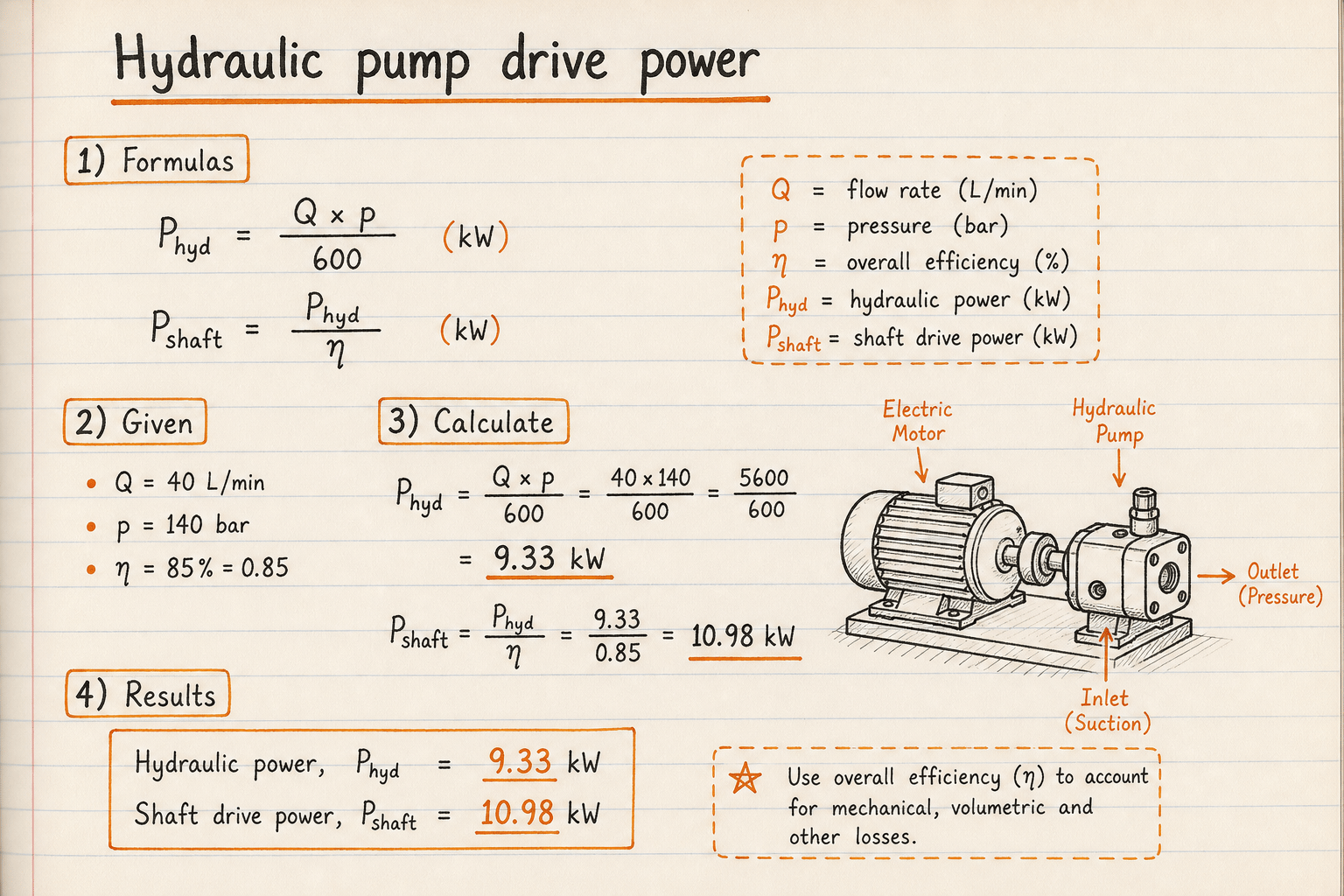
Default CALCULATE path: P_hyd ≈ 9.33 kW; P_shaft ≈ 10.98 kW at η 85%.
Torque uses T = 9550 × P_shaft / n at the entered pump speed.
Flow from displacement, or displacement from flow
Pump displacement sizing solves V = Q×1000/(n×η_vol) in cc/rev. The reverse is Q = V·n·η_vol/1000. Use volumetric efficiency below 100% when you want a larger real-world pump than the theoretical size.
Mode Output flow takes catalog cc/rev and RPM. Mode Required displacement takes the circuit target flow and drive speed. Both report L/min and US GPM; displacement also shows in³/rev (231 × GPM / n).
Displacement modes:
| Mode | Known | Solved |
|---|---|---|
| Output flow | V, n, η_vol (, p) | Q · optional P_shaft |
| Required displacement | Q, n, η_vol | V (cc/rev and in³/rev) |
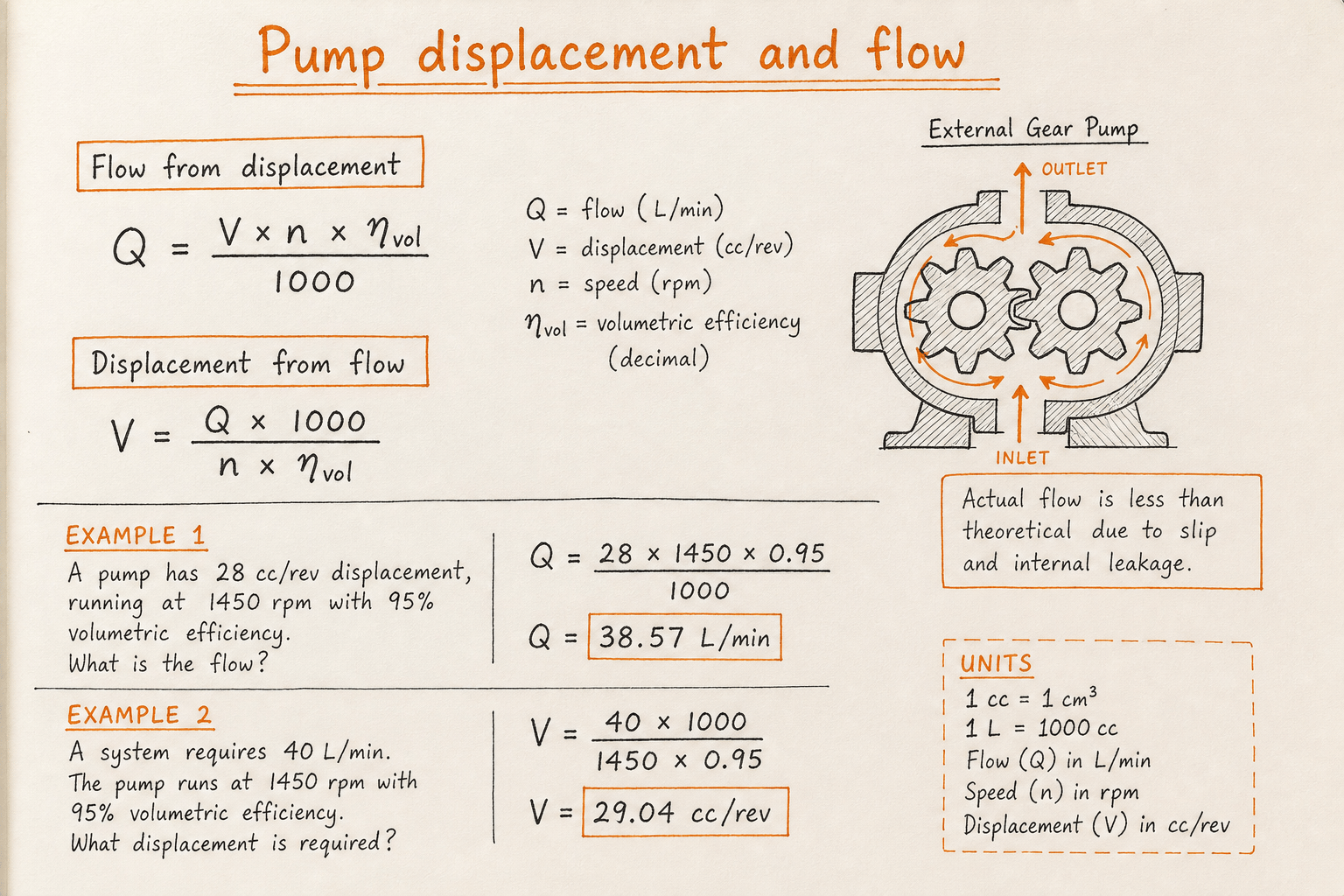
28 cc/rev at 1450 rpm and η_vol 95% → Q ≈ 38.57 L/min.
Target 40 L/min at the same speed → V ≈ 29.04 cc/rev.
What this pad is not
Centrifugal water-pump tools with differential head, NPSH, and pipe suction/discharge are a different discipline. Use the pump power calculator for ρ·g·Q·H power. Catalog SKU pickers and full cylinder–orifice–pipe system models are out of scope.
Confirm final size against manufacturer pressure rating, shaft speed limits, inlet conditions, oil viscosity, and duty cycle before you order.
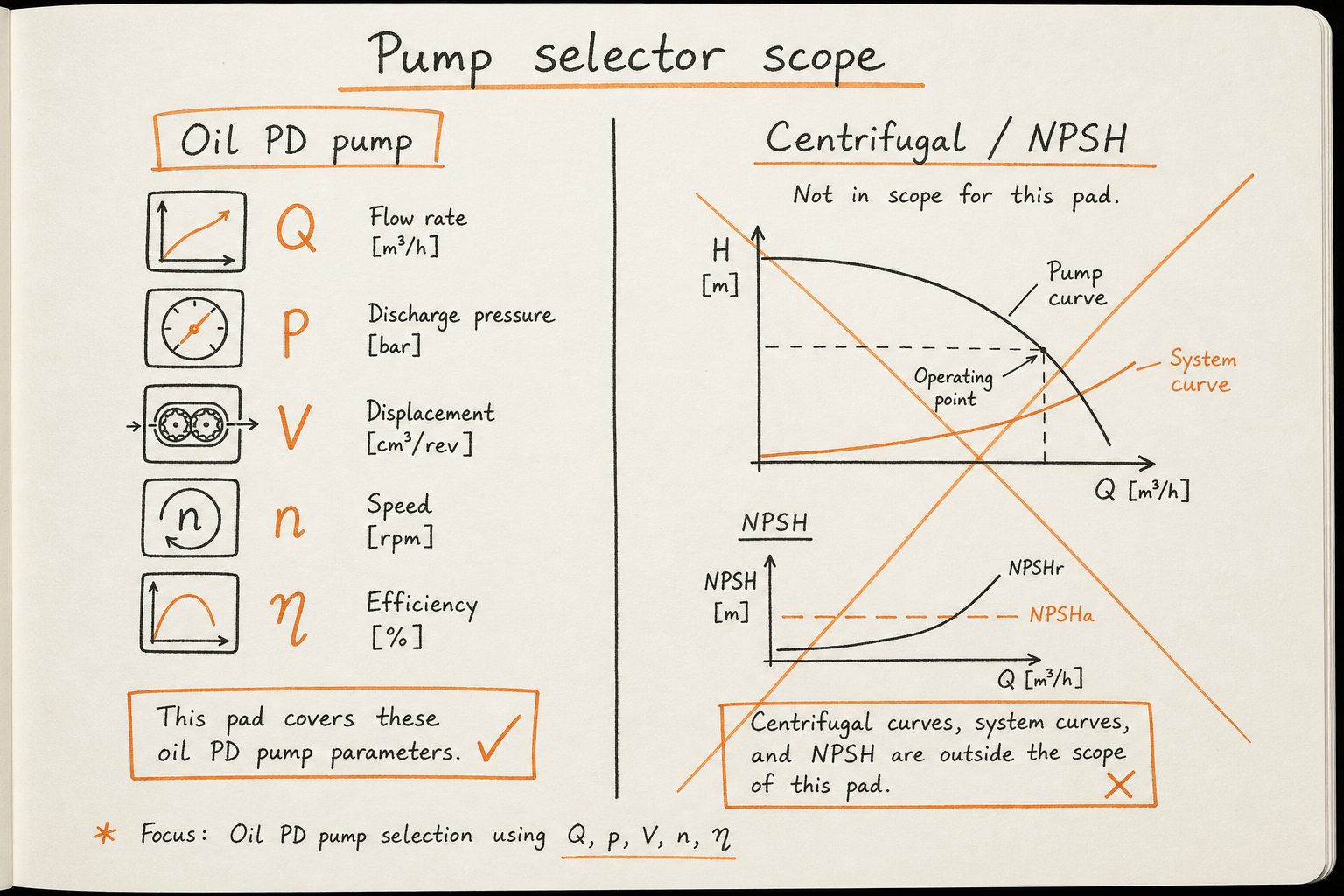
This pad: oil PD pump · Q, p, V, n, η.
Not this pad: system curves, NPSH available, catalog SKU pick.
Worked example
Default Drive power path: 40 L/min, 140 bar, η 85%, 1450 rpm. Reproduce on CALCULATE.
- Leave Input mode on Drive power · flow + pressure. Confirm η Typical gear/vane 85% and 1450 rpm.
- P_hyd = 40 × 140 / 600 = 9.333 kW.
- P_shaft = 9.333 / 0.85 ≈ 10.98 kW ≈ 14.72 HP.
- T = 9550 × 10.98 / 1450 ≈ 72.3 N·m.
- Implied displacement at η_vol 95%: V = 40 × 1000 / (1450 × 0.95) ≈ 29.04 cc/rev.
Result: Default: ≈ 10.98 kW shaft (14.72 HP), ≈ 72.3 N·m, ≈ 29.04 cc/rev screening displacement.
When to use
- First-pass motor kW/HP for a hydraulic pump from circuit flow and pressure
- Estimating L/min or GPM from catalog cc/rev and drive RPM
- Sizing required displacement for a target flow at a known speed
- Cross-checking common hydraulic pump toolbox results
- Converting between metric and imperial power formulas
Limitations
- Positive-displacement oil-pump screening — not centrifugal head, NPSH, or system-curve selection.
- Does not pick OEM pump SKUs, mounting, or noise class.
- Overall η and η_vol are presets/guidance, not a measured pump curve.
- Inlet conditions, cavitation, viscosity derating, and thermal duty are out of scope.
- Cylinder bore-from-force sizing is not on this pad — use hydraulic cylinder force with known geometry.
- Manufacturer catalog pickers and full circuit network models stay with the OEM or dedicated hydraulic software.
FAQ
- How is this different from the pump power calculator?
- Pump power uses ρ·g·Q·H for centrifugal/head applications. This pad uses Q·p/600 for oil-hydraulic positive-displacement pumps and also solves displacement ↔ flow.
- What efficiency should I use?
- Overall η ~85% is a typical gear/vane first pass; piston pumps often 90%+. Volumetric η_vol ~95% for sizing displacement; use 100% only for theoretical checks. Follow the pump maker when you have a curve.
- Why 600 and 1714?
- 600 converts L/min and bar to kW (from N·m/s). 1714 converts PSI and US GPM to mechanical HP. Same physics with different unit constants.
- Can this replace a full hydraulic pump selection tool?
- You get the same core PD-pump relations (power, flow, displacement, torque). You do not get product catalogs or every unit toggle — confirm ratings in the manufacturer data.
- Does this size a hydraulic cylinder bore?
- No. Bore-from-force belongs with cylinder force tools. This pad sizes the pump that supplies the circuit.
- What about NPSH and pipe losses?
- Out of scope here. Use a centrifugal or system-curve tool when head and suction conditions dominate.
Hydraulic Cylinder Force Calculator
Extend and retract force, areas, and optional stroke speed from pressure, bore, rod, and oil flow. Metric or Imperial.
Open calculatorPneumatic Cylinder Force Calculator
Extend and retract air-cylinder force from pressure, bore, and rod. Metric or Imperial, with optional friction loss.
Open calculatorPump Power Calculator
Hydraulic, shaft, and electrical pump power from flow, head or pressure, density, and efficiencies.
Open calculatorMotor Gearbox Selector Calculator
Motor power from load torque, or gearbox output torque from motor power, ratio, SF, and efficiency.
Open calculator