You need a first-pass motor kW/HP from a known load torque and output speed, or the reverse: gearbox output torque from a motor nameplate, input RPM, and ratio. This pad does both. Mode 0 is the classic P = T·n·2π/60,000 path with service factor and efficiency. Mode 1 mirrors industrial gearbox torque tools: n_out = n_in/i, T_out = 9550·P_kW·η/n_out, then T_rated ≈ T_out × SF for catalog screening.
Defaults open on Motor power from load torque: 120 N·m at 1450 rpm, SF 1.25 (Moderate · 8 h/day), η 95%. CALCULATE returns base ≈ 18.22 kW and required motor ≈ 23.98 kW (32.15 HP). Switch to Output torque from motor power for the 5.5 kW · 1450 rpm · i = 10 path. Math stays in your browser.
It sits under Mechanical Calculators next to the gear ratio calculator and belt drive calculator. This pad is industrial motor/gearbox sizing — not a vehicle MPH table from tire height and axle ratio.
Formula
- Mode 0 — base power: P_kW = T (N·m) × n_out (rpm) × 2π ÷ 60,000 (same as T·n / 9550).
- Mode 0 — required motor: P_req = P_base × SF ÷ η. HP = kW × 1.341022.
- Mode 1 — speeds: n_out = n_in ÷ i (gear ratio i = n_in / n_out).
- Mode 1 — delivered torque: T_out (N·m) = 9550 × P_kW × η ÷ n_out (exact SI uses 60000/(2π)).
- Mode 1 — imperial check: T (lb·ft) = 5252 × HP × η ÷ n_out (common supplier convention).
- Catalog screen: T_rated ≈ T_out × SF (generated torque × service factor).
Reproduce the default Motor power from load torque path on CALCULATE:
| Quantity | Value |
|---|---|
| Load | 120 N·m @ 1450 rpm |
| SF / η | 1.25 · 95% |
| Base power | ≈ 18.22 kW |
| Required motor | ≈ 23.98 kW (32.15 HP) |
| Catalog torque hint | 120 × 1.25 = 150 N·m |
How it works
Size a drive two ways: convert load torque and output speed into required motor kW/HP with service factor and efficiency, or convert motor power, input RPM, and gear ratio into delivered and SF-rated output torque.
Pick Input mode: Motor power from load torque (default) or Output torque from motor power. Set SF and efficiency with industrial presets (load × hours matrix, stage efficiency chips) or Custom. Mode 1 also picks kW vs HP for motor power, then input RPM and gear ratio. CALCULATE fills Results and updates the live motor→gearbox sketch (Play/Pause). Editing a field clears Results. RESET restores the 120 N·m / 1450 rpm defaults.
Two solve directions: power from load, or torque from motor
Classic torque-to-power analysis uses P = T·ω. The reverse problem starts from motor HP/kW, input RPM, ratio, and efficiency to get output torque.
This pad keeps both. Mode 0 is for “I know the load shaft.” Mode 1 is for “I know the motor and reducer.” Use the same η and SF conventions in either direction so motor shortlists and gearbox torque ratings stay consistent.
What each mode solves:
| Mode | Known | Solved |
|---|---|---|
| Motor power from load torque | T_out, n_out, SF, η | P_base, P_req (kW/HP) |
| Output torque from motor power | P_motor, n_in, i, SF, η | n_out, T_out, T_rated |
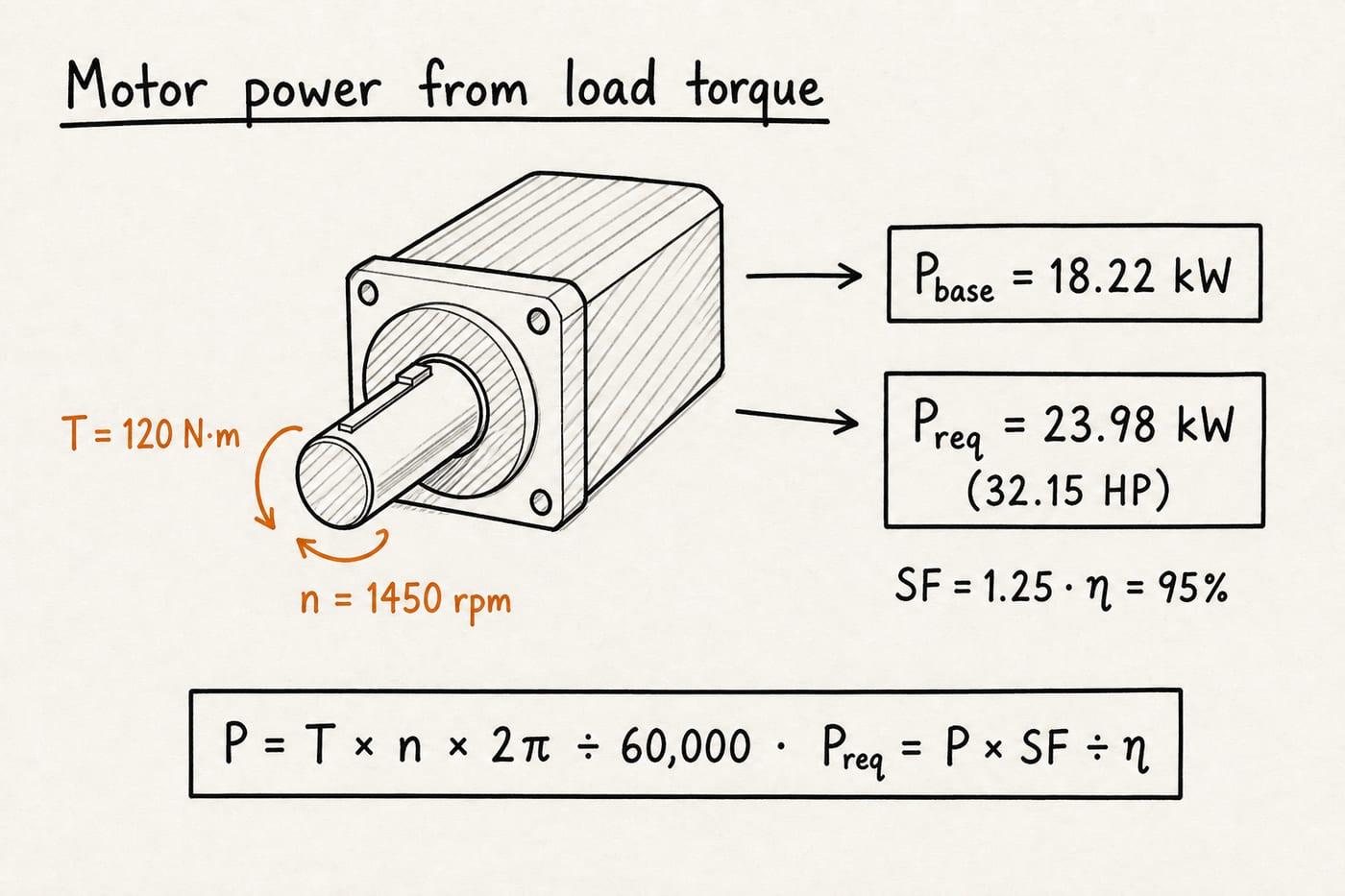
Default CALCULATE path: base ≈ 18.22 kW, required ≈ 23.98 kW after SF 1.25 and η 95%.
Catalog torque hint on mode 0 is simply load torque × SF — a quick gearbox rating check before you open a catalog.
Ratio, efficiency, and the 5252 / 9550 constants
Gearbox selection flows ask for motor kW or HP, input speed, and ratio. Physics underneath is the same: slower output → higher torque, minus efficiency.
On mode 1 this pad uses i = n_in / n_out. Delivered torque uses exact SI (equivalent to 9550·P_kW·η/n_out). Imperial example: 5252·HP·η/n_out for lb·ft. Stage efficiency chips follow common guidance (~96% / 94% / 90% / 85%). If you do not know η, the “Unknown — use 90%” chip matches common supply-house advice.
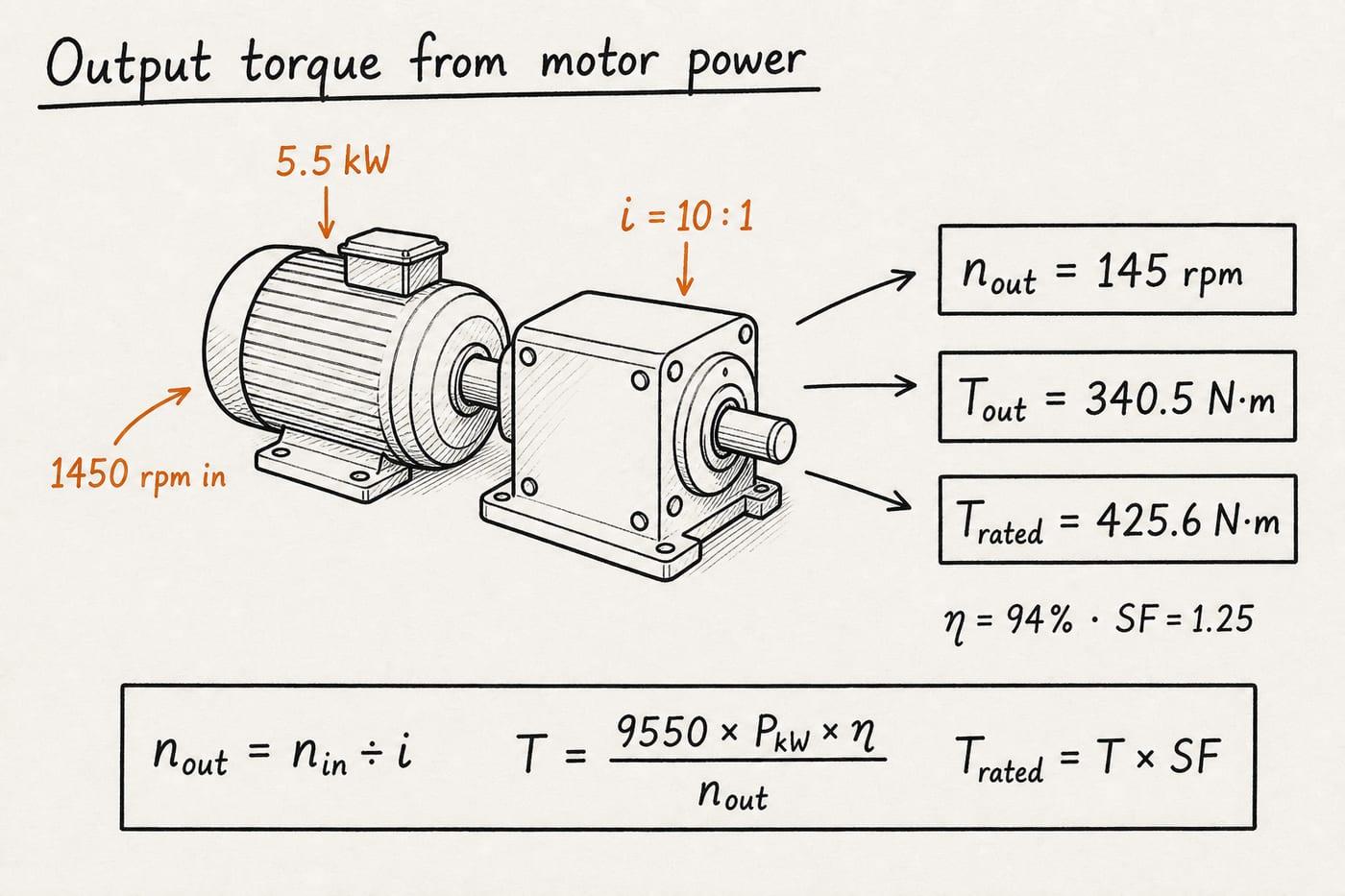
Mode 1 example: 5.5 kW · 1450 rpm · i = 10 · η 94% → 145 rpm and ≈ 340.5 N·m delivered.
Required rated torque multiplies by SF (1.25 → ≈ 425.6 N·m) for catalog screening.
Service factor: load type × hours/day
Catalogs publish a service-factor matrix from load class (uniform / moderate / heavy) and hours per day (8 / 16 / 24). Simple SF chips (1.2 / 1.5 / 2) are also common. Both ideas show up on this pad as presets; pick Custom to type any SF ≥ 1.
In mode 0, SF multiplies required motor power. In mode 1, SF multiplies delivered torque to get a required rated (catalog) torque — the generated torque × SF idea. Always confirm the manufacturer’s own SF table for thermal and mechanical ratings.
Indicative SF matrix used by the presets:
| Hours/day | Uniform | Moderate | Heavy |
|---|---|---|---|
| 8 h | 1.00 | 1.25 | 2.00 |
| 16 h | 1.50 | 1.75 | 2.25 |
| 24 h | 1.75 | 2.00 | 2.50 |
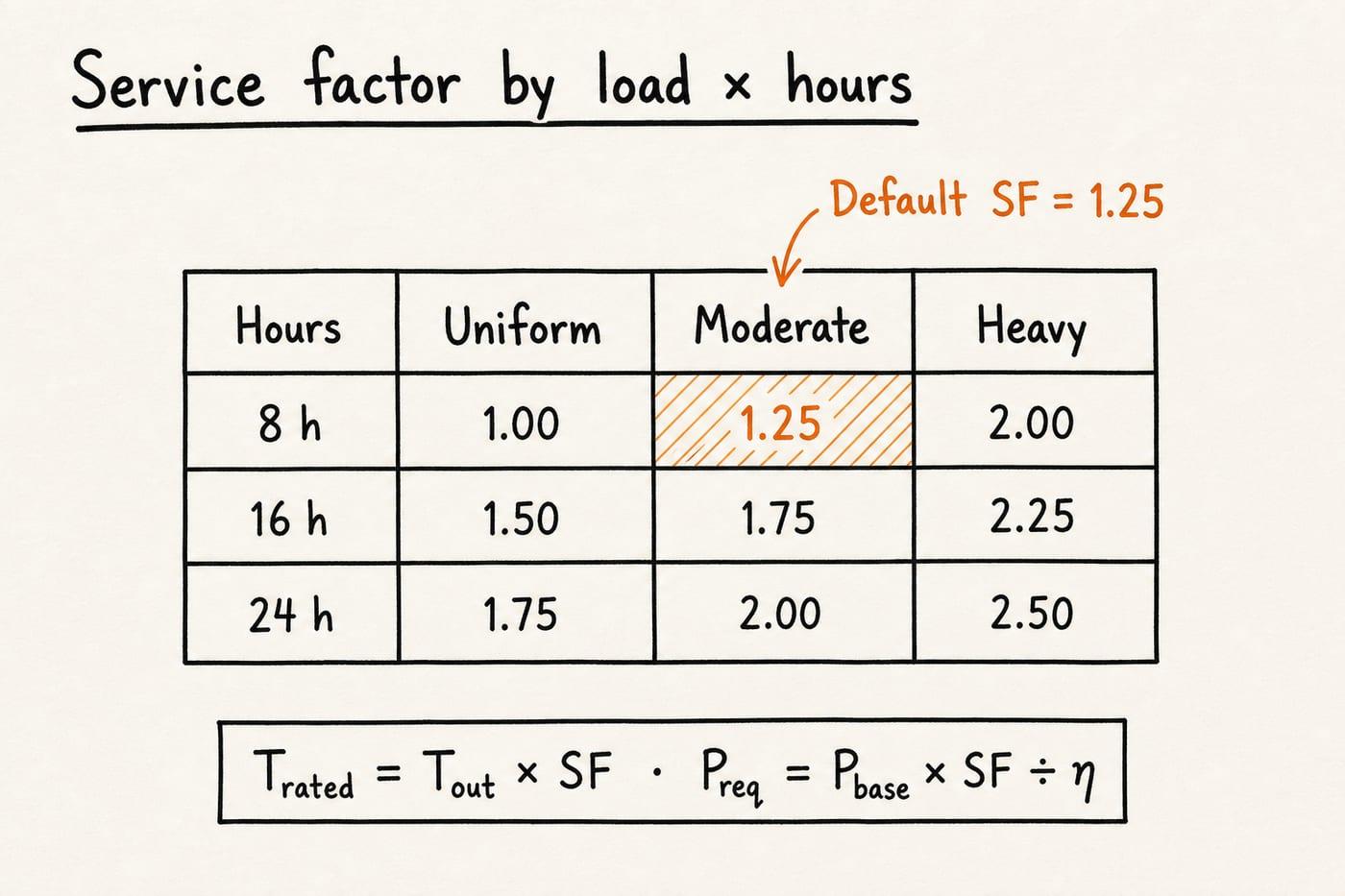
Default preset: Moderate · 8 h/day → SF 1.25.
Heavier shock or continuous duty pushes SF toward 2.0–2.5 on this table.
Not a vehicle transmission MPH calculator
Automotive transmission tools solve engine RPM or vehicle speed from transmission gear ratio, tire height, MPH, and ring-and-pinion ratio. That is an automotive driveline tool.
Out of scope here. For tooth counts, diameters, and compound trains use the gear ratio calculator. For industrial motor kW and gearbox torque screening, stay on this pad. Manufacturer configurators still own final frame size, thermal rating, and mounting.
Scope boundaries:
| In scope | Out of scope |
|---|---|
| P ↔ T with SF and η | Motor frame / IEC size pick |
| Ratio from n_in / n_out | Vehicle MPH / tire / axle |
| Catalog T_rated ≈ T × SF | OEM 3D CAD / quotation |
| kW ↔ HP display | Mounting / AGMA thermal rating |
Worked example
Default Motor power from load torque: 120 N·m at 1450 rpm, SF 1.25, η 95%. Reproduce on CALCULATE.
- Leave Input mode on Motor power from load torque. Confirm SF Moderate · 8 h (1.25) and efficiency 95%.
- CALCULATE → base power ≈ 18.22 kW; required motor ≈ 23.98 kW (32.15 HP).
- Mode 1 example: Output torque from motor power, 5.5 kW, 1450 rpm in, i = 10, η 94%, SF 1.25 → n_out 145 rpm, T_out ≈ 340.5 N·m, T_rated ≈ 425.6 N·m.
- Imperial example: same path with 7.5 HP → T_out ≈ 346.2 N·m (≈ 255.4 lb·ft).
- Precision-style example: 5 HP, 1440 rpm in, i = 120 (n_out = 12), η 88%, SF 2 → T_out ≈ 2611 N·m, T_rated ≈ 5222 N·m.
Result: Default: ≈ 23.98 kW (32.15 HP) motor. Mode 1 5.5 kW / 10:1: ≈ 340.5 N·m delivered, ≈ 425.6 N·m rated.
When to use
- Shortlisting motor kW/HP from a known load torque and speed
- Estimating gearbox output torque from a motor nameplate and ratio
- Applying industrial SF (load × hours) before catalog lookup
- Converting between kW and HP while keeping η in the loop
- Cross-checking supplier torque calculators
Limitations
- Steady-state average power — not peak accel or starting torque unless you raise SF yourself.
- Service factor must be ≥ 1.0 (duty margin). Values below 1 are rejected in the UI and clamped to 1.0 in the formula.
- Does not select motor frame, insulation class, or IEC size.
- Does not check gearbox thermal rating, overhung load, or AGMA life.
- Efficiency presets are typical stage guidance, not a measured gearbox curve.
- Not a vehicle MPH / tire / axle calculator (use automotive tools; ratio geometry → gear ratio pad).
- Manufacturer configurators still own final product selection.
FAQ
- What service factor should I use?
- Start from the load × hours presets (e.g. moderate shock, 8 h/day → 1.25). Heavy shock or 24 h duty can reach 2.0–2.5. SF is always ≥ 1.0 on this pad — it adds margin, it does not knock power or torque down. Follow the gearbox maker’s table when it differs.
- How is this different from the gear ratio calculator?
- Gear ratio solves i, n_out, and T_out from teeth or diameters. This pad sizes motor power or gearbox torque from power, RPM, ratio, SF, and efficiency — the catalog pre-screen step.
- Why multiply torque by SF in mode 1?
- Delivered torque is what the shaft sees after η. Rated (catalog) torque is usually sized above that by a service factor so shock and hours do not eat the mechanical rating.
- kW or HP?
- Mode 0 always shows both. Mode 1 lets you enter either; conversion uses 1 kW = 1.341022 HP (mechanical). Imperial torque checks use 5252·HP·η/n_out.
- Can I use this like a manufacturer product finder?
- You get the same physics inputs (power, speeds, SF). You do not get a SKU, mounting, or “with/without motor” quote — that stays with the manufacturer’s configurator.
- Does this cover vehicle transmission / tire calculators?
- No. Those solve vehicle speed or engine RPM from tire height and axle ratio. This pad is industrial motor and gearbox sizing only.
Gear Ratio Calculator
Gear ratio, output RPM, and torque for spur pairs, compound trains, direct ratio, speed solve, or idler trains.
Open calculatorChain Drive Calculator
ANSI roller chain length, pitch diameters, wrap angle, design power, and tensile safety factor.
Open calculatorBelt Drive Calculator
Classical, narrow, cogged, flat, timing, and poly-V belt sizing plus open/crossed length and C from L.
Open calculator