- Peak Torque @ Base
- n/aN·m
- Torque @ Max Speed
- n/aN·m
- Electrical Input
- n/akW
- DC Current (est.)
- n/aA
You need shaft torque from motor power and speed, or a first-pass EV torque-speed envelope before you size an inverter or gearset. This pad uses the shop 9550 rule for torque and power, with a Torque-speed curve mode for constant-torque then constant-power regions, plus a Point convert mode that solves torque or power. Efficiency turns mechanical power into electrical input. Optional DC bus voltage estimates current.
Defaults open on a traction-motor curve: 150 kW, base 4000 rpm, max 12 000 rpm, 94% efficiency, 400 V bus. That path gives about 358.1 N·m at base, 119.4 N·m at max (speed ratio 3), about 159.57 kW electrical input, and about 398.9 A on the DC bus. Switch Metric (kW, N·m) or Imperial (hp, lb·ft). Math stays in your browser.
It lives under EV & Renewable Calculators. Pair it with the EV battery pack sizing calculator or the regenerative braking calculator when you move from shaft torque to pack energy.
Formula
- T (N·m) = 9550 × P (kW) / N (rpm). Exact constant is 60×1000/(2π) ≈ 9549.3; this pad uses 9550.
- P (kW) = T × N / 9550 (point convert, solve power).
- Curve mode: T_base = 9550 × P / n_base (constant torque). T_max = 9550 × P / n_max (constant power).
- Electrical input P_elec = P_mech / (η/100).
- DC current (est.) I = P_elec × 1000 / V_bus when voltage > 0.
- Imperial: 1 hp = 0.7457 kW; 1 lb·ft = 1.3558 N·m (converted before the 9550 rule).
Reproduce the default Metric curve path:
| Check | Value on this pad |
|---|---|
| Inputs | 150 kW, 4000 / 12 000 rpm, 94%, 400 V |
| Peak torque @ base | ≈ 358.1 N·m (≈ 264.1 lb·ft) |
| Torque @ max | ≈ 119.4 N·m · speed ratio 3.0 |
| Electrical input | ≈ 159.57 kW |
| DC current | ≈ 398.9 A |
How it works
Pick Metric or Imperial, then Torque-speed curve or Point convert. Curve mode uses T = 9550 × P(kW) / N(rpm) at base and max speed for a constant-torque then constant-power envelope. Point convert solves torque from power and speed, or power from torque and speed. Electrical input is mechanical power divided by efficiency. Optional DC bus voltage estimates current as P_elec / V. CALCULATE updates the sketch. RESET restores 150 kW / 4000 / 12000 / 94% / 400 V.
Pick Metric (kW, N·m) or Imperial (hp, lb·ft). Choose Torque-speed curve for an EV envelope (max speed ≥ base speed), or Point convert to solve torque from power and speed (or power from torque and speed). Enter efficiency for electrical input. Optional DC bus voltage estimates current; set voltage to 0 to hide that card. CALCULATE fills the result cards and updates the sketch. RESET restores 150 kW / 4000 / 12 000 / 94% / 400 V (or Imperial equivalents).
Constant torque, then constant power
Traction motors often hold peak torque from zero to base speed, then hold roughly constant power while torque falls as 1/n through the field-weakening region. This pad models that first-pass envelope: one power number, two speeds, two torque cards.
On the default path, base 4000 rpm and max 12 000 rpm give a speed ratio of 3. Torque at max is one-third of peak torque when power is held constant. Real motors have thermal limits, inverter current ceilings, and soft corners. Use the curve for screening, not a certified map.
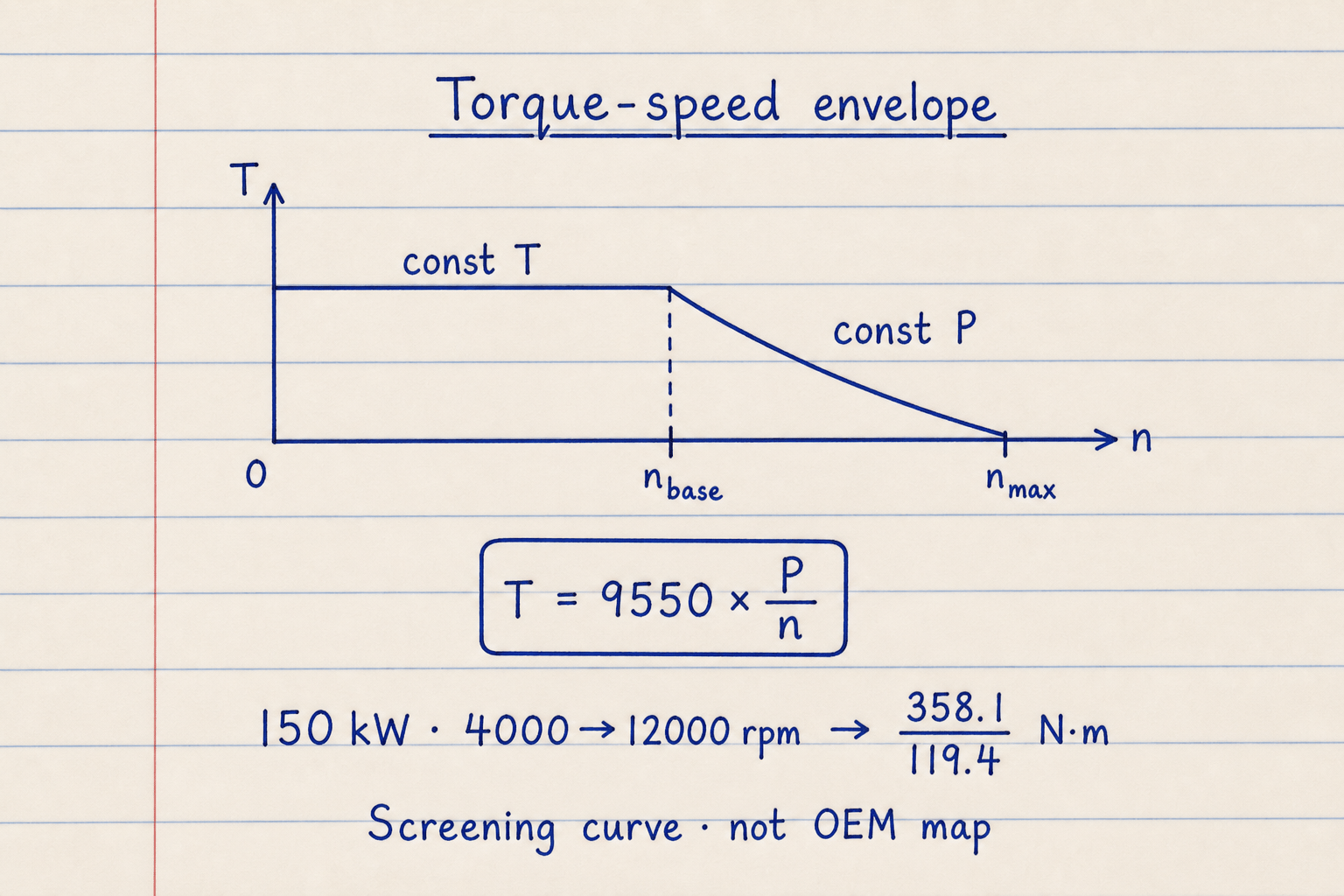
Left of n_base: constant torque. Right of n_base: constant power with T falling as speed rises.
Default CALCULATE: 150 kW · 4000→12 000 rpm → ≈358.1 N·m / ≈119.4 N·m.
Where the 9550 rule comes from
Shaft power is torque times angular speed. With P in kW and N in rpm, torque rearranges to T = 9550 × P / N. The exact factor is 60×1000/(2π) ≈ 9549.3. Shop pads and nameplates almost always round to 9550.
Point convert mode is the same identity used by power-torque-speed converters: solve T from P and N, or P from T and N. Imperial mode converts hp and lb·ft to kW and N·m before applying 9550, then converts results back for display.
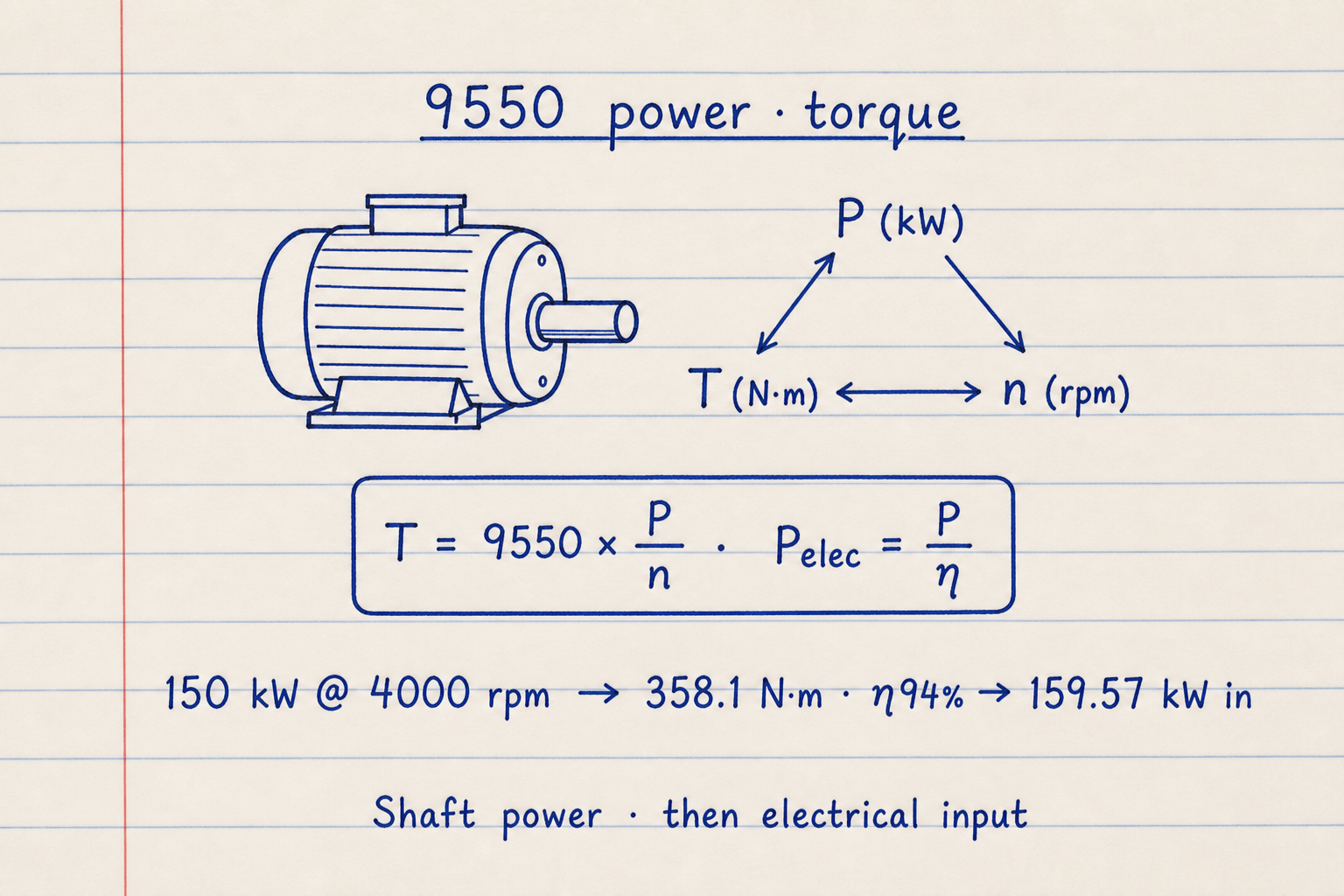
Mechanical shaft power uses T = 9550 × P / n. Electrical input is P / η.
Default: 150 kW @ 4000 rpm → 358.1 N·m · η 94% → ≈159.57 kW electrical.
Electrical input and DC current
Nameplate mechanical power is shaft output. Controllers and batteries see electrical input P_elec = P_mech / η. Size fuses, cables, and the pack to the electrical side, not the shaft kW alone.
Optional DC bus voltage gives a first-pass current I = P_elec / V for a DC or DC-link estimate. It is not a three-phase line-current calc with power factor. Set voltage to 0 if you only want torque and electrical kW.
Worked example
150 kW, base 4000 rpm, max 12 000 rpm, 94% efficiency, 400 V (curve, Metric).
- T_base = 9550 × 150 / 4000 = 358.125 N·m ≈ 358.1 N·m.
- T_max = 9550 × 150 / 12 000 = 119.375 N·m ≈ 119.4 N·m.
- P_elec = 150 / 0.94 ≈ 159.57 kW.
- I_dc ≈ 159 570 / 400 ≈ 398.9 A.
Result: ≈ 358.1 N·m at base, ≈ 119.4 N·m at max, ≈ 159.57 kW electrical, ≈ 398.9 A at 400 V.
When to use
- First-pass EV traction torque at base and max speed
- Converting shaft power and RPM to torque (or the reverse)
- Estimating electrical input from nameplate efficiency
- Rough DC-link current before inverter or cable screening
Limitations
- Constant-power region is idealised; no thermal or inverter current map
- DC current ignores three-phase power factor and PWM ripple
- No gear ratio, Kv, or brushed-motor resistance model
- 9550 is the rounded shop constant, not a FEA torque curve
- Not a substitute for manufacturer torque-speed charts
FAQ
- Where does 9550 come from?
- Power P = T × ω with ω = 2πN/60. Solving for T with P in watts and N in rpm gives T = 60P/(2πN). With P in kW that is T = 9550 P / N (exact factor ≈ 9549.3).
- What is base speed?
- Base speed is where the motor leaves the constant-torque region and enters field weakening (constant power). Below base speed, peak torque is available. Above it, torque falls roughly as 1/n if power is held.
- Can max speed be lower than base speed?
- No. In Torque-speed curve mode, max speed must be greater than or equal to base speed. Equal speeds give speed ratio 1 and the same torque on both cards (no field-weakening stretch).
- When should I use Point convert?
- Use it for a single operating point: known power and RPM to get torque, or known torque and RPM to get power. Use Torque-speed curve when you care about both base and max speed on one envelope.
- How is electrical input different from shaft power?
- Shaft power is mechanical output. Electrical input divides that by efficiency to cover motor and drive losses. Controllers, fuses, and packs should be sized to the electrical side.
- Is the DC current a three-phase line current?
- No. It is a DC or DC-link estimate I = P_elec / V. Three-phase line current needs voltage definition, power factor, and √3. Use a dedicated electrical motor amps tool for that job.
- Can I enter horsepower?
- Yes. Switch to Imperial. Power becomes hp and torque becomes lb·ft. The pad converts to kW and N·m for the 9550 math, then converts results back.
EV Battery Pack Sizing Calculator
Usable and installed pack energy, Ns×Np cell layout, pack Ah, and discharge power from range, efficiency, and cell specs.
Open calculatorRegenerative Braking Energy Calculator
Recovered energy, range added, and pack share from braking ΔKE or downhill PE. Metric or Imperial.
Open calculator