You need a fast cylinder or sphere screen before you open a code worksheet: hoop and longitudinal (or meridional) stress, thin vs thick classification, Lamé inner-surface hoop for stocky walls, a von Mises check, and a preliminary required thickness with joint efficiency and corrosion allowance.
Defaults open on Metric Stress from geometry: cylindrical shell, Di = 500 mm, t = 10 mm, P = 2 MPa, S = 140 MPa, E = 1. CALCULATE returns t/ri = 0.04 (Thin), σh = 50 MPa, σl = 25 MPa, Lamé inner ≈ 51.0 MPa, FOS = 2.8, Pass, and membrane required t ≈ 3.57 mm. Switch to Required thickness or Spherical shell when that matches the job. Math stays in your browser.
It lives under Mechanical Calculators. Pair the principals with the von Mises calculator or a margin check on the safety factor calculator.
Formula
- Thin cylinder: σh = P·Di/(2t), σl = P·Di/(4t). Thin sphere: σ = P·Di/(4t).
- Thin-wall class when t/ri < 0.1 (ri = Di/2). Some texts use 1/20; this pad uses 0.1.
- In-plane max shear = |σh − σl|/2. Absolute max shear includes σ3 = 0.
- Lamé cylinder (Po = 0): σθ,i = P(ro²+ri²)/(ro²−ri²), σr,i = −P, σz = P ri²/(ro²−ri²). Thick sphere uses the closed-form inner hoop; governing switches to Lamé when t/ri ≥ 0.1.
- Membrane required t: cylinder P·Di/(2 S E); sphere P·Di/(4 S E).
- ASME VIII-1 screen: cylinder t = P·R/(S E − 0.6P); hemi/sphere form t = P·R/(2 S E − 0.2P). Then t_buy = t_ASME + CA.
Reproduce the default Metric cylinder stress path on CALCULATE:
| Quantity | Value on this pad |
|---|---|
| Di / t / P / S | 500 mm · 10 mm · 2 MPa · 140 MPa |
| t/ri | 0.040 · Thin |
| σh / σl | 50 / 25 MPa |
| Lamé σθ,i | ≈ 51.0 MPa |
| FOS / check | 2.80 · Pass |
| Membrane t_req | ≈ 3.57 mm |
How it works
Calculates thin-wall hoop and longitudinal stresses for cylinders and spheres, Lamé thick-wall stresses, von Mises screen, and required thickness with joint efficiency and corrosion allowance (membrane + ASME UG-27/UG-32 screening).
Pick Metric or Imperial (ksi for both P and S). Choose Stress from geometry or Required thickness, then Cylindrical or Spherical shell. Enter Di, t (stress mode), P, allowable S, joint efficiency E, and optional CA. CALCULATE locks Results and updates the sketch. Stress mode reports FOS and Pass/Fail; thickness mode sizes t and shows FOS/check as n/a. Editing a field clears Results. RESET restores defaults for the active unit system.
Thin-wall hoop and longitudinal stress
For a thin cylindrical shell the membrane formulas match mechanics textbooks: hoop (circumferential) stress is twice the longitudinal stress. A sphere carries equal biaxial membrane stress at half the cylinder hoop for the same Di, P, and t.
On this pad, CALCULATE the defaults. You should see σh = 50 MPa and σl = 25 MPa. Absolute max shear includes the free surface (σ3 = 0), so it is larger than the in-plane value for a cylinder.
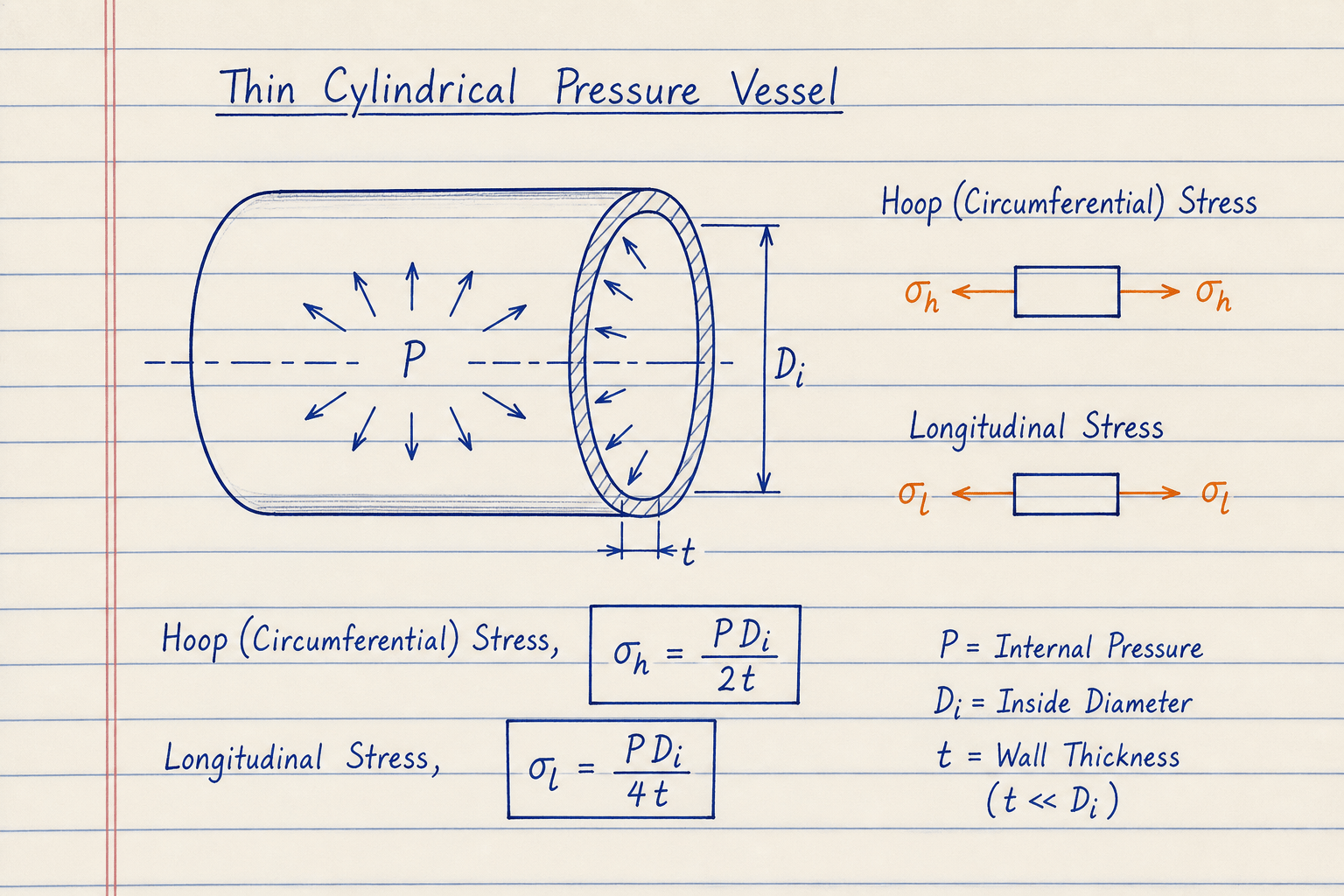
Use gauge pressure P (relative to atmosphere), inside diameter Di, and wall thickness t in consistent units.
Spherical shells replace the pair of stresses with a single σ = P·Di/(4t).
When Lamé thick-wall matters
Once the wall is no longer thin, stress varies through the thickness. Lamé (or equivalent) thick-wall formulas apply. This pad flags Thick when t/ri ≥ 0.1 and uses the Lamé inner hoop as the governing stress for FOS on both cylinders and spheres.
Try a cylinder Di = 200 mm, t = 20 mm, P = 10 MPa: t/ri = 0.2, thin membrane would say 50 MPa, but governing Lamé inner hoop is about 55.5 MPa. The same geometry as a sphere jumps from membrane 25 MPa to Lamé about 30.6 MPa. That gap is why thin-wall alone is unsafe for stocky shells.
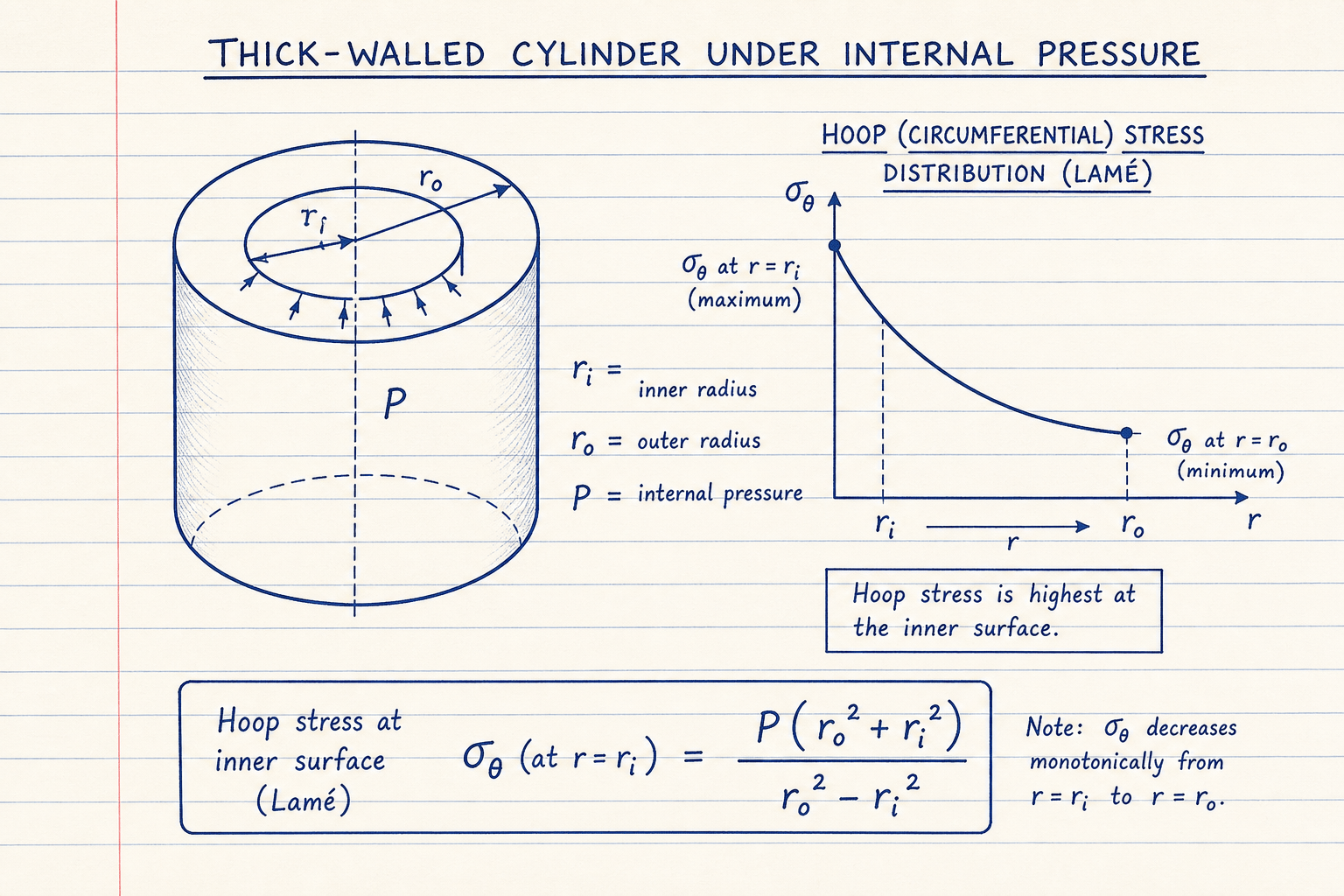
Radial stress at the inner surface equals −P. Outer hoop is lower than inner hoop for internal pressure only.
Closed-end axial stress from Lamé is reported for cylinders; spheres use the thick-sphere inner hoop form.
Required thickness, E, and corrosion allowance
Preliminary sizing adds joint efficiency and corrosion allowance. Membrane t = P·Di/(2 S E) is the textbook start. This pad also shows an ASME VIII-1 UG-27 / UG-32 screening thickness, then adds CA.
Required thickness mode with Di = 1000 mm, P = 1.6 MPa, S = 137 MPa, E = 1, CA = 1 mm returns membrane t ≈ 5.84 mm, ASME screen ≈ 5.88 mm, and t + CA ≈ 6.88 mm. That is a buy/estimate number, not a stamped design. Heads, nozzles, vacuum, and external pressure need a full code run.
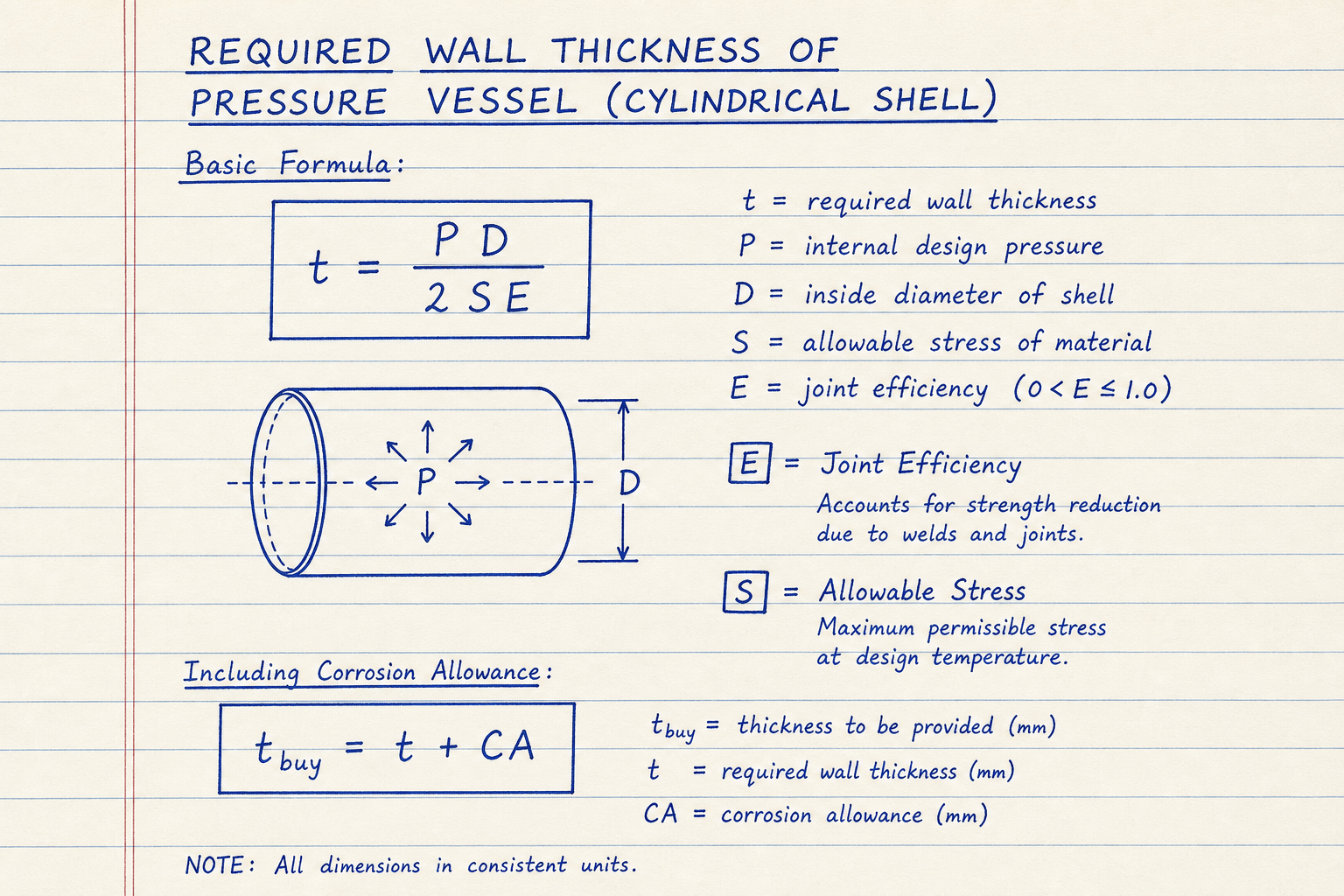
S is code allowable stress at design temperature, not yield strength.
E depends on weld type and radiography; do not assume 1.0 without a basis.
Worked example
Default Metric cylinder: Di = 500 mm, t = 10 mm, P = 2 MPa, S = 140 MPa, E = 1. Reproduce on CALCULATE.
- Leave Solve mode on Stress from geometry and Vessel type on Cylindrical shell.
- CALCULATE → t/ri = 0.04 Thin, σh = 50 MPa, σl = 25 MPa, FOS = 2.8, Pass.
- Lamé inner hoop ≈ 51.0 MPa (close to thin because the wall is light).
- Switch to Required thickness with the same Di, P, S, E and CA = 0 → membrane t ≈ 3.57 mm; FOS/check show n/a.
- Sphere example: same Di/t/P → σ = 25 MPa (half the cylinder hoop).
Result: Default: Thin cylinder, σh = 50 MPa, Pass at S = 140 MPa. Membrane t_req ≈ 3.57 mm.
When to use
- First-pass hoop/longitudinal stress on a tank or pipe shell
- Checking whether thin-wall theory still applies (t/ri)
- Comparing membrane vs Lamé inner hoop on a thicker cylinder
- Rough required thickness with E and CA before a code worksheet
- Teaching cylinder vs sphere membrane stress
Limitations
- Internal gauge pressure only. No external pressure, vacuum, or wind/seismic.
- Prismatic cylinder or sphere shell. No nozzles, saddles, or openings.
- ASME UG-27 / UG-32 forms are screening only, not a stamped Div 1 calculation with all UG rules.
- No ellipsoidal/torispherical/conical heads (use a code head calculator).
- Not a vessel volume / fill-height tool.
- Allowable S must come from your code and temperature table.
FAQ
- Is allowable stress the same as yield strength?
- No. S is a code allowable at design temperature (often well below Sy). Using Sy directly overstates capacity. Pull S from ASME II-D, EN, or your project spec.
- Why show both membrane and ASME thickness?
- Membrane t = P·Di/(2 S E) is the mechanics textbook form. ASME UG-27 adds the 0.6P term in the denominator for cylinders. Comparing both keeps the screen honest without pretending to be a full Div 1 workbook.
- When should I trust Lamé over thin-wall?
- When t/ri is not small. This pad switches the governing hoop to Lamé inner for cylinders and spheres once t/ri ≥ 0.1. Still confirm with your code for design.
- Why is Pass/Fail n/a in Required thickness mode?
- Thickness mode sizes wall t from P, S, E, and CA. There is no entered wall to check against S. Switch to Stress from geometry and enter t if you want FOS and Pass/Fail.
- Does this size heads or volume?
- No. Head formulas and liquid volume are separate jobs. This pad is shell stress and preliminary shell thickness only.
Safety Factor Calculator
Factor of safety from strength ÷ stress. Yield or ultimate basis, material presets, and reverse solve modes.
Open calculatorVon Mises Stress Calculator
Distortion-energy equivalent stress from plane stress, principals, or a 3D tensor, with yield check.
Open calculatorBeam Stress and Deflection Calculator
Six textbook beam cases: max moment, shear, stress, deflection, slope, and L/360 check with animated 2D sketches.
Open calculatorColumn Buckling Calculator
Euler and Johnson critical buckling load, slenderness, and FOS check for compression columns.
Open calculator