- Hydraulic power
- —
- Shaft / brake power
- —
- Electrical input
- —
- Recommended motor
- —
- Uses — Centrifugal
- —
- Applications — Centrifugal
- —
You need a first-pass motor size for a centrifugal, axial/mixed-flow, or process positive-displacement pump before you open a vendor curve. This pad takes flow, total dynamic head (or differential pressure), fluid density or specific gravity, pump efficiency, and motor efficiency, then returns hydraulic power, shaft (brake) power, electrical input, and an API 610-style recommended motor margin. A Pump category guide (12 types under Dynamic and Positive displacement) teaches which machine you have — it does not change the Ph = ρgQH math.
Defaults open on Metric head duty with Centrifugal: 50 m³/h, 30 m TDH, water at 1000 kg/m³, 70% pump efficiency, 90% motor efficiency. CALCULATE returns about 4.09 kW hydraulic, 5.84 kW shaft (≈7.83 HP), 6.49 kW electrical, about 7.30 kW recommended motor after a 25% margin, plus Uses and Applications for the selected category. Pick a specific pump category (multistage, axial, gear, plunger, diaphragm, metering, …), Imperial, or Pressure when that matches your data sheet. Math stays in your browser.
It lives under Thermal & Fluids Calculators. Build friction head on the pipe flow pressure drop calculator. Check pipe Reynolds number on the Reynolds number calculator. Oil positive-displacement HPU pumps (L/min, bar, cc/rev) belong on the hydraulic pump selector, not here.
Formula
- Hydraulic power (SI): Ph (kW) = ρ · g · Q · H / 1000 with Q in m³/s, H in m, ρ in kg/m³. Equivalent: Ph = q · ρ · g · H / 3.6×10⁶ with q in m³/h.
- From pressure: H = Δp / (ρ · g) in both Metric and Imperial (psi converted to Pa). US customary teaching form for water horsepower: WHP = Q_gpm · H_ft · SG / 3960.
- Shaft (brake) power: Ps = Ph / η_pump. Electrical input: Pe = Ps / η_motor.
- Recommended motor (screening): Ps × 1.25 if Ps < 22 kW, × 1.15 if 22–55 kW, × 1.10 if Ps > 55 kW. Round up to the next standard frame.
- Total head teaching (Apiste-style): H_total = (H_suction_static + H_suction_pipe) + (H_discharge_static + H_discharge_pipe), plus pressure/velocity head when needed. Pump category guide is teaching only.
Default Metric path (50 m³/h · 30 m · water · ηp 70% · ηm 90% · Centrifugal):
| Quantity | Value |
|---|---|
| Hydraulic power Ph | 4.09 kW |
| Shaft power Ps | 5.84 kW (7.83 HP) |
| Electrical input Pe | 6.49 kW |
| Recommended motor | 7.30 kW (+25% margin) |
| Head used | 30 m |
| Gear PD family check | familyIdx = 5 → same Ph (math unchanged) |
How it works
Size centrifugal, axial/mixed-flow, and process pump motors from flow and total dynamic head (or differential pressure). Returns hydraulic power (water horsepower), shaft/brake power from pump efficiency, electrical input from motor efficiency, and an API 610-style recommended motor margin. Twelve pump-category tips (dynamic + PD) are teaching only. Metric and Imperial. Oil PD displacement (cc/rev) belongs on the hydraulic pump selector.
Pick Metric or Imperial, Head (TDH) or Pressure, and a Pump category under Dynamic (turbo) or Positive displacement — centrifugal, multistage, axial, mixed, cascade, gear, screw, vane, progressive cavity, plunger/piston, diaphragm, or metering. The Results sketch shows a distinct mechanism for each category. Enter flow, head or Δp, density (Metric) or SG (Imperial), pump efficiency, and motor efficiency. Category tips never overwrite your numbers or change Ph = ρgQH. Water preset fills ρ = 1000 kg/m³ or SG = 1. CALCULATE fills hydraulic, shaft, electrical, recommended-motor, plus Uses and Applications for the selected pump. Editing a field or switching units/duty/category clears Results. RESET restores defaults for the active unit system, returns duty to Head (TDH), and category to Centrifugal.
Hydraulic vs shaft vs electrical power
Hydraulic power (water horsepower in US units) is the useful power delivered to the fluid. Shaft or brake power is what the coupling must transmit after pump losses. Electrical input is what the motor draws from the supply after motor losses.
Never size a motor from hydraulic power alone. Divide by pump efficiency first, then apply a duty margin and round up to a standard frame. This pad shows all three layers so you can see where the energy goes.
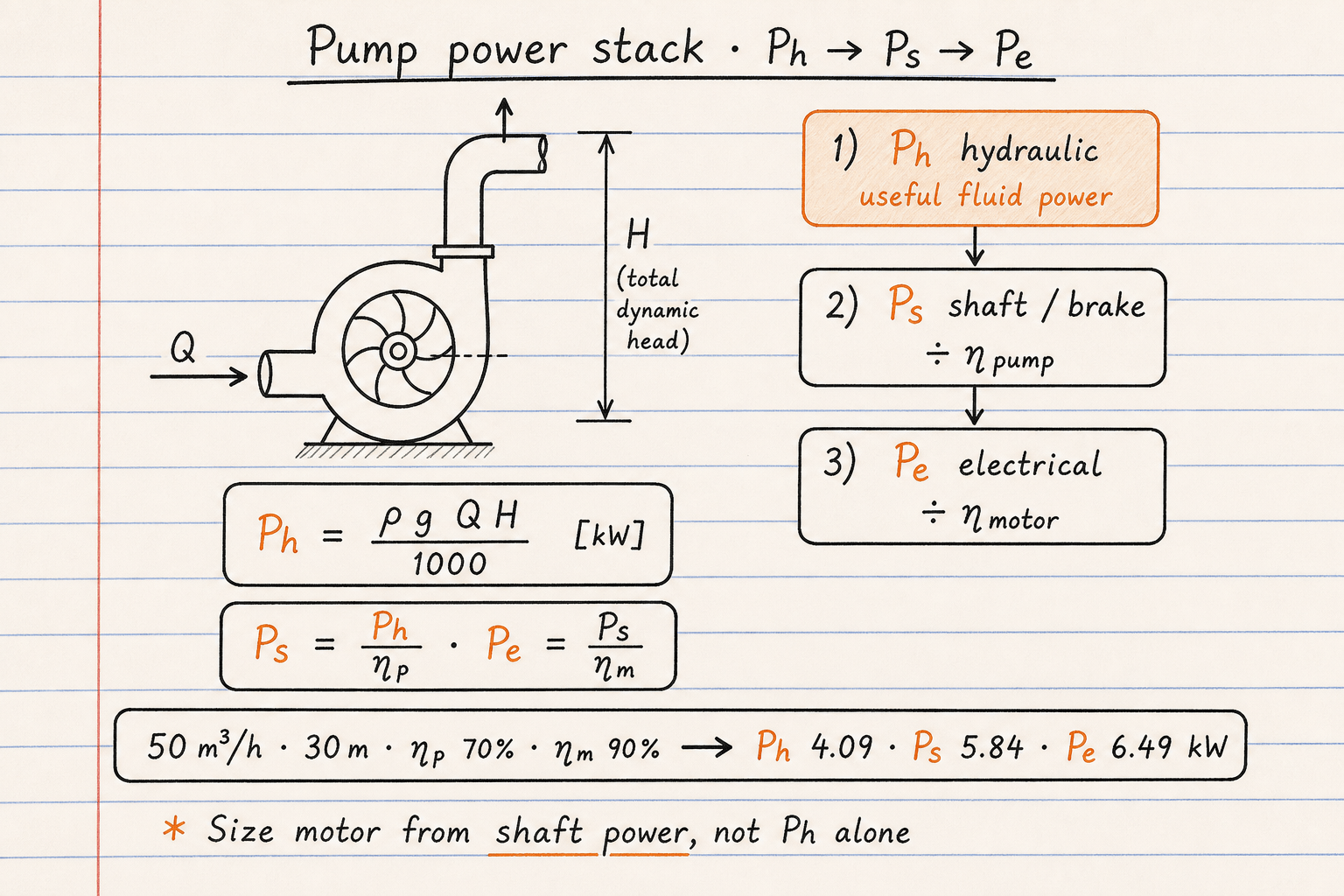
Ph = ρ g Q H / 1000 (kW). Ps = Ph / η_pump. Pe = Ps / η_motor.
Default keep-alive: 50 m³/h · 30 m · ηp 70% · ηm 90% → Ph 4.09 · Ps 5.84 · Pe 6.49 kW.
What to put in total dynamic head
TDH is not static lift alone. Shop teaching (for example Apiste’s pump-types guide) builds total head as suction side plus discharge side: actual suction head and suction piping resistance, plus actual discharge head and discharge piping resistance. Add any required discharge pressure converted to head. Velocity head is usually small in liquid systems but belongs in a careful balance.
Use the pipe flow pressure drop calculator for straight-pipe friction head, then add fittings and static lift by hand before you paste TDH here. Pressure mode is the same physics when you already know Δp across the pump.
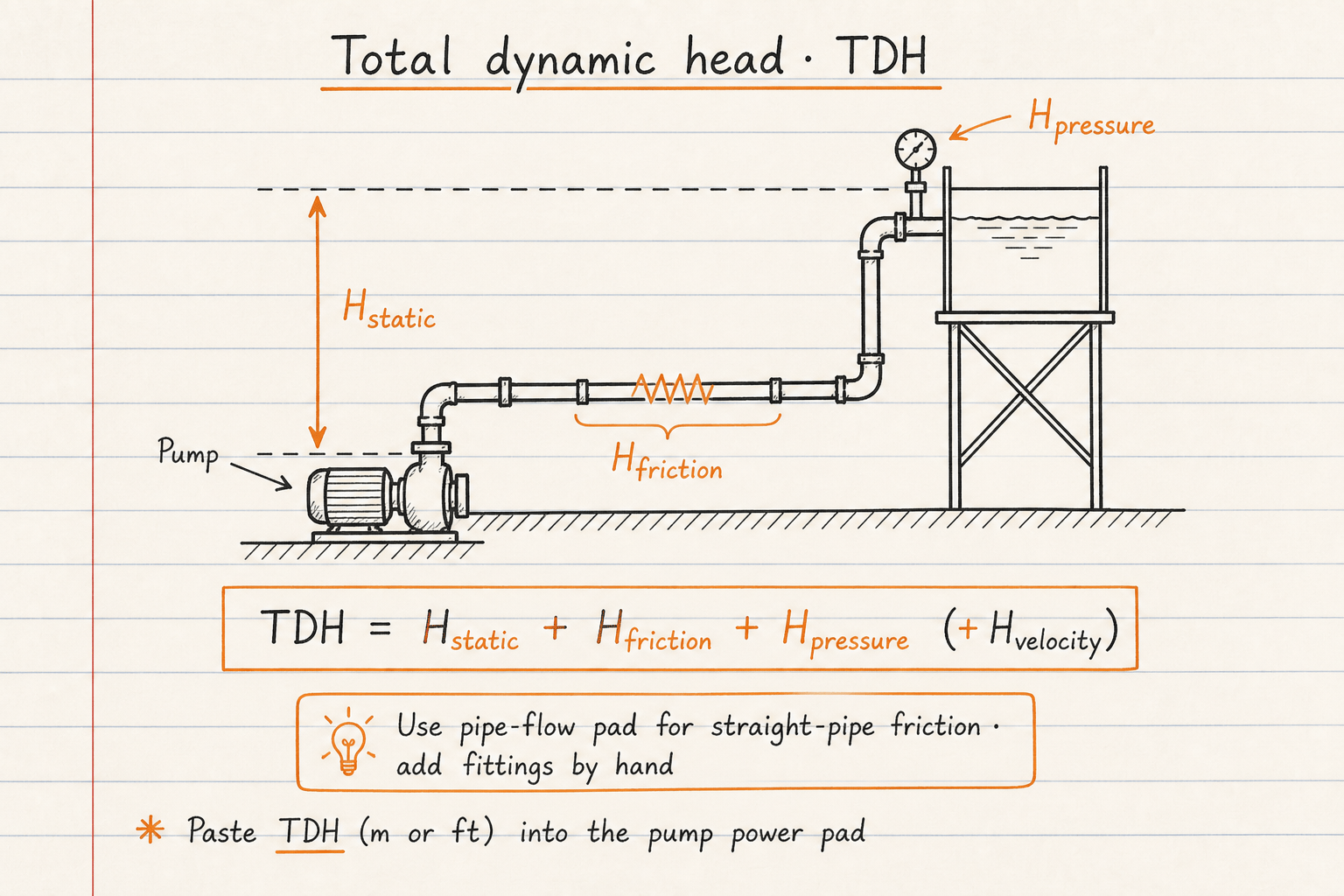
H_total ≈ (H_suction_static + H_suction_pipe) + (H_discharge_static + H_discharge_pipe) (+ pressure/velocity when needed).
Build straight-pipe friction on the pipe-flow pad, then paste the total TDH into this calculator.
Pump types — dynamic vs positive displacement
Pumps split into dynamic (non-positive-displacement / turbo) and positive-displacement families. Dynamic machines — centrifugal, axial-flow, and mixed-flow — add energy with a rotating impeller; flow changes with system head. Positive-displacement machines trap a volume and force it out: rotary types (gear, screw, vane, progressive cavity) and reciprocating types (piston, plunger, diaphragm), plus metering services that demand accurate volume per time.
Oil and gas plants often list centrifugal, reciprocating plunger, progressive cavity, gear, diaphragm, and metering pumps on the same site. At a given speed, many PD pumps deliver nearly constant flow despite system pressure — so a relief valve on the discharge is essential. This pad’s Pump category guide surfaces those tips; power still uses your entered η and Ph = ρgQH. Oil HPU displacement (cc/rev) belongs on the hydraulic pump selector.
API-style motor margin on this pad
Process plants often size pump motors above calculated shaft power so the driver stays cool at off-BEP flow, startup, and fouling. This pad uses a common API 610-style screening band: 125% below 22 kW shaft, 115% from 22 to 55 kW, and 110% above 55 kW.
That is a first-pass recommendation, not a certified selection. Project specs, soft starts, VFD continuous torque, altitude derates, and OEM curves still govern the purchase. Round the recommended kilowatts or horsepower up to the next standard motor rating.
Worked example
Metric default: Centrifugal, 50 m³/h of water against 30 m TDH, pump η = 70%, motor η = 90%.
- Leave Pump category on Centrifugal. Q = 50/3600 = 0.01389 m³/s
- Ph = 1000 × 9.81 × 0.01389 × 30 / 1000 = 4.0875 kW
- Ps = 4.0875 / 0.70 = 5.839 kW (≈ 7.83 HP)
- Pe = 5.839 / 0.90 = 6.488 kW
- Ps < 22 kW → margin 25% → recommended ≈ 7.30 kW (round up to next standard frame)
- Optional: switch category to Gear — Ph stays 4.0875 kW; Results note, Uses, and Applications update for Gear; tip warns about relief valves / hydraulic-selector handoff.
Result: Hydraulic 4.09 kW, shaft 5.84 kW, electrical 6.49 kW, recommended motor about 7.30 kW (Uses/Applications follow the selected category).
When to use
- First-pass centrifugal, axial/mixed, or process PD motor sizing from flow and TDH
- Converting a known pump Δp into hydraulic and shaft power
- Comparing Metric data sheets with Imperial gpm / feet duties
- Checking which pump family tip applies before you buy a motor frame
Limitations
- Steady single-phase liquid only; no gas, slurry, or two-phase flow
- Pump category guide is teaching only — it does not change Ph/Ps/Pe
- Pump efficiency is a user input, not a BEP curve lookup
- No NPSH available/required check or cavitation model
- Motor margin is API-style screening, not a full NEMA/IEC catalog pick
- Does not build system curves or Hazen–Williams pipe networks
- Does not size PD displacement (cc/rev) — use the hydraulic pump selector for oil HPU
FAQ
- What is the difference between hydraulic power and shaft power?
- Hydraulic power is the useful power in the fluid (Ph = ρgQH). Shaft or brake power is Ph divided by pump efficiency, so it is always higher for a real pump. Size the driver from shaft power (plus margin), not from hydraulic power alone.
- Which pump category should I pick?
- Under Dynamic (turbo): Centrifugal for most water/low-viscosity transfer; Multistage / turbine for higher head; Axial-flow or Mixed-flow for high flow at lower head; Cascade / regenerative for small flow at high pressure. Under Positive displacement: Gear, Screw, Vane, Progressive cavity, Plunger / piston, Diaphragm, or Metering — roughly constant flow at speed, so protect the discharge with a relief valve. The category updates tips, the Results sketch, Uses, and Applications only — it does not change Ph = ρgQH. Enter the correct η for your machine.
- What is total head (Apiste-style)?
- Total head is the energy the pump must add, expressed as fluid height. A practical shop form is (actual suction head + suction piping resistance) + (actual discharge head + discharge piping resistance), plus any discharge pressure or velocity head you still need. Paste that sum as TDH here, or use Pressure mode when you already know Δp.
- Why do positive-displacement tips mention relief valves?
- At a given speed, many PD pumps deliver nearly constant flow even if the downstream system pressure rises. Without a relief path, pressure can climb until something fails. That is piping/protection practice — this pad still sizes power from Q, H (or Δp), and η.
- How does this differ from the hydraulic pump selector?
- This pad sizes motors from flow and head (or Δp) for centrifugal and process pumps, including a PD teaching guide. The hydraulic pump selector sizes oil positive-displacement HPU pumps from L/min, bar, and cc/rev. Pick the pad that matches your machine.
- Why recommend 7.30 kW when shaft power is 5.84 kW?
- Below 22 kW shaft, the pad applies a 25% API-style screening margin (5.84 × 1.25 ≈ 7.30 kW). You still round up to the next standard motor frame and check project rules, VFD duty, and the OEM curve.
- Can I check the Engineering Toolbox imperial example?
- Yes. Switch to Imperial, enter 600 gpm, 110 ft head, SG = 1, pump efficiency 60%. CALCULATE returns shaft power about 27.8 HP. That tracks the common US customary BHP = Q·H·SG/(3960·η) check (exact 3960 arithmetic is 27.78 HP; this pad uses SI ρgQH after unit conversion, within about 0.2%).
Pipe Flow Pressure Drop Calculator
Darcy–Weisbach or Hazen–Williams pressure drop with fittings K, elevation, Reynolds number, and friction factor.
Open calculatorHydraulic Pump Selector Calculator
Size a positive-displacement hydraulic pump: drive power, output flow, or required displacement.
Open calculatorReynolds Number Calculator
Reynolds number and flow regime for pipe, duct, flat plate, or sphere — kinematic or dynamic viscosity.
Open calculator