- Kinetic Energy Shed
- n/aWh
- Energy Recovered
- n/akWh
- Range Added
- n/akm
- Share of Pack
- n/a%
You need a first-pass estimate of how much energy an EV or hybrid can put back into the pack when it slows down or descends a grade. This pad takes vehicle mass, regen efficiency, and either a speed change (braking) or an elevation drop (descent), then returns available energy, recovered Wh/kWh, range added from your vehicle Wh per distance, and optional pack share.
Defaults open on a city braking path: 1500 kg, 80→10 km/h, 70% regen, 180 Wh/km, 60 kWh pack. That path sheds about 101.3 Wh of kinetic energy, recovers about 0.071 kWh (70.9 Wh), adds about 0.39 km of range, and is about 0.12% of the pack. Switch to Descent for m·g·h. Metric or Imperial first. Math stays in your browser.
It lives under EV & Renewable Calculators. Size the pack with the EV battery pack sizing calculator, or check traction torque with the motor torque-speed calculator.
Formula
- Braking available energy: ΔKE = ½ m (v₁² − v₂²) with v in m/s (km/h ÷ 3.6 or mph converted).
- Descent available energy: PE = m · g · h with g = 9.80665 m/s².
- Recovered energy = available × (regen % / 100).
- Wh = joules / 3600. kWh = Wh / 1000.
- Range added (km) = recovered Wh ÷ vehicle Wh/km (Imperial converts Wh/mi).
- Pack share % = recovered kWh ÷ pack kWh × 100 (hidden when pack is 0).
Reproduce the default Metric braking path:
| Check | Value on this pad |
|---|---|
| Inputs | 1500 kg, 80→10 km/h, 70% regen, 180 Wh/km, 60 kWh pack |
| ΔKE available | ≈ 101.3 Wh (≈ 364.6 kJ) |
| Recovered | ≈ 0.071 kWh (≈ 70.9 Wh) |
| Range added | ≈ 0.39 km |
| Pack share | ≈ 0.12% |
How it works
Pick Metric or Imperial, then Braking or Descent. Braking uses ΔKE = ½ m (v₁² − v₂²) with speeds in m/s. Descent uses PE = m g h. Recovered energy multiplies by regen efficiency. Range added divides recovered Wh by your vehicle Wh per distance. Optional pack kWh shows the recovery as a percent of the pack. CALCULATE updates the energy sketch. RESET restores the 1500 kg / 80→10 km/h defaults.
Pick Metric (kg, km/h, m, Wh/km) or Imperial (lb, mph, ft, Wh/mi). Choose Braking for a speed drop or Descent for elevation. Enter mass, regen efficiency, vehicle efficiency, and optional pack kWh (0 hides pack share). CALCULATE fills available energy, recovered energy, range, and pack share, and updates the energy sketch. RESET restores 1500 kg / 80→10 km/h / 70% / 180 Wh/km / 60 kWh (or Imperial equivalents) for the unit system you have selected.
Why speed squared dominates city stops
Kinetic energy follows ½ m v². Doubling speed quadruples the energy you must shed. That is why a highway stop returns far more Wh than a neighborhood crawl, even at the same regen efficiency.
On the default path, slowing 80→10 km/h sheds about 101.3 Wh before efficiency. A full stop from 80 km/h would shed a little more. Hard stops still blend friction brakes, so treat η as a round-trip motor + inverter + battery factor, typically about 60–70%.
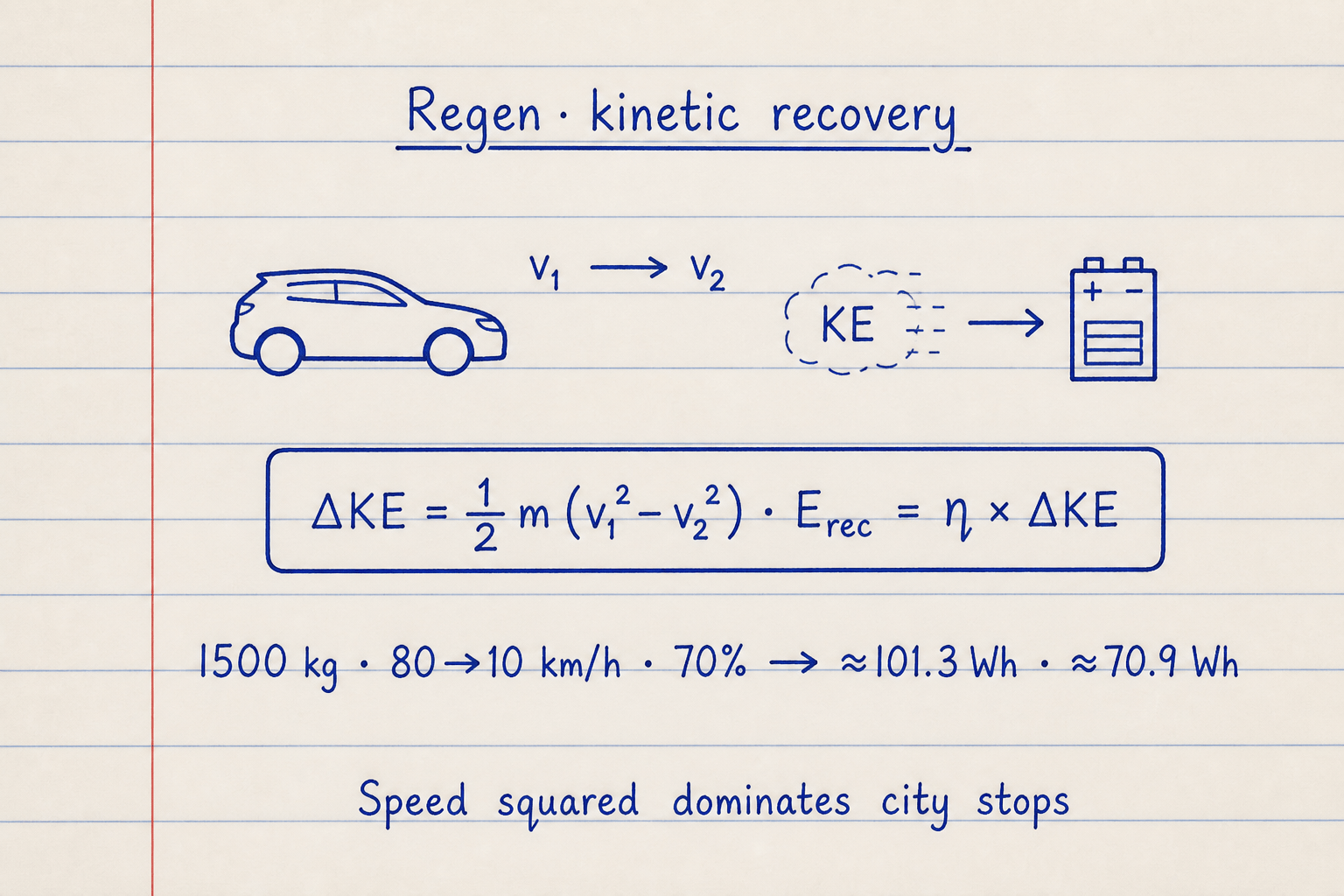
Available energy is ΔKE = ½ m (v1² − v2²). Recovered = η × ΔKE.
Default CALCULATE: 1500 kg · 80→10 km/h · 70% → ≈101.3 Wh available · ≈70.9 Wh recovered.
Descent mode uses potential energy
On a grade, the vehicle gives up gravitational potential PE = m g h. Regen can capture a share of that drop even if road speed stays roughly constant. Long mountain descents often recover more Wh than a single city stop.
That is the same split used by dual-mode regen tools that separate braking from downhill recovery. Regenerative braking still cannot create net energy on flat ground. Climbing spent the PE you later recover on the way down.
- Switch the Descent tab and enter elevation drop
- Default elevation sample is 300 m (about 984 ft)
- At 1800 kg, 300 m, 65% η → about 0.96 kWh recovered
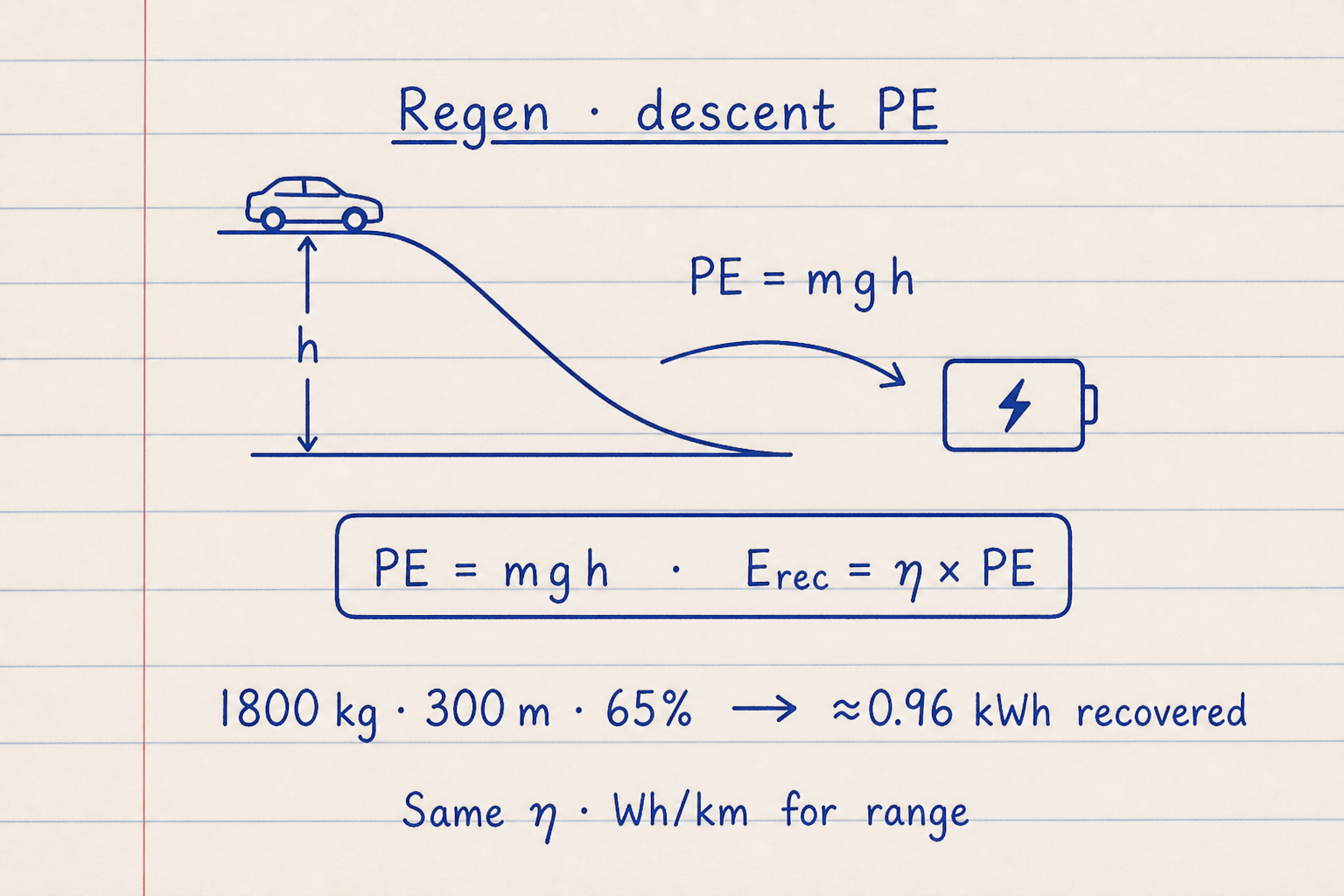
Descent available energy is PE = m g h, not a speed change. Recovered = η × PE.
Sample: 1800 kg · 300 m · 65% → ≈0.96 kWh recovered. Same Wh/km turns that into range.
Range added needs your Wh/km, not a fixed 5 km/kWh
Older pads multiplied recovered kWh by a fixed 5 km/kWh (200 Wh/km). That hid real vehicle efficiency. This pad divides recovered Wh by the Wh/km (or Wh/mi) you enter, matching the same efficiency language as the pack sizing tool.
Optional pack capacity shows how small one event is against a full charge. A 0.071 kWh recovery on a 60 kWh pack is about 0.12%. Regen pays off across hundreds of events, not one stop.
Worked example
1500 kg, 80→10 km/h, 70% regen, 180 Wh/km, 60 kWh pack (Braking, Metric).
- v₁ = 80/3.6 ≈ 22.22 m/s, v₂ = 10/3.6 ≈ 2.78 m/s.
- ΔKE = ½ × 1500 × (22.22² − 2.78²) ≈ 364.6 kJ ≈ 101.3 Wh.
- Recovered = 101.3 × 0.70 ≈ 70.9 Wh = 0.071 kWh.
- Range = 70.9 / 180 ≈ 0.39 km. Pack share = 0.071/60 ≈ 0.12%.
Result: ≈ 0.071 kWh recovered, ≈ 0.39 km range, ≈ 0.12% of a 60 kWh pack.
When to use
- Estimating Wh returned from a speed drop or stop
- Screening downhill regen on a known elevation
- Comparing regen efficiency assumptions (60–70%)
- Turning recovered Wh into range with your vehicle Wh/km
Limitations
- No aerodynamic drag, rolling resistance, or rotational inertia
- No blend with friction brakes or ABS limits at low speed
- Battery cannot accept regen when full; SOC limit not modeled
- Single event only, not a full drive-cycle sum
- Not a substitute for OEM regen maps or dyno data
FAQ
- What regen efficiency should I enter?
- Use 60–70% for a typical round-trip motor, inverter, and battery path. Hard stops and cold packs land lower. Idealized classroom checks sometimes use 100%, which this pad allows but real cars do not achieve.
- Why is final speed not always zero?
- Many events are slowdowns, not full stops. Enter the speed after the brake event. Leave final speed at 0 for a stop to standstill.
- When do I use Descent instead of Braking?
- Use Descent when elevation drop drives the energy and speed is roughly steady. Use Braking when the energy comes from a speed change on level ground. Do not add both for the same event unless you intentionally split a complex maneuver.
- How is range added calculated?
- Range (km) = recovered Wh ÷ vehicle Wh/km. Imperial mode uses Wh/mi and reports miles. Match the efficiency you use on the pack sizing pad for consistent first-pass math.
- Why is pack share so small?
- One stop returns tens of Wh. A traction pack holds tens of kWh. City regen wins through many events. Set pack capacity to 0 if you only want energy and range cards.
- Can regen fully recharge the battery?
- No on flat ground. You only recover a fraction of energy you already spent accelerating or climbing. Long descents can add a few percent to the pack, but less than the climb cost.
- What if initial and final speed are equal?
- Available kinetic energy is zero, so recovered energy and range are zero. Use Descent mode if the energy comes from elevation instead of a speed change.
EV Battery Pack Sizing Calculator
Usable and installed pack energy, Ns×Np cell layout, pack Ah, and discharge power from range, efficiency, and cell specs.
Open calculatorMotor Torque-Speed and Efficiency Calculator
EV torque-speed curve or point convert with the 9550 rule, electrical input, and optional DC current. Metric or Imperial.
Open calculator