You need a clear factor of safety before you accept a stress number, size material from a design factor, or explain margin to a non-engineer. This pad computes FoS = strength ÷ applied stress (or load), stress utilization, residual capacity, and a Pass / Marginal / Fail status. Use yield or ultimate tensile strength, optional material presets, and three solve modes.
Defaults open on FoS from strength & stress: mild-steel yield ≈ 250 MPa, applied 80 MPa. CALCULATE returns FoS = 3.125, utilization 32%, residual 170 MPa, and Pass. Switch to Required strength from FoS when you know the design factor and load, or Allowable stress from FoS when you know capacity and target FoS. Math stays in your browser.
It sits under Mechanical Calculators next to the beam stress calculator and bolt torque calculator. Bearing static safety factor (fs = C₀ / P) belongs on the bearing life calculator — that is a different job.
Formula
- Factor of safety: FoS = strength ÷ applied stress (or capacity ÷ load). Same units on both.
- Utilization (%) = (applied ÷ strength) × 100. Residual strength = strength − applied.
- Required strength mode: strength = target FoS × applied stress.
- Allowable stress mode: applied = strength ÷ target FoS.
- Strength basis: Yield (Sy) for ductile screening, or Ultimate tensile (Sut) when you intentionally use ultimate.
- Status on this pad: Fail FoS < 1.0 · Marginal 1.0 ≤ FoS ≤ 1.5 · Pass FoS > 1.5 (screening guide, not a code).
Reproduce the default FoS from strength & stress path on CALCULATE:
| Quantity | Value |
|---|---|
| Material / basis | Mild steel · Yield Sy ≈ 250 MPa |
| Applied stress | 80 MPa |
| FoS | 3.125 |
| Utilization | 32% |
| Status | Pass |
How it works
Pick FoS from strength & stress, required strength from a target FoS, or allowable stress from capacity. Use yield or ultimate strength with optional material presets. Status is Fail below 1, Marginal to 1.5, Pass above 1.5.
Pick Input mode: FoS from strength & stress (default), Required strength from FoS, or Allowable stress from FoS. Modes 0 and 2 show material preset, Yield/Ultimate basis, and Sy/Sut (edit Sy/Sut to jump to Custom). Mode 1 only needs applied stress and target FoS — material fields are hidden. CALCULATE fills Results and updates the live strength-vs-load sketch (Play/Pause). Editing a field clears Results. RESET restores mild-steel 250 / 80 MPa defaults.
FoS is strength over load — units must match
Factor of safety is maximum strength (or capacity) divided by design load. The same ratio works for stresses: FoS = maximum stress ÷ working stress.
Shop charts emphasize the same rule: keep load and capacity in identical units. Mixing kN with MPa makes the ratio meaningless. On this pad both fields are stress in MPa; if your data is force, convert to stress first or use consistent force units offline and treat the ratio the same way.
Same FoS idea, three solve directions:
| Mode | Known | Solved |
|---|---|---|
| FoS from strength & stress | Sy or Sut, applied σ | FoS, util %, status |
| Required strength from FoS | Target FoS, applied σ | Required strength |
| Allowable stress from FoS | Sy or Sut, target FoS | Allowable applied σ |
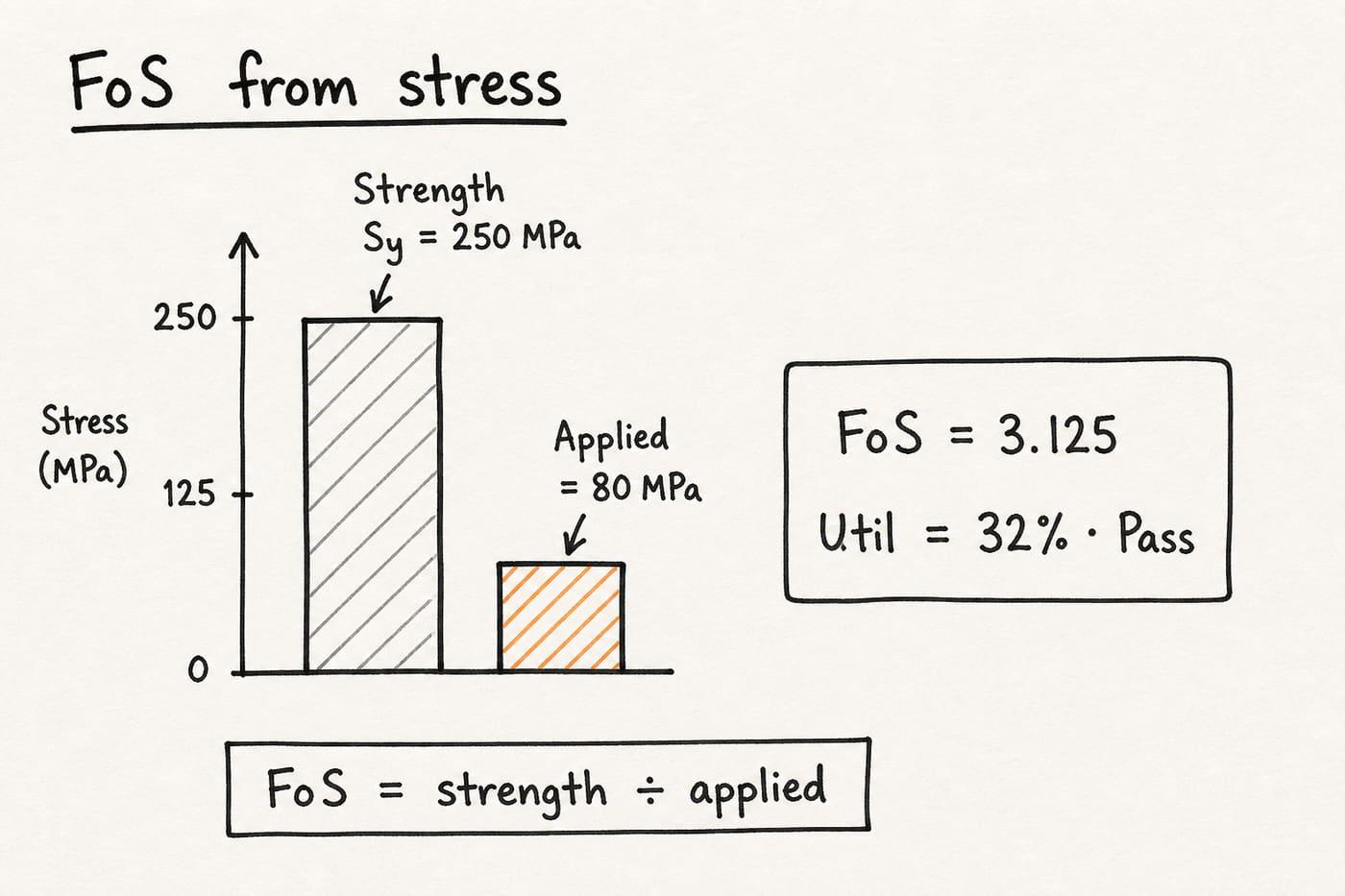
Default CALCULATE path: 250 ÷ 80 = 3.125 FoS at 32% utilization (Pass).
FoS = 1 means you are at the strength limit with no margin; FoS < 1 means the applied value already exceeds capacity.
Yield vs ultimate — pick the strength you mean
You can use yield (Sy) or ultimate tensile (Sut) as the maximum stress, often with material presets. Ductile machine parts usually screen against yield. Brittle materials and some rough comparisons use ultimate — but ultimate FoS is not the same as code allowable stress.
On this pad, Strength basis chooses Sy or Sut. Material presets fill both numbers (mild steel, 6061-T6, 304, 4140, Ti-6Al-4V). Example: same 80 MPa applied on mild steel Sut ≈ 400 MPa gives FoS = 5.0 — a larger number that is not automatically “safer” for ductile design if your standard is yield-based.
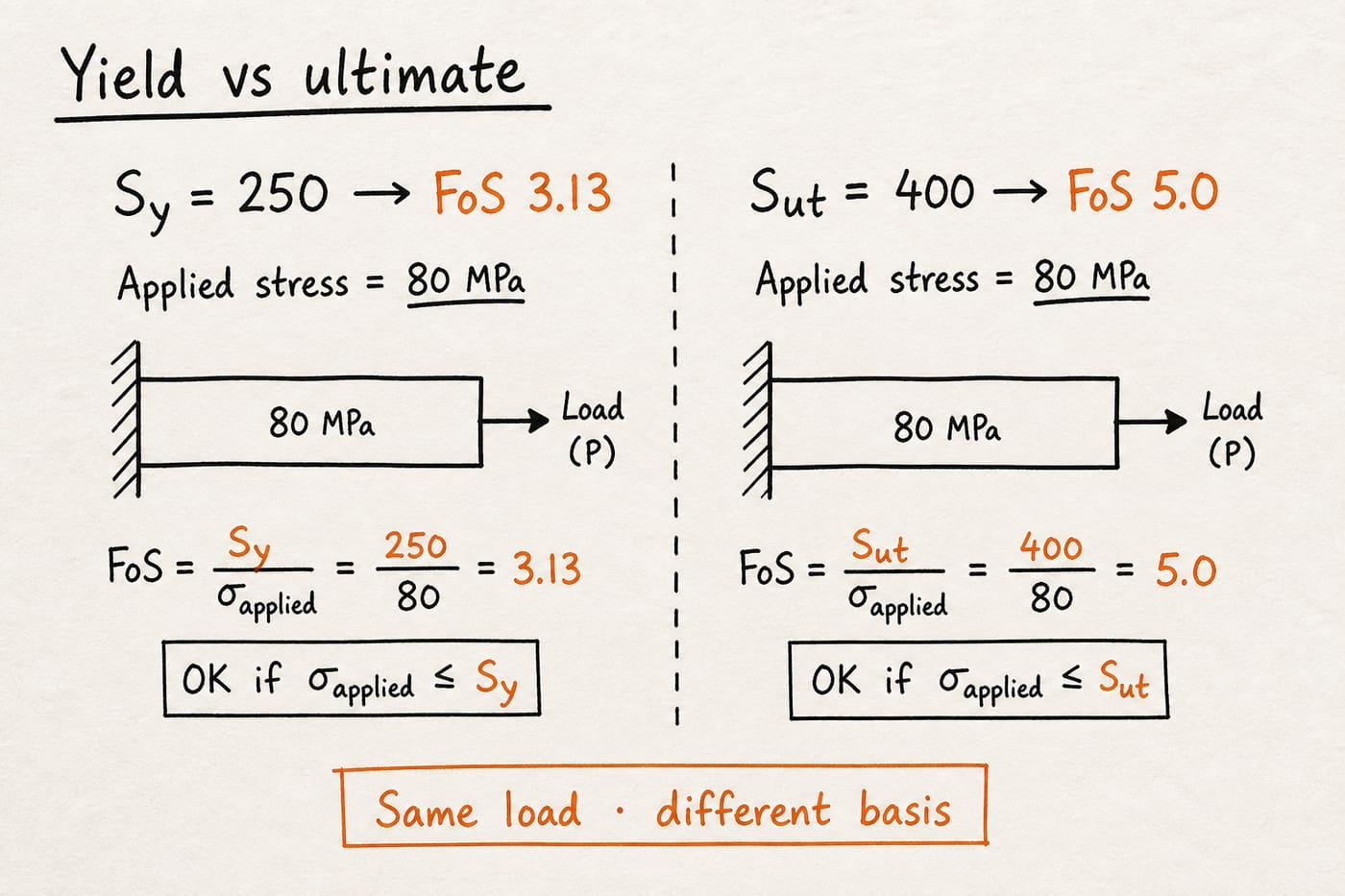
Yield path (Sy 250) → FoS ≈ 3.13. Ultimate path (Sut 400) → FoS = 5.0 for the same applied stress.
Label which basis you used when you report FoS to a reviewer or customer.
Design factor solve: required strength or allowable stress
The same equation rearranges both ways. Required strength = FoS × applied. Allowable applied = strength ÷ FoS. That matches early sizing: pick a design factor (often 1.5–2 for static ductile, higher for dynamic or impact), then find the material strength or working stress you need.
Example examples on this pad: target FoS = 2 with 80 MPa applied → required strength 160 MPa. Or Sy = 250 MPa with target FoS = 2 → allowable applied 125 MPa. These are screening numbers — project codes, fatigue, buckling, and stress concentrations still apply.
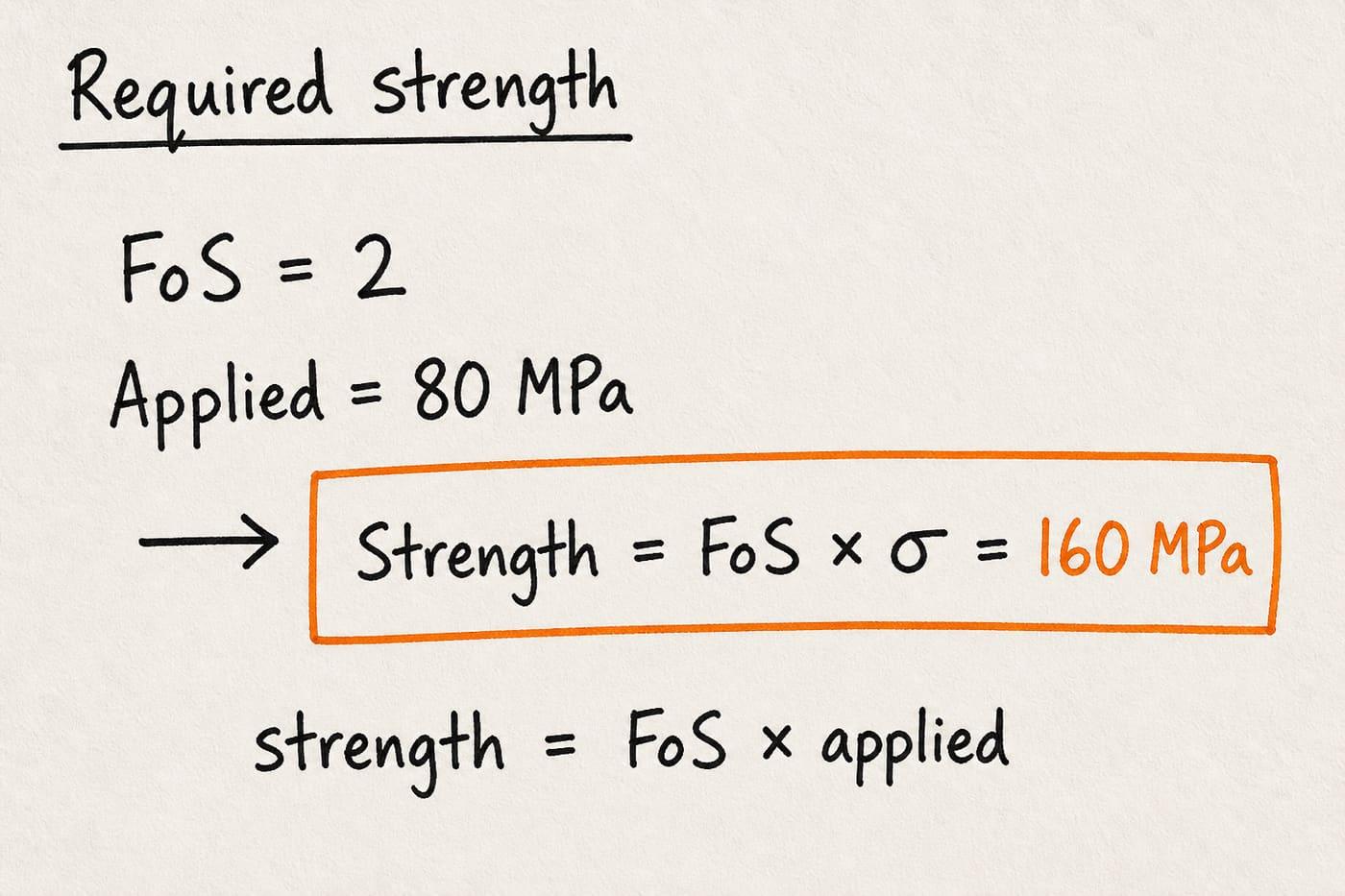
Required-strength mode: strength = 2 × 80 = 160 MPa.
Use Allowable stress mode when capacity is known and you need the working stress that keeps the target FoS.
Not a bearing life or static safety modulus tool
Bearing life tools compute rating life and a static safety factor fs = C₀r / P (basic static load rating over equivalent load). Typical guidance is about 1.0 for normal operation, 1.5 with shock, and 2.0+ for quiet high-accuracy rotation.
That is a catalog bearing check, not uniaxial material FoS. Use this pad for strength ÷ stress screening. Use the bearing life calculator for L10 / static fs style selection.
Typical FoS targets (guidance only — follow your code):
| Application | Typical FoS (yield-based) |
|---|---|
| Static ductile | 1.5 – 2.0 |
| Dynamic / fatigue | 2.0 – 4.0 |
| Impact | 3.0 – 6.0 |
| Brittle materials | Often based on ultimate + code rules |
Worked example
Default FoS from strength & stress: mild steel Sy ≈ 250 MPa, applied 80 MPa. Reproduce on CALCULATE.
- Leave Input mode on FoS from strength & stress. Material Mild steel, Strength basis Yield.
- Confirm applied stress 80 MPa. CALCULATE.
- FoS = 250 ÷ 80 = 3.125. Utilization = 32%. Status Pass.
- Ultimate example: same material, basis Ultimate → FoS = 400 ÷ 80 = 5.0.
- Required-strength example: mode Required strength, FoS 2, applied 80 → strength 160 MPa.
- Allowable example: mode Allowable stress, Sy 250, FoS 2 → applied 125 MPa.
Result: Default: FoS 3.125 · 32% util · Pass. Ultimate same load: FoS 5.0. Required Sy for FoS 2 at 80 MPa: 160 MPa.
When to use
- Quick margin check during preliminary design or a design review
- Explaining FoS to a buyer or student with a single clear ratio
- Sizing required material strength from a known design factor
- Finding allowable working stress from capacity and target FoS
- Comparing yield-based vs ultimate-based FoS on the same load
Limitations
- Uniaxial (or single equivalent) stress only — no Kt, FEA, or multi-axial theory built in.
- Static screening assumed unless you choose a higher target FoS yourself.
- Material presets are approximate room-temperature values, not certified mill data.
- Not code allowable-stress design (ASME, AISC, EN, etc.).
- Not bearing L10 life or fs = C₀ / P (use the bearing life calculator).
- Does not check fatigue, buckling, corrosion, or temperature knockdowns.
FAQ
- What is a good factor of safety?
- It depends on load uncertainty and failure consequences. Static ductile parts often target about 1.5–2.0 on yield. Dynamic, impact, or life-critical structures need higher margins or a formal code. There is no universal “good” number.
- What does Fail / Marginal / Pass mean here?
- Fail is FoS below 1.0 (applied exceeds strength). Marginal is 1.0 through 1.5 inclusive. Pass is above 1.5. Those bands are a screening aid on this pad — your drawing or standard may require something different.
- Yield vs ultimate strength?
- Yield is the usual ductile screen. Ultimate gives a larger FoS for the same load and is not the same as allowable design stress. Choose the basis that matches how you will report the result.
- Can I solve for strength or working stress?
- Yes. Required strength mode uses strength = FoS × applied. Allowable stress mode uses applied = strength ÷ FoS.
- Is this the same as a bearing safety factor?
- No. Bearing static safety factor is usually fs = C₀ / P from catalog ratings. Use the bearing life calculator for that. This pad is material or capacity FoS from strength ÷ stress.
- Do load and capacity need the same units?
- Yes. FoS is a ratio. On this pad both sides are MPa. Offline, kN/kN or ton/ton is fine as long as they match.
Beam Stress and Deflection Calculator
Six textbook beam cases: max moment, shear, stress, deflection, slope, and L/360 check with animated 2D sketches.
Open calculatorBolt Torque Calculator
Tightening torque or clamp load from T = K × F × d. Metric sizes, property class % proof, and reverse torque mode.
Open calculatorBearing Life (L10) Calculator
ISO 281 L10 and adjusted Lnm life from C, P, speed, and reliability factors a1/a2/a3.
Open calculator