A screw jack turns handle rotation into a much larger lifting force. Thread incline, thread friction, and optional collar drag all eat torque before any of it lifts the load. This pad returns raising and lowering torque, handle effort, efficiency, mechanical advantage, and whether the jack self-locks.
Defaults open on Metric square thread with no collar: dm = 50 mm, lead = 10 mm, μ = 0.12, W = 10 kN, L = 300 mm. Results cards show dashes until you click CALCULATE. That path returns efficiency ≈ 34.4%, raise torque ≈ 46.3 N·m, handle force ≈ 154 N, and Self-locking = Yes. Math stays in your browser.
It sits under Mechanical Calculators. For fastener clamp from torque, use the bolt torque calculator. For a first strength screen on the screw itself, see the safety factor calculator.
Formula
- Lead angle: tan λ = lead / (π × dm). Friction angle: φ = atan(μ′), with μ′ = μ / cos(α).
- Thread half-angle α: Square 0°, Acme 14.5° (29° included), Metric trapezoidal 15° (30° included).
- Thread torque to raise: T_screw = W × (dm/2) × (μ′ + tan λ) / (1 − μ′ tan λ).
- Collar torque: T_collar = W × (dc/2) × μc. Total raise: T_raise = T_screw + T_collar.
- Handle force: F = T_raise / L. Ideal (frictionless) force: F_ideal = (W × lead) / (2π × L).
- Lowering: T_lower = W × (dm/2) × (μ′ − tan λ) / (1 + μ′ tan λ) + T_collar.
- Efficiency: η = (W × lead) / (2π × T_raise) × 100%. Mechanical advantage: MA = W / F.
- Self-locking when T_lower > 0 (equivalently φ > λ on the thread when collar is zero).
Reproduce the default Metric square-thread path (no collar):
| Check | Value on this pad |
|---|---|
| Inputs | dm 50 mm · lead 10 mm · μ 0.12 · W 10 kN · L 300 mm |
| λ / φ | ≈ 3.64° · ≈ 6.84° |
| T_raise / F | ≈ 46.27 N·m · ≈ 154 N |
| Efficiency / MA | ≈ 34.4% · ≈ 64.8 |
| Self-locking | Yes (T_lower > 0) |
How it works
Lead angle from lead and mean diameter. Effective friction includes thread flank angle. Raising and lowering torque split thread incline vs optional collar drag. Efficiency is useful lifting work over one turn divided by handle work. Self-locking when lowering torque stays positive.
Pick Metric or Imperial inside Inputs. Choose Square, Acme, or Metric trapezoidal for the flank half-angle. Enter load, mean diameter, lead, thread friction, handle length, and optional collar fields. Results cards stay visible with dashes until you click CALCULATE. The diagram previews λ and φ as you edit. RESET restores defaults for the active unit system.
Torque balance: thread plus collar
Raising torque has two parts. The thread term fights both the lead incline and sliding friction on the flanks. The collar term is flat bearing drag under the screw head or thrust face. Machine-design texts write T_screw with μ′ and tan λ, then add T_collar = W·(dc/2)·μc.
On this pad, leave dc and μc at 0 for a thread-only screen (common for preliminary checks and square-thread examples). When a real jack has a thrust collar or dry bearing face, collar drag often takes 30 to 40% of total torque. Do not ignore it for handle sizing.
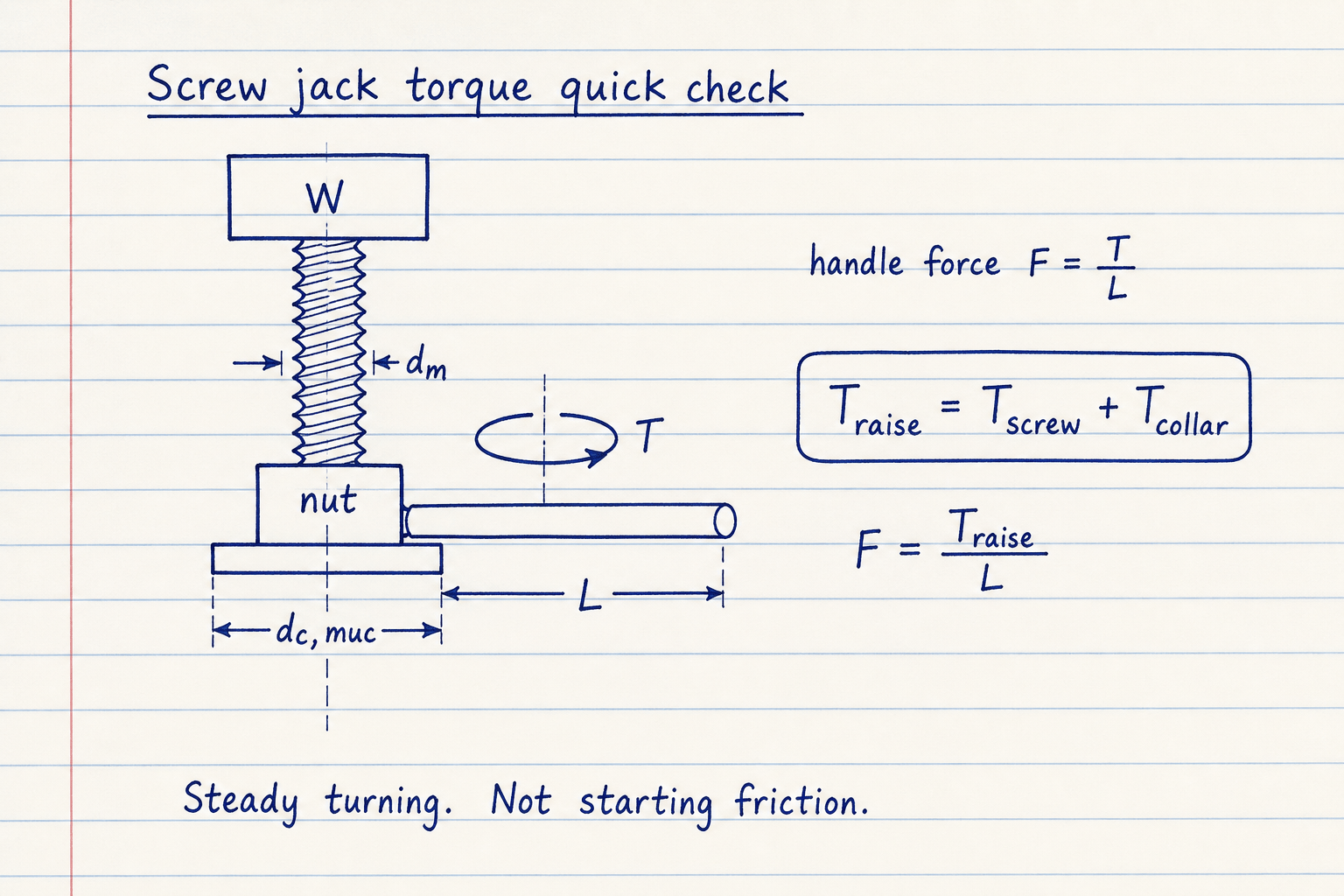
Handle force is total raising torque divided by lever length. Longer handles cut effort linearly but do not change efficiency or self-locking.
Useful work per turn is W × lead. Input work is 2π × T_raise. Their ratio is efficiency.
Self-locking when φ beats λ
Self-locking means the load cannot spin the screw backward on its own. On the thread that is φ > λ (friction angle greater than lead angle). Equivalently, lowering torque stays positive, so you still need to turn the handle to lower the load. The square-thread check μ·π·dm > lead is the small-angle form of the same idea.
If T_lower comes out negative, the jack backdrives and needs a brake or ratchet for safe holding. Near-zero margins are unreliable: wear, oil, or a hotter day can flip the sign. Treat borderline cases as not self-locking for design.
Worked square-thread check (no collar):
| Input / result | Value |
|---|---|
| W / dm / lead / μ | 5000 N · 20 mm · 4 mm · 0.15 |
| T_raise | ≈ 10.79 N·m |
| Efficiency (this pad) | ≈ 29.5% work-based |
| Self-locking | Yes (μ·π·dm > lead) |
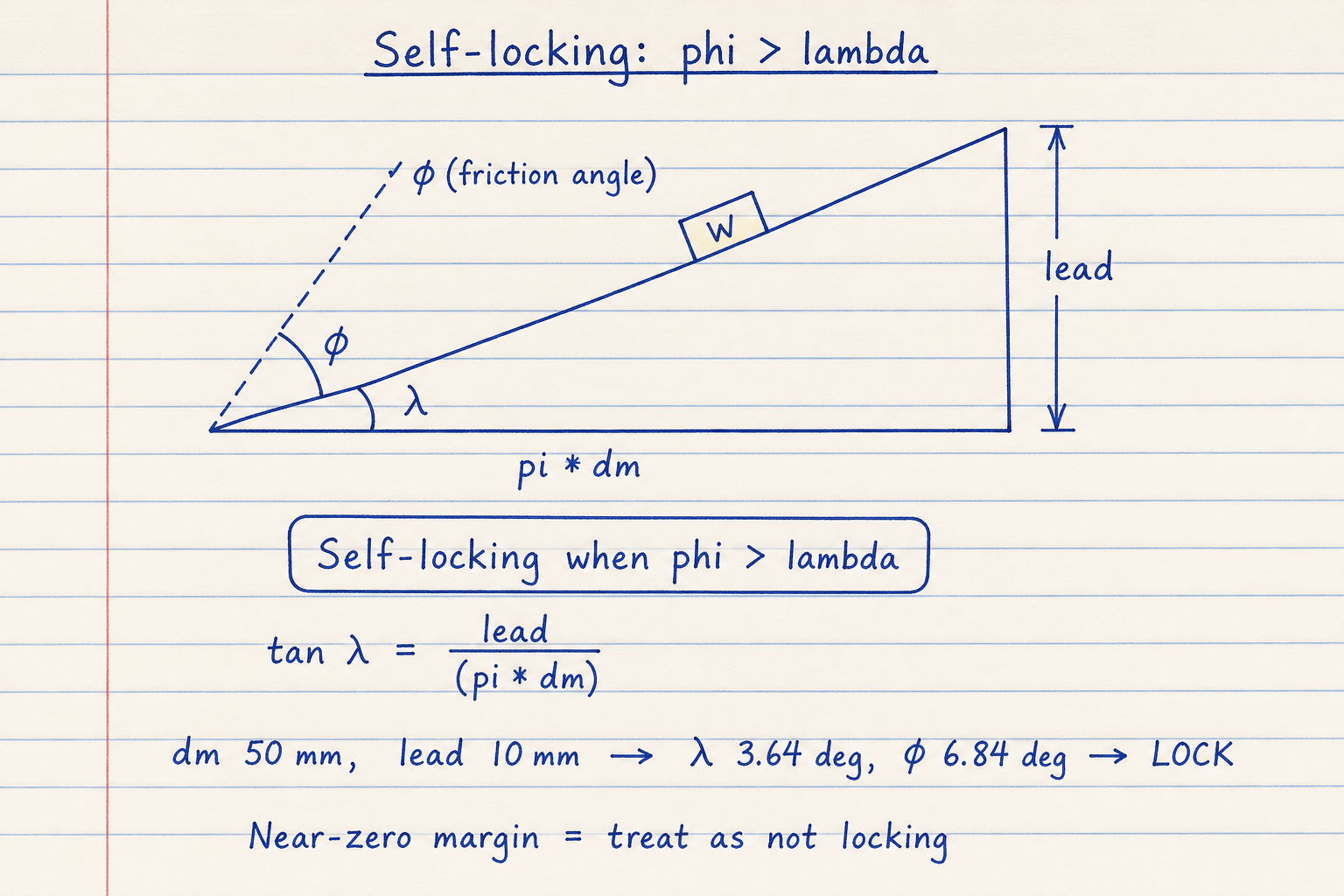
Finer leads shrink λ and favor locking, at the cost of more turns and usually lower efficiency.
Lubrication lowers μ and φ. That cuts handle effort, but holding without a brake gets worse.
Square, Acme, and trapezoidal μ′
Square threads keep μ′ = μ (half-angle α = 0). Acme (29° included, α = 14.5°) and metric trapezoidal (30°, α = 15°) raise effective friction to μ′ = μ / cos(α). For the same entered μ, an Acme jack needs slightly more handle force than a square jack (about 3% higher μ′ at μ = 0.15).
This pad is for sliding-friction power screws (Acme / trapezoidal / square). Ball screws use rolling contact and often 85–95% efficiency; they usually backdrive and need a separate holding brake. Do not use these formulas for ball-screw sizing.
- Efficiency in the 10–30% band is normal for a locking jack, not a defect
- Apply a torque safety factor of about 2–4 for handle and drive sizing
- Starting friction and shock loads sit outside this steady-turning model
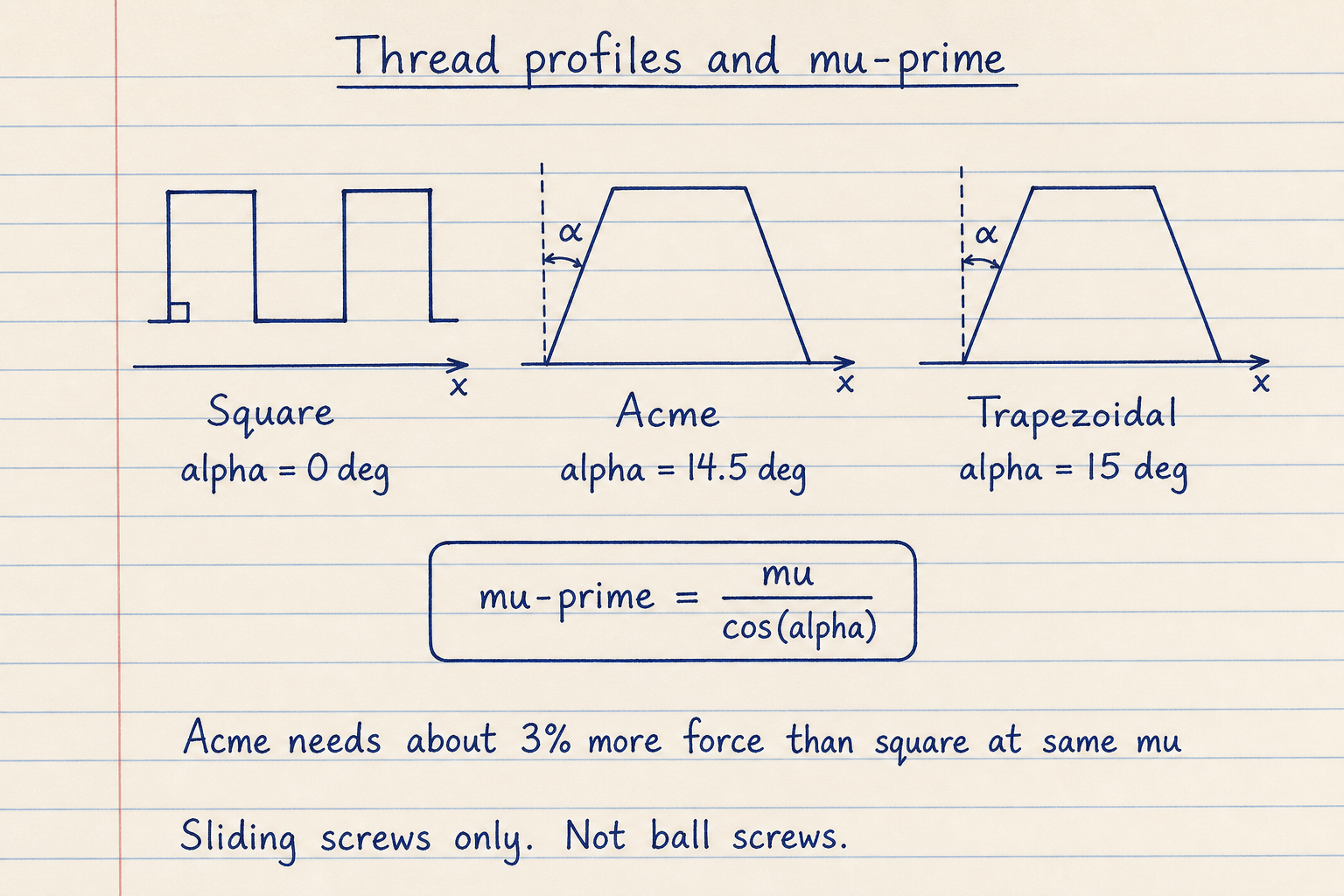
Pick the profile that matches your screw. The pad sets α from the dropdown; you do not enter half-angle by hand.
Typical dry steel-on-steel μ is 0.15–0.25; lubricated bronze-on-steel is often 0.08–0.15. When unsure, use the higher μ for torque and re-check locking with a lower μ.
Worked example
Imperial square-thread check on this UI: switch to Imperial, Square thread, W = 5000 lbf, lead = 0.25 in, dm = 1.5 in, μ = 0.15, dc = 2.0 in, μc = 0.10, L = 20 in, then CALCULATE.
- μ′ = 0.15 (square). tan λ = 0.25 / (π × 1.5) = 0.0531.
- T_screw = 5000 × 0.75 × (0.15 + 0.0531) / (1 − 0.15 × 0.0531) = 767.55 in·lbf.
- T_collar = 5000 × 1.0 × 0.10 = 500 in·lbf. T_raise = 1267.55 in·lbf (105.63 ft·lbf).
- Handle force F = 1267.55 / 20 = 63.38 lbf. η = 15.70%. Self-locking: Yes.
Result: Handle force 63.4 lbf, efficiency 15.7%, self-locking with 43.0 lbf to lower.
When to use
- Sizing hand-wheel or motor torque for a screw jack lift
- Checking whether a jack holds load without a separate brake
- Comparing square vs Acme / trapezoidal effort for the same μ
- Estimating how much collar or thrust-bearing drag adds to handle force
Limitations
- Steady turning model. Not starting friction, impact, or buckling of the screw
- Sliding-friction power screws only; not ball screws or roller screws
- Does not rate screw/nut materials, wear life, or structural capacity of the frame
- Multiple-start leads: enter the true lead (starts × pitch), not pitch alone
FAQ
- Do I need to click CALCULATE?
- Yes. Results cards stay on dashes until CALCULATE. Editing any input clears the locked result so you recalculate. The diagram can still preview lead and friction angles while you edit.
- When is a screw jack self-locking?
- When lowering torque is positive, or equivalently when the friction angle exceeds the lead angle (φ > λ). The load cannot back-drive the screw; you still need torque to lower it. Near-zero margins should be treated as not locking.
- Why does Acme need more handle force than square for the same μ?
- Acme has a 14.5° half-angle, so μ′ = μ / cos(14.5°) is about 3.3% higher than the entered μ. That higher effective friction carries straight through into raising torque and handle force.
- How much does collar friction matter?
- Collar torque is W × (dc/2) × μc and adds the same amount to raise and lower. In the 5000 lbf worked example it is 500 of 1268 in·lbf total (about 40%). It does not change the lead angle, but it does change handle force and efficiency.
- What efficiency should I expect?
- Roughly 10–30% is typical for a lubricated general-purpose jack. Low efficiency is the same friction that provides self-locking. If you need high efficiency and speed, look at ball screws or actuators and plan a holding brake.
- What friction coefficient should I use?
- Dry steel-on-steel is often 0.15–0.25. Lubricated bronze-on-steel is often 0.08–0.15. Be conservative (higher μ) for torque sizing, then re-check self-locking with a lower μ for the worst holding case.
- Can I use this for ball screws?
- No. These formulas assume sliding flank friction. Ball screws roll, run much higher efficiency, and usually backdrive. Use manufacturer torque charts or a ball-screw-specific tool instead.
Mohr's Circle Calculator
Plane-stress principals, max shear, principal angle, stress transformation, and von Mises from σx, σy, τxy.
Open calculatorVibration Natural Frequency Calculator
SDOF natural frequency from spring-mass, static sag, or pendulum, with damping and resonance check.
Open calculatorSafety Factor Calculator
Factor of safety from strength ÷ stress. Yield or ultimate basis, material presets, and reverse solve modes.
Open calculator