- Optimal Tilt (selected)
- n/a°
- Year-Round Fixed
- n/a°
- Winter Tilt
- n/a°
- Summer Tilt
- n/a°
- Facing Azimuth
- n/a°
You need a first-pass tilt angle before you order a rack or argue with a roof pitch. This pad takes signed site latitude and returns year-round fixed tilt, winter and summer seasonal tilts, and a facing azimuth (true south or true north). Mid-latitudes use the Landau forms that beat the old latitude ±15° rule by a few percent.
Defaults open on Delhi at 28.61°N, year-round. That path gives about 24.8° fixed, 44.2° winter, 5.6° summer, and 180° facing (true south). Pick Winter or Summer when the mount can be adjusted twice a year. Math stays in your browser.
It lives under EV & Renewable Calculators. Size storage with the EV battery pack sizing calculator, or screen a rotor with the wind turbine TSR calculator.
Formula
- Use |φ| (absolute latitude). Signed input only sets hemisphere for facing.
- Fixed: |φ| < 25° → |φ| × 0.87; 25–50° → |φ| × 0.76 + 3.1° (Landau); |φ| > 50° → same mid-lat form as a screening estimate.
- Winter / summer, 25°–50°: β_w = |φ| × 0.875 + 19.2° · β_s = max(0, |φ| × 0.93 − 21°).
- Outside 25°–50° seasons: β_w = min(90, |φ| + 15°) · β_s = max(0, |φ| − 15°).
- Facing: 180° true south (φ ≥ 0) or 0° true north (φ < 0).
Reproduce the default Delhi year-round path:
| Check | Value on this pad |
|---|---|
| Inputs | 28.61°N, Year-round |
| Optimal (selected) | ≈ 24.8° |
| Fixed / winter / summer | ≈ 24.8° / ≈ 44.2° / ≈ 5.6° |
| Facing azimuth | 180° (true south) |
How it works
Enter site latitude (+N / −S) and pick Year-round, Winter, or Summer. Mid-latitudes (25–50°) use Landau fixed tilt |φ|×0.76+3.1°, winter |φ|×0.875+19.2°, and summer |φ|×0.93−21°. Below 25° uses |φ|×0.87 fixed with ±15° seasons. Above 50° extends the mid-lat fixed form and uses ±15° seasons. Facing is true south (180°) in the Northern Hemisphere and true north (0°) in the Southern. CALCULATE updates the sketch. RESET restores 28.61° year-round.
Enter latitude in decimal degrees (+ north, − south). Choose Year-round, Winter, or Summer. Optional city chips (Delhi, Denver, Sydney, Singapore) fill common sites. CALCULATE fills optimal tilt for the selected season, plus fixed / winter / summer cards and facing azimuth, and updates the side-view sketch. Changing season or latitude clears results until you CALCULATE again. RESET restores 28.61° year-round.
Tilt from horizontal, not from the wall
Tilt β is the angle between the panel face and the ground. Flat is 0°. Vertical is 90°. A year-round fixed rack aims for the sun’s average height at your latitude so annual energy stays high without seasonal visits.
The mid-latitude fixed form β = |φ| × 0.76 + 3.1° (Landau) outperforms a plain tilt-equals-latitude rule for annual yield by a few percent.
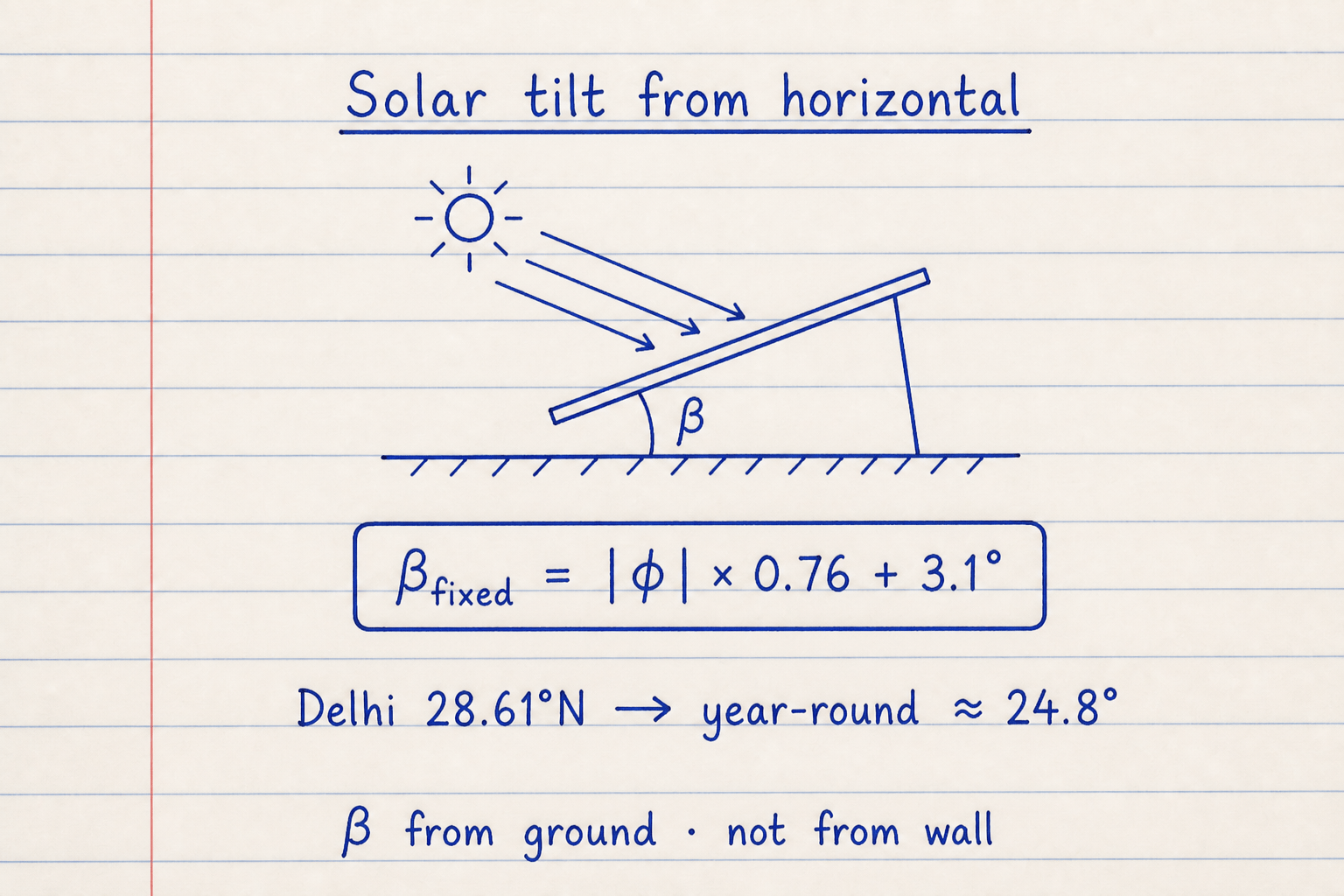
β is measured from horizontal (ground), not from a wall. Fixed β ≈ |φ| × 0.76 + 3.1°.
Default Delhi 28.61°N year-round ≈ 24.8°, not the full latitude.
Why winter is steeper and summer is flatter
In winter the sun sits lower, so a steeper panel faces the beam more squarely and sheds snow better. In summer the sun rides high, so a shallower tilt reduces reflection losses at midday. Two seasonal adjustments capture most of the gain of four seasonal moves.
Between 25° and 50° latitude this pad uses Landau winter and summer forms. Outside that band it falls back to the classic ±15° rule and says so in Limitations. That is still a screening tool, not a climate-specific irradiance model.
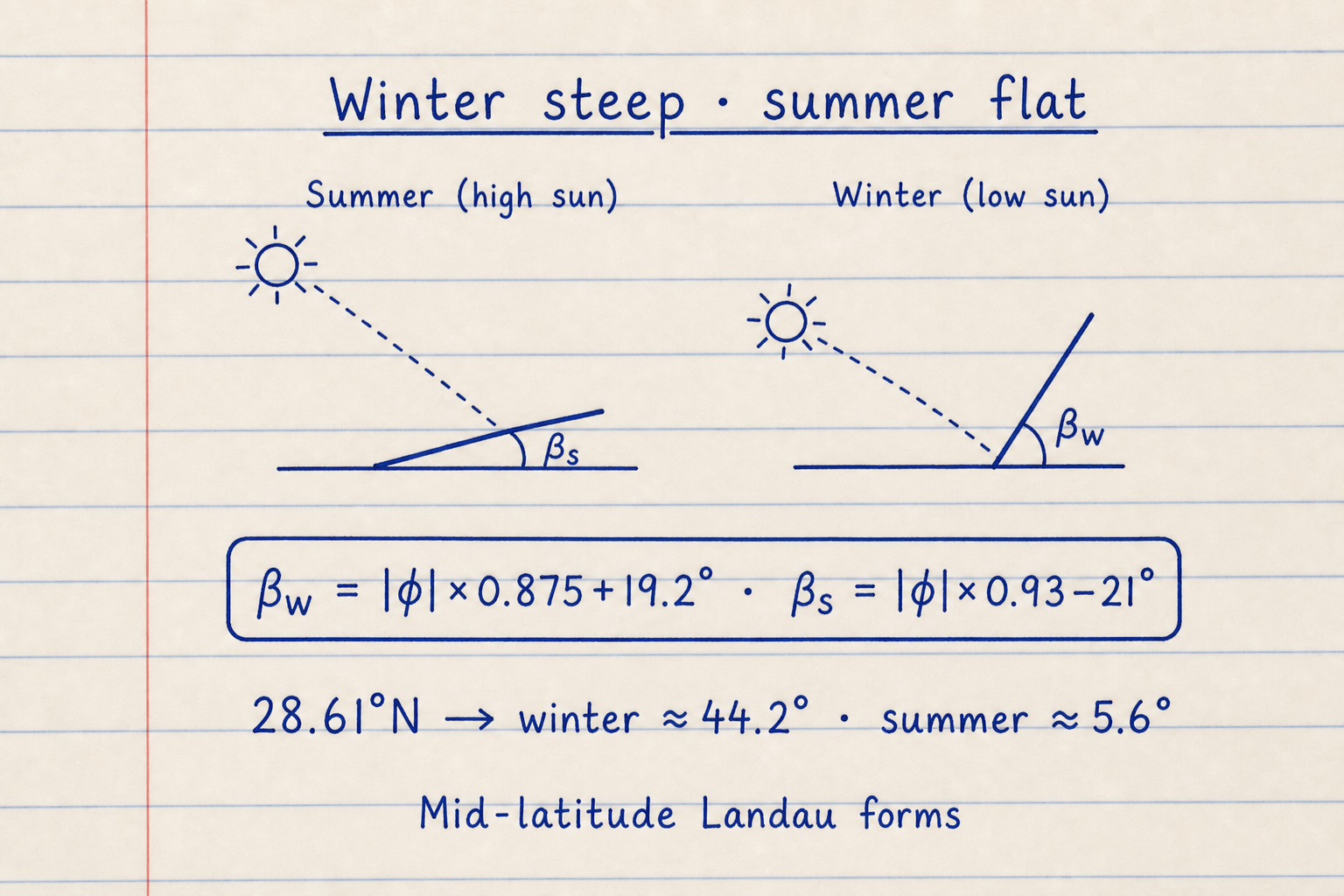
Summer: high sun, flatter panel. Winter: low sun, steeper panel (mid-latitude Landau forms).
Default at 28.61°N: summer ≈5.6° · winter ≈44.2°.
Facing true south or true north
Orientation matters as much as tilt. In the Northern Hemisphere panels should face true south (azimuth 180° in the common convention this pad uses). In the Southern Hemisphere they face true north (0°). True directions are not magnetic compass bearings.
A few tens of degrees off true costs only a few percent of annual energy at typical residential tilts. Roof geometry often forces a compromise. This pad reports the ideal facing; it does not model east-west splits or shading.
Worked example
28.61°N (Delhi), Year-round selected.
- |φ| = 28.61 (mid-latitude band).
- Fixed β = 28.61 × 0.76 + 3.1 = 24.8436° ≈ 24.8°.
- Winter β = 28.61 × 0.875 + 19.2 = 44.23375° ≈ 44.2°.
- Summer β = 28.61 × 0.93 − 21 = 5.6073° ≈ 5.6°.
- Facing = 180° (true south).
Result: Optimal (year-round) ≈ 24.8°. Switch Winter or Summer to promote 44.2° or 5.6°.
When to use
- Choosing a fixed rack angle from site latitude
- Setting twice-yearly adjustable mounts (winter / summer)
- Checking hemisphere facing before a compass walk
- Teaching why tilt-equals-latitude is only a rough start
Limitations
- Rule-of-thumb geometry only; not NREL PVWatts or PVGIS climate data
- No shading, roof obstruction, or soiling model
- Above 50° and odd roof azimuths need site-specific irradiance tools
- Not a structural or wind-uplift design check
- Magnetic declination is not applied to the facing card
FAQ
- Why is fixed tilt less than my latitude?
- The Landau mid-latitude form tilts a bit flatter than |φ| so the array catches more of the abundant summer sun. At 28.61°N that is about 24.8° instead of 28.61°. The difference is usually a few percent of annual energy versus tilt-equals-latitude.
- Is this the same as latitude ±15°?
- No. Books often teach winter = latitude + 15° and summer = latitude − 15°. Between 25° and 50° this pad uses tighter Landau seasonal formulas that improve annual yield by roughly a few percent. Outside that band seasons still use the ±15° rule.
- What if my latitude is below 25° or above 50°?
- Below 25°, fixed tilt is |φ| × 0.87 and seasons use ±15°. Above 50°, fixed tilt keeps the mid-lat form |φ| × 0.76 + 3.1° as a screening estimate, and seasons again use ±15°. Landau’s published tables stop at 50°, so treat high-latitude results as first-pass only.
- Do I enter negative latitude in the Southern Hemisphere?
- Yes. Use negative degrees for south (for example Sydney ≈ −33.87). Tilt math uses the absolute value. The facing card flips to true north (0°).
- Should I adjust tilt every season?
- Twice a year (winter and summer) captures most of the adjustable-mount gain. Four seasonal moves add only a little more for most grid-tied homes. Fixed mounts skip the visits and accept a modest annual energy trade-off.
- What about snow or tropical rain?
- Steeper winter tilts help snow slide off. Very flat summer tilts near the equator can hold dust or water. Use a practical minimum around 10° for self-cleaning when the formula returns near-zero summer tilt (Singapore summer can hit 0° on this pad), then confirm with local practice.
- Can I use this instead of PVWatts?
- No. Use this for a quick geometric angle. Use NREL PVWatts, PVGIS, or a full design package when you need kWh/kWp, weather, or bankable yield.
EV Battery Pack Sizing Calculator
Usable and installed pack energy, Ns×Np cell layout, pack Ah, and discharge power from range, efficiency, and cell specs.
Open calculatorWind Turbine TSR and Cp Calculator
Measure tip-speed ratio and Cp from rotor data, or estimate electrical power from Cp and drivetrain efficiency. Metric or Imperial.
Open calculator