You need a helical extension spring that pulls to a working load after the coils unstick. This pad takes wire size, linked mean / OD / ID diameters, active coils, initial tension Pi, applied load, and wire material, then returns rate, extension past preload, Wahl shear stress, body length (hooks excluded), max static load, and a Safe or Fail design verdict.
Defaults open on a music-wire spring: 2.5 mm wire, 20 mm mean coil, 12 active coils, Pi = 20 N, F = 70 N. That path gives about 4.12 N/mm rate, 12.14 mm extension past Pi, stress ≈ 85.8% of the guideline, and Safe. Max Load (45% static) is about 81.62 N on that geometry; try F = 120 N to see Fail. Switch Metric or Imperial first. Math stays in your browser.
It lives under Mechanical Calculators. For push springs use the compression spring calculator; for angular rate use the torsion spring calculator.
Formula
- Mean coil diameter from linked fields: OD = D + d, ID = D − d (edit any of d, Mean D, OD, or ID).
- Spring index C = D/d. Target 4–12 for manufacturability.
- Rate k = G × d⁴ ÷ (8 × D³ × Na), same body formula as compression. G from the material preset.
- Deflection beyond preload δ = (F − Pi) / k when F > Pi; otherwise δ = 0.
- Wahl factor Kw = (4C − 1)/(4C − 4) + 0.615/C. Shear stress τ = 8 × F × D × Kw ÷ (π × d³).
- Body length ≈ (Na + 1) × d excludes hooks. FoS uses 0.45 × Sys vs τ.
- Max static load at 45% yield: F_max = 0.45 × Sys × π d³ / (8 Kw D).
Reproduce the default Metric path:
| Check | Value on this pad |
|---|---|
| Inputs | d 2.5 mm, mean D 20 mm, Na 12, Pi 20 N, F 70 N, music wire |
| Rate / index | k ≈ 4.120 N/mm, C = 8, Kw ≈ 1.184 |
| Extension past Pi | ≈ 12.14 mm |
| Body length | ≈ 32.5 mm (hooks not included) |
| Verdict | Safe (stress ≈ 85.8% of 45% yield guideline) |
How it works
Use Metric or Imperial, then enter wire diameter and any of Mean D, OD, or ID. Linked fields update from OD = D + d and ID = D − d. Rate uses the same body formula as compression, but deflection starts after initial tension Pi. Wahl shear stress is at the applied load F. Safe requires index and stress checks. Body length excludes hooks. Hook stress is out of scope.
Pick Metric or Imperial at the top. Edit any of d, Mean D, OD, or ID and the others sync from OD = D + d and ID = D − d. The live diagram labels the active diameter and stretches the closed-wound body under pull. Enter active coils, initial tension Pi, applied load, and material, then click CALCULATE. Deflection stays zero until F exceeds Pi. Results show rate, Wahl stress, max static load (~81.62 N on defaults), and Safe/Fail. RESET restores the music-wire defaults.
Linked OD, ID, and mean diameter
Shop prints often give outside or inside diameter, not mean coil diameter. This pad keeps d, Mean D, OD, and ID linked: OD = D + d and ID = D − d. Change any one field and the others update before you CALCULATE.
Spring index C = D/d should land between 4 and 12 for most shop coils. Below 4 is hard to wind. Above 12 is soft. The Index check flags values outside that band.
Index band on this pad:
| C = D/d | What it means here |
|---|---|
| Below 4 | Index check flags Above limit; hard to manufacture |
| 4 to 12 | Typical shop range; Within limit |
| Above 12 | Index check flags; soft coil |
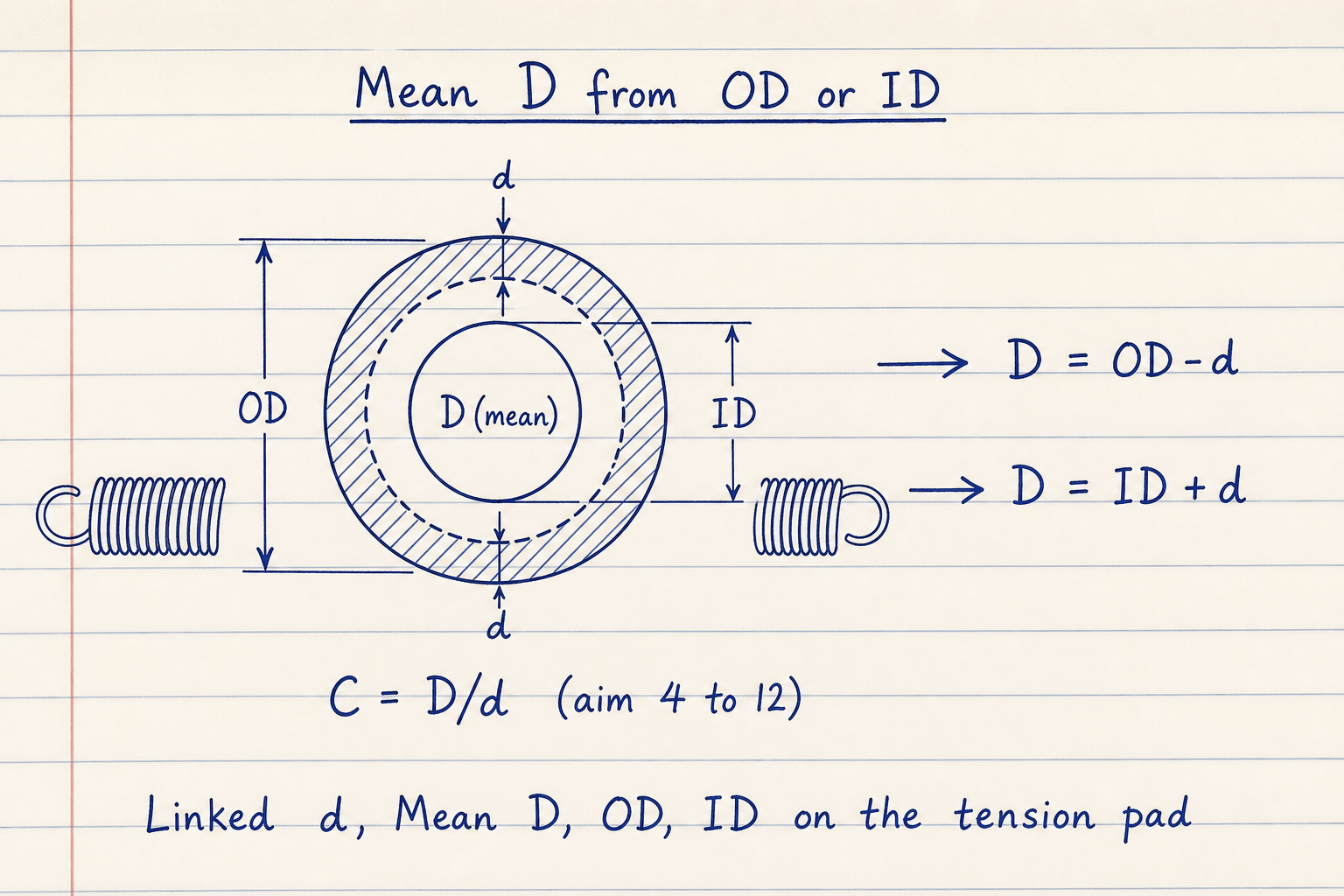
The top-view ring shows outside diameter OD, inside diameter ID, and wire thickness d. Mean diameter D sits on the wire centerline.
On this pad, edit any of d, Mean D, OD, or ID. The others sync from OD = D + d and ID = D − d. Spring index C = D/d should land between 4 and 12 for most shop coils.
Initial tension is not free travel
Closed-wound extension springs hold an initial tension Pi between the coils. Until the external load exceeds Pi, the body does not open. This pad sets δ = 0 when F ≤ Pi, then δ = (F − Pi)/k. The Travel past Pi check flags No travel when the load never clears preload.
Shop practice treats Pi the same way: rate applies after the coils unstick. If your load never clears Pi, you still get rate and body stress at F, but zero extension on the Results cards.
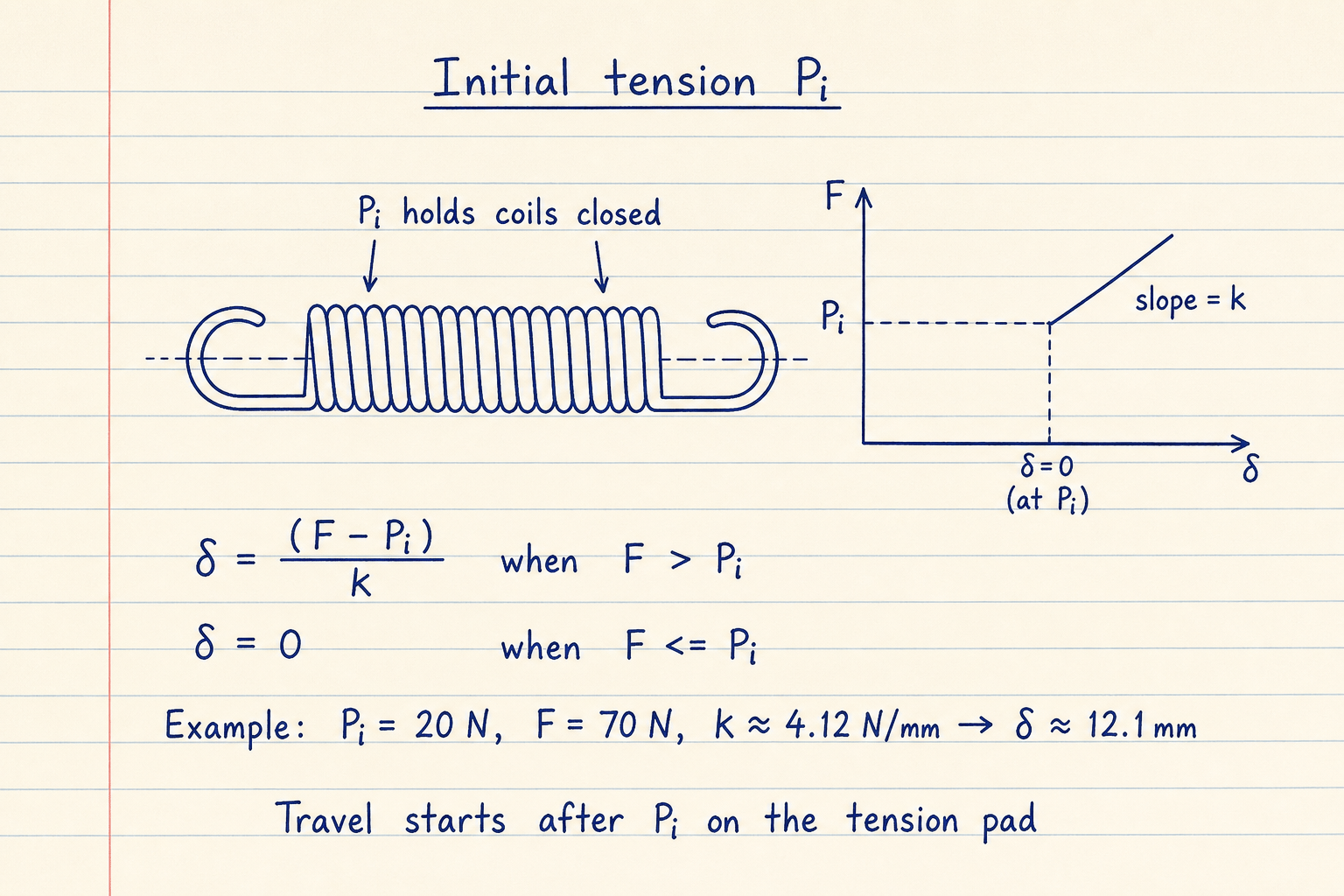
Pi holds the coils closed. Travel starts only after the applied load clears Pi. On the force vs extension sketch the line stays flat until Pi, then rises with slope k.
Default CALCULATE path: Pi = 20 N, F = 70 N, k ≈ 4.12 N/mm → δ ≈ 12.1 mm. Set F = Pi to reproduce the No travel check.
Wahl stress on the body wire
Body shear stress uses the same Wahl correction as compression springs. At C = 8, Kw ≈ 1.184. Stress is evaluated at the applied load F (not at F − Pi). Safe requires index within 4–12 and stress at or below about 45% of the material Sys on this pad.
Max Load (45% static) back-solves the largest F that keeps stress at the guideline. On the default geometry that ceiling is about 81.62 N. Use it as a first-pass limit, not a fatigue rating. Hook tensile stress is out of scope here.
Preset G and approx Sys (MPa):
| Material | G | Approx Sys |
|---|---|---|
| Music wire (A228) | 81,000 | 700 |
| Hard-drawn | 79,500 | 560 |
| Oil-tempered | 79,000 | 620 |
| Chrome-vanadium | 79,000 | 700 |
| Chrome-silicon | 77,500 | 770 |
| Stainless 302/304 (A313) | 69,000 | 520 |
Hooks and length inside hooks stay out of scope
Length Inside Hooks (LIH) comes from body length and hook style. Manufacturing worksheets also add German loops, English loops, and other end forms with Lh limits.
This pad reports body length ≈ (Na + 1) × d and body wire length only. Machine hooks, crossover hooks, and German hooks add stress concentrations and length that we do not size. Confirm hook style with your coiler or a manufacturing tool after the body rate and stress look right.
- Wahl stress is for the body wire at load F
- LIH and loop-shape CAD are not inputs here
- No fatigue, Goodman diagram, or catalog pricing
Worked example
Music wire extension spring: d = 2.5 mm, mean D = 20 mm, Na = 12, Pi = 20 N, F = 70 N. Reproduce on CALCULATE.
- Keep Mean D at 20 mm (or enter OD 22.5 mm / ID 17.5 mm and let the fields sync) so D = 20 mm.
- C = 20 ÷ 2.5 = 8. Kw ≈ 1.184. Rate k = 81000 × 2.5⁴ ÷ (8 × 20³ × 12) ≈ 4.120 N/mm.
- δ = (70 − 20) ÷ 4.120 ≈ 12.14 mm. Body length ≈ (12 + 1) × 2.5 = 32.5 mm.
- Stress at F = 70 N is under the 45% Sys guideline → Safe. Try F = 120 N to see Fail.
Result: Rate ≈ 4.120 N/mm, extension ≈ 12.14 mm past preload, C = 8, verdict Safe. Hooks not included in length.
When to use
- First-pass extension spring rate after initial tension
- Converting OD or ID print dimensions to mean diameter before sizing wire
- Checking body Wahl stress with a Safe/Fail static guideline
- Screening whether a working load clears Pi before you order
- Comparing music wire vs stainless on the same coil envelope
Limitations
- Hook geometry, hook stress, and length inside hooks are not calculated
- Loop-shape libraries (German, English, crossover) are out of scope
- No fatigue or cycle-life analysis
- Body length excludes hooks and attachment hardware
- Not a substitute for manufacturer design software or sign-off
FAQ
- Why is deflection zero?
- Applied load is at or below initial tension. Raise F above Pi, or lower Pi, then CALCULATE again. The Travel past Pi check shows No travel in that case.
- Is this the same rate formula as compression?
- Yes for the body: k = G d⁴ / (8 D³ Na). Extension springs add Pi before travel starts.
- Can I enter OD instead of mean diameter?
- Yes. Edit OD directly. Mean D and ID update from OD = D + d and ID = D − d. The diagram label follows whichever diameter family you last edited.
- Do you size hooks?
- No. Body length and wire length are coil-body estimates. Hook style and LIH need a coiler or manufacturing worksheet.
- What does Safe / Fail mean here?
- Safe requires spring index within 4–12 and body shear stress at or below about 45% of Sys. The Travel past Pi check is separate: No travel means F never cleared Pi, but the design can still read Safe on stress. Hook stress is not part of the verdict.
- Can I use Imperial units?
- Yes. Use the Imperial tab. Lengths become inches and force becomes lbf. Rate displays as lbf/in and stress as psi. Linked OD/ID geometry and Safe/Fail checks stay the same.
- What is Max Load (45% static)?
- It is the largest applied load F that keeps Wahl body stress at the 45% Sys guideline on this geometry. On the default music-wire path that is about 81.62 N. It is a static first-pass ceiling, not a fatigue rating.
Spring Calculator
Compression spring rate, Wahl stress, solid height by end type, and buckling checks. Metric or imperial; OD, ID, or mean diameter.
Open calculatorTorsion Spring Calculator
Torsion spring angular rate, deflection, and bending stress. Metric or Imperial; moment or force × arm; linked OD/ID.
Open calculatorSafety Factor Calculator
Factor of safety from strength ÷ stress. Yield or ultimate basis, material presets, and reverse solve modes.
Open calculator