You need a helical torsion spring that hits a working torque without overstressing the wire. This pad takes wire size, linked mean / OD / ID diameters, active coils, load as moment or force × arm, and wire material, then returns angular rate, deflection, Ki bending stress, max static torque, and a Safe or Fail design verdict.
Defaults open on a music-wire spring: 3 mm wire, 24 mm mean coil, 8 active coils, 1.5 N·m moment. That path gives about 62.99° deflection, 23.82 N·mm/deg, and Fail on the 45% bending-stress check so you can see the banner. Max Moment (45% static) is about 1.298 N·m on that geometry. Switch Metric or Imperial first. Math stays in your browser.
It lives under Mechanical Calculators. For axial springs use the compression spring calculator or tension spring calculator.
Formula
- Mean coil diameter from linked fields: OD = D + d, ID = D − d (edit any of d, Mean D, OD, or ID).
- Spring index C = D/d. Target 4–12 for manufacturability.
- Curvature factor Ki = (4C² − C − 1) / (4C(C − 1)). This is not the compression Wahl factor Kw.
- Bending stress σ = Ki × 32 M / (π d³) with M in N·mm.
- Angular deflection θ (rad) = 64 M D Na / (E d⁴). E comes from the wire material preset.
- Rate k = M / θ in N·mm/deg; also N·m/rev (or lbf·in/deg and lbf·in/rev in Imperial).
- Optional load path: M = F × r when you enter force and arm length instead of moment.
- Max static moment at 45% allowable: M_max = 0.45 × Sb × π d³ / (32 Ki). Safe when index OK and stress ≤ guideline.
Reproduce the default Metric moment path:
| Check | Value on this pad |
|---|---|
| Inputs | d 3 mm, mean D 24 mm, Na 8, M 1.5 N·m, music wire |
| Index / Ki | C = 8, Ki ≈ 1.103 |
| Deflection | ≈ 62.99° (≈ 0.175 rev) |
| Rate | ≈ 23.82 N·mm/deg |
| Max moment / verdict | ≈ 1.298 N·m · Fail (stress ≈ 116% of guideline) |
How it works
Use Metric or Imperial, then enter wire diameter and any of Mean D, OD, or ID. Linked fields update from OD = D + d and ID = D − d. Rate and angular deflection use elastic modulus E. Curvature factor Ki corrects bending stress. Enter moment directly or force × arm (M = F × r). Safe requires index and stress checks. Leg geometry and free position are out of scope.
Pick Metric or Imperial at the top. Edit any of d, Mean D, OD, or ID and the others sync from OD = D + d and ID = D − d. The live diagram labels the active diameter and winds the legs under torque. Choose Applied moment or Force × arm (defaults F = 50 N at r = 30 mm equal 1.5 N·m), set active coils and material, then click CALCULATE. Results show rate, deflection, Ki stress, max static torque (~1.298 N·m on defaults), and Safe/Fail. RESET restores the music-wire defaults.
Linked OD, ID, and mean diameter
Shop prints often give outside or inside diameter, not mean coil diameter. This pad keeps d, Mean D, OD, and ID linked: OD = D + d and ID = D − d. Change any one field and the others update before you CALCULATE.
Spring index C = D/d should land between 4 and 12 for most shop coils. Below 4 is hard to wind. Above 12 is soft and more sensitive to leg length and space. The Index check flags values outside that band.
Index band on this pad:
| C = D/d | What it means here |
|---|---|
| Below 4 | Index check flags Above limit; hard to manufacture |
| 4 to 12 | Typical shop range; Within limit |
| Above 12 | Index check flags; soft coil, watch space and leg stress |
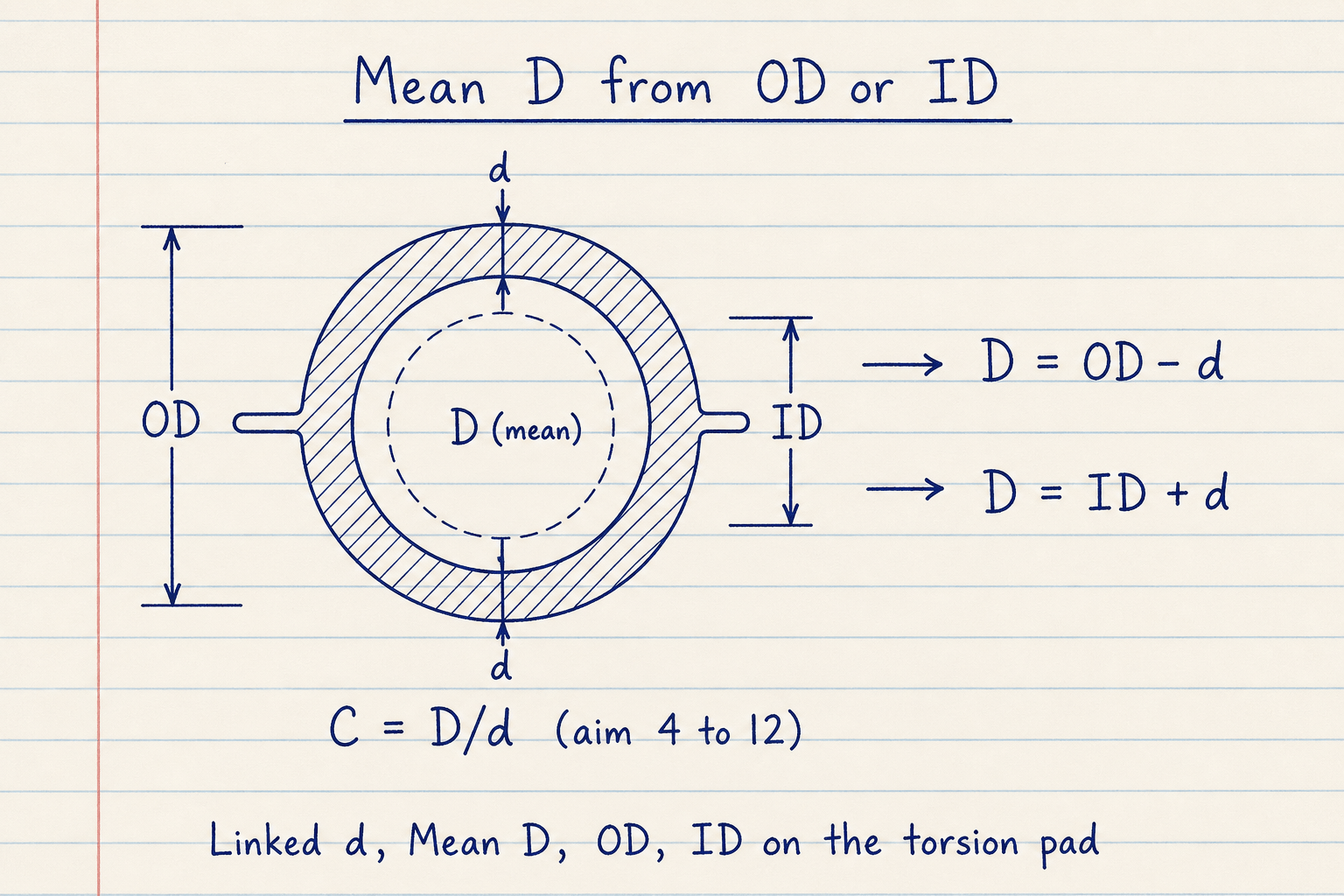
The top-view ring shows outside diameter OD, inside diameter ID, and wire thickness d. Mean diameter D sits on the wire centerline. Short leg stubs mark this as a torsion body, not a compression coil.
On this pad, edit any of d, Mean D, OD, or ID. The others sync from OD = D + d and ID = D − d. Spring index C = D/d should land between 4 and 12 for most shop coils.
Bending stress and Ki, not Wahl shear
Torsion spring wire is bent, so stress uses elastic modulus E and curvature factor Ki, not the compression Wahl shear factor. The same helical spring geometry that needs Kw in compression needs Ki here. Ki grows as index C drops.
At C = 8, Ki ≈ 1.103. Reproduce that on the default CALCULATE path before you change diameters. Stress / 45% Allowable compares Ki-corrected bending stress to about 45% of the preset allowable bending strength for static service. Above 100% the card highlights and the design verdict fails.
- σ = Ki × 32 M / (π d³) with M in N·mm
- FoS on this pad is Sb / σ using the material allowable
- Fatigue and elevated temperature need a separate material review
Moment or force × arm
Many shop worksheets accept either a direct torque or a force at a known radius. This pad matches that: Force × arm sets M = F × r before the same deflection and stress formulas run.
Example equivalent to the default moment: F = 50 N at r = 30 mm gives M = 1.5 N·m. In Imperial, about 11.24 lbf at 1.181 in gives the same torque in lbf·in. Arm length here is the moment radius, not the manufacturing leg length on the spring body.
- Rate units: N·mm/deg and N·m/rev in Metric; lbf·in/deg and lbf·in/rev in Imperial
- 360° per revolution links the two rate columns
- θ (rad) = 64 M D Na / (E d⁴) after M is known
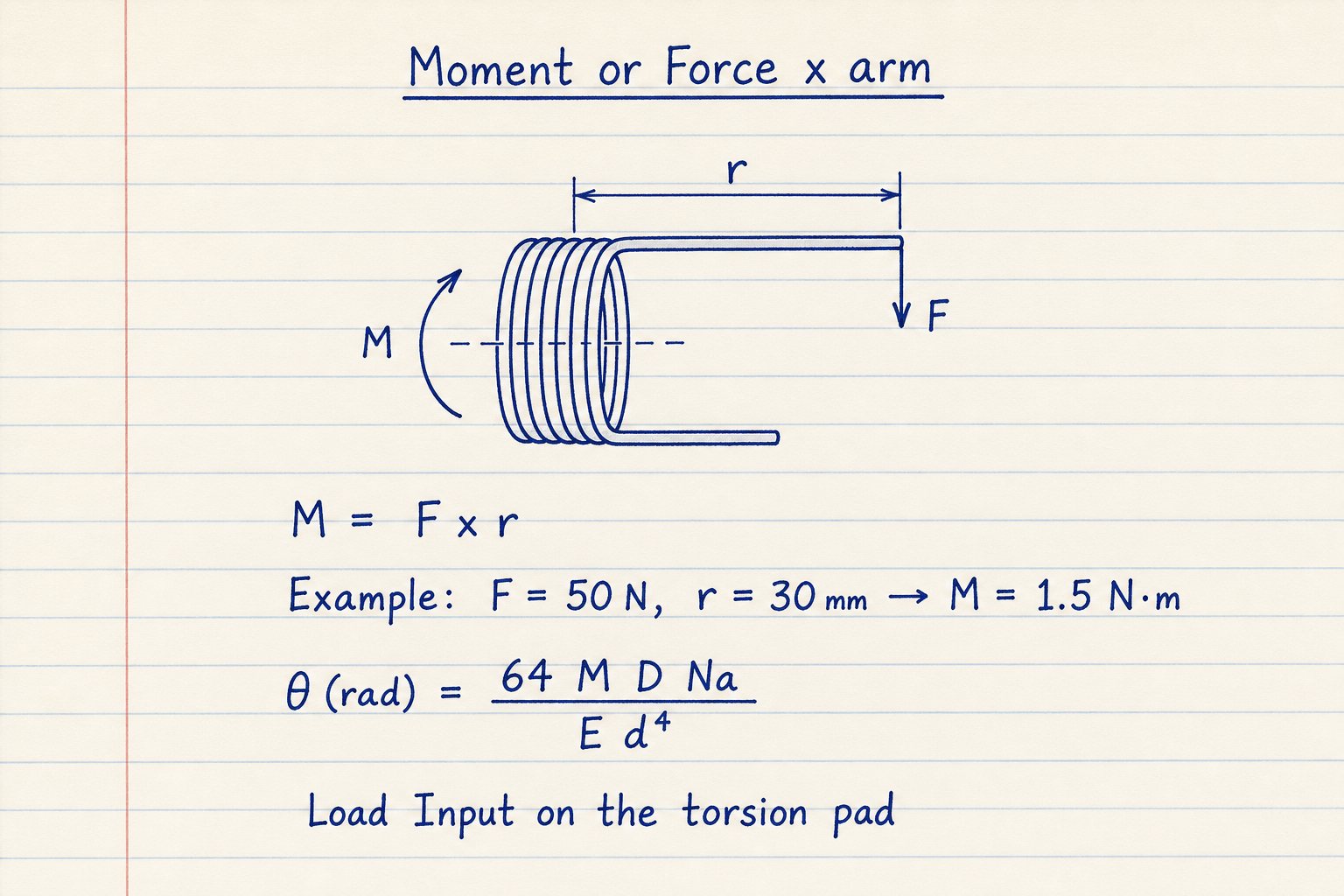
The sketch shows force F at arm radius r producing moment M about the coil axis. Load Input on this pad lets you enter M directly or F and r.
With F = 50 N and r = 30 mm you get M = 1.5 N·m, the same default moment path. Angular deflection still uses θ = 64 M D Na / (E d⁴).
Wire material and the 45% bending guideline
Material presets fill elastic modulus E used in the angular deflection formula from handbooks. Music wire is the default at E = 207,000 MPa. Stainless 302/304 drops E to 193,000 MPa, so the same geometry deflects more under the same torque.
Safe requires index within 4–12 and bending stress at or below about 45% of the material allowable on this pad. The default 1.5 N·m case fails on stress on purpose (about 116% of the guideline). On that geometry Max Moment (45% static) is about 1.298 N·m. Use that ceiling or lower for a passing static check.
Preset E and allowable bending Sb (MPa):
| Material | E | Approx Sb |
|---|---|---|
| Music wire (A228) | 207,000 | 1,200 |
| Hard-drawn | 200,000 | 900 |
| Oil-tempered | 200,000 | 1,000 |
| Chrome-vanadium | 205,000 | 1,100 |
| Chrome-silicon | 205,000 | 1,200 |
| Stainless 302/304 (A313) | 193,000 | 850 |
What industry tools add, and what we skip
Manufacturing worksheets ask for leg length, free position angle, wind direction, and body length for quotes. Catalog tools focus on rate and deflection with similar coil inputs.
This pad sizes the coil body under a pure moment on the mandrel axis. Leg CAD, free position, left/right wind, and pricing stay out of scope. Add them in CAD or a coiler worksheet after the body rate and stress look acceptable. A double torsion set is roughly twice the rate of one single set with the same wire and mean diameter.
- No fatigue life or coil-to-coil friction model
- Mandrel clearance and leg bending beyond the body are not included
- Not a substitute for manufacturer design software or catalog certification
Worked example
Music wire, d = 3 mm, mean coil 24 mm, Na = 8, M = 1.5 N·m. Reproduce on CALCULATE.
- Keep Mean D at 24 mm (or enter OD 27 mm / ID 21 mm and let the fields sync) so D = 24 mm.
- C = 24 ÷ 3 = 8. Ki = (4×64 − 8 − 1) / (4×8×7) ≈ 1.103.
- Convert moment to 1500 N·mm. θ = 64 × 1500 × 24 × 8 / (207000 × 3⁴) ≈ 62.99°.
- Rate ≈ 1500 / 62.99 ≈ 23.82 N·mm/deg. Stress ≈ 116% of the 45% Sb guideline → Fail. Max Moment on this geometry ≈ 1.298 N·m.
Result: About 62.99° deflection, 23.82 N·mm/deg, C = 8, index OK, verdict Fail (stress). Drop to ≈ 1.298 N·m or increase wire to pass.
When to use
- First-pass torsion spring angular rate and deflection at a working torque
- Converting OD or ID print dimensions to mean diameter before sizing wire
- Checking Ki bending stress with a Safe/Fail static guideline
- Entering catalog-style loads as force on a lever arm (F × r)
- Comparing music wire vs stainless on the same coil envelope
Limitations
- Leg length, free position, wind direction, and body length for quoting are not modeled
- Double-torsion conversion is described in content only; no separate converter tool
- No fatigue or cycle-life analysis
- Coil friction and mandrel clearance effects ignored
- Not a substitute for manufacturer design software or sign-off
FAQ
- Why N·mm/deg and N·m/rev?
- Both describe the same stiffness. N·mm/deg matches hand calcs with millimetre wire. N·m/rev matches many catalog rate columns. Imperial shows lbf·in/deg and lbf·in/rev. They convert through 360° per revolution.
- What is Ki?
- Curvature correction for bending stress in a coiled wire. Ki = (4C² − C − 1) / (4C(C − 1)). It is not the compression Wahl factor Kw.
- Can I enter OD instead of mean diameter?
- Yes. Edit OD directly. Mean D and ID update from OD = D + d and ID = D − d. The diagram label follows whichever diameter family you last edited.
- Why does the default show Fail?
- M = 1.5 N·m on d = 3 mm music wire sits near 116% of the 45% static bending guideline. That is intentional for teaching. Drop to about 1.298 N·m (Max Moment) or increase wire diameter to pass.
- What is Max Moment (45% static)?
- It is the largest applied moment that keeps Ki bending stress at the 45% Sb guideline on this geometry. On the default music-wire path that is about 1.298 N·m. It is a static first-pass ceiling, not a fatigue rating.
- How do double torsion springs relate to single coils?
- A double torsion spring is two single sets wound in opposite directions. Combined rate is approximately twice one set with the same wire and mean diameter. Size each set separately for detailed design.
- Force × arm vs moment?
- Same physics: M = F × r. Defaults show F = 50 N at r = 30 mm equals 1.5 N·m. Use force mode when your load is a linear force on a lever; use moment mode when you already have torque in N·m or lbf·in.
- Can I use Imperial units?
- Yes. Use the Imperial tab. Lengths become inches, force lbf, and moment lbf·in. Rates display as lbf·in/deg and lbf·in/rev. Linked OD/ID geometry and Safe/Fail checks stay the same.
Spring Calculator
Compression spring rate, Wahl stress, solid height by end type, and buckling checks. Metric or imperial; OD, ID, or mean diameter.
Open calculatorTension Spring Calculator
Extension spring rate, initial tension, Wahl stress, and Safe/Fail. Metric or Imperial; linked OD/ID.
Open calculatorSafety Factor Calculator
Factor of safety from strength ÷ stress. Yield or ultimate basis, material presets, and reverse solve modes.
Open calculator