Quick reference
| Millimeters (mm) | Inches |
|---|---|
| 1 | 0.039 |
| 2 | 0.079 |
| 3 | 0.118 |
| 5 | 0.197 |
| 10 | 0.394 |
| 15 | 0.591 |
| 20 | 0.787 |
| 25 | 0.984 |
| 30 | 1.181 |
| 50 | 1.969 |
| 75 | 2.953 |
| 100 | 3.937 |
A print calls for 100 mm. The catalog quotes inches. A gauge reads kPa while the relief note is in PSI. This hub is the quick conversion step before CAD, a stock order, or another TaskJunction calculator.
One page covers sixteen categories: area, data transfer rate, digital storage, energy, force, frequency, fuel economy, length, mass, plane angle, power, pressure, speed, temperature, time, and volume (about 110 units). Pick the category so From and To stay in family, enter the value, then click CALCULATE. The peach Result panel shows Converted Value plus a full Expression line. Swap flips the units with a short animation. RESET restores Length with mm → inch. Conversion runs in your browser only.
Find it under Utilities Calculators beside the scientific calculator. Convert units here first. Open the scientific pad only when you still need trig, powers, or chained expressions after the units match. For billet mass after a length or volume check, continue to the metal weight calculator.
Formula
- For area, data rate, digital storage, energy, force, frequency, length, mass, plane angle, power, pressure, speed, time, and volume: convert to a SI or category base, then to the target. In practice: converted = (value ÷ fromFactor) × toFactor.
- Length base is the metre. 100 mm → inches: 100 ÷ 1000 = 0.1 m, then 0.1 × 39.3701 ≈ 3.937 in.
- Pressure base is the pascal. 100 kPa → PSI on this pad returns about 14.5038 PSI.
- Temperature is not a single multiply. Every pair routes through Celsius with offsets. °C → °F is C × 9/5 + 32. °C → K is C + 273.15.
- Fuel economy is inverse-style: every pair routes through L/100 km. Lower L/100 km means better economy; US mpg uses 235.214583 ÷ (L/100 km).
- Digital storage lists decimal KB/MB/GB (1000-based) and binary KiB/MiB/GiB (1024-based). Read the label before you CALCULATE.
- Mach in Speed uses a fixed sea-level factor. Mach 1 CALCULATE to m/s returns about 340.37 m/s on this pad. It is not altitude-corrected.
Which path this hub uses:
| Category type | Method | Example |
|---|---|---|
| Factor-based (14 categories) | Base unit, then scale | 100 mm → 3.937 in |
| Temperature | Offset via °C | 100 °C → 212 °F |
| Fuel economy | Inverse via L/100 km | 8 L/100 km → 29.40 US mpg |
How it works
Pick a category, choose From and To units, enter a value, then click CALCULATE. Temperature uses offset formulas through Celsius. Every other category multiplies by fixed factors relative to a SI base. Swap flips From and To. RESET restores the Length mm → inch starting pair.
Choose the category first so From and To only list units for that family. Enter the value, set the units, then click CALCULATE. Converted Value and Expression appear in the peach Result panel. Swap exchanges From and To (with a brief spin animation) and clears the last result until you calculate again. RESET restores Length with mm → inch.
Starting pairs for all sixteen categories
Changing Category resets From and To to a shop-common pair for that family. The Value field stays as typed (default 100) until you edit it or hit RESET. The sample column uses 100 or 1 so the result stays readable. Reproduce any row with CALCULATE.
- Frequency default is MHz → rpm; for motor checks, try 60 Hz → rpm to get 3600 rpm on this pad
- Digital Storage default crosses decimal MB and binary MiB so you notice the 1000 vs 1024 difference
Default From → To when you pick each category:
| Category | Default pair | Sample (Value noted) |
|---|---|---|
| Area | Square metre → Square foot | 1 → 10.764 ft² |
| Data Transfer Rate | Mbit/s → KB/s | 1 → 125 KB/s |
| Digital Storage | Megabyte → Mebibyte | 1 → 0.9537 MiB |
| Energy | Kilowatt-hour → BTU | 1 → 3412.1 BTU |
| Force | Newton → Pound-force | 100 → 22.481 lbf |
| Frequency | Megahertz → rpm | 60 Hz → 3600 rpm (see note) |
| Fuel Economy | L/100 km → US mpg | 8 → 29.40 US mpg |
| Length | Millimetre → Inch | 100 → 3.937 in |
| Mass / Weight | Kilogram → Pound | 1 → 2.205 lb |
| Plane Angle | Degree → Radian | 90 → 1.5708 rad |
| Power | Kilowatt → Horsepower | 1 → 1.341 hp |
| Pressure | Kilopascal → PSI | 100 → 14.5038 PSI |
| Speed | Kilometre/hour → Mile/hour | 100 → 62.137 mph |
| Temperature | Celsius → Fahrenheit | 100 → 212 °F |
| Time | Hour → Minute | 1 → 60 min |
| Volume | Litre → US gallon | 1 → 0.2642 US gal |
Millimetres and inches on the print
Shop drawings often mark holes and stock in millimetres while US catalogs still quote inch-based hardware. Convert the critical dimension before you type it into a hole pattern or stock cutter. Default Length on this hub is mm → inch because that is the pair most fixture work hits first.
One inch is exactly 25.4 mm. That is why 25.4 mm CALCULATE to Inch returns 1, and 100 mm returns about 3.937 in.
Handy length checks:
| You enter | Result on this pad |
|---|---|
| 25.4 mm → Inch | 1 in |
| 100 mm → Inch | 3.937 in |
| 1 Inch → Millimetre (mm) | ≈ 25.4 mm |
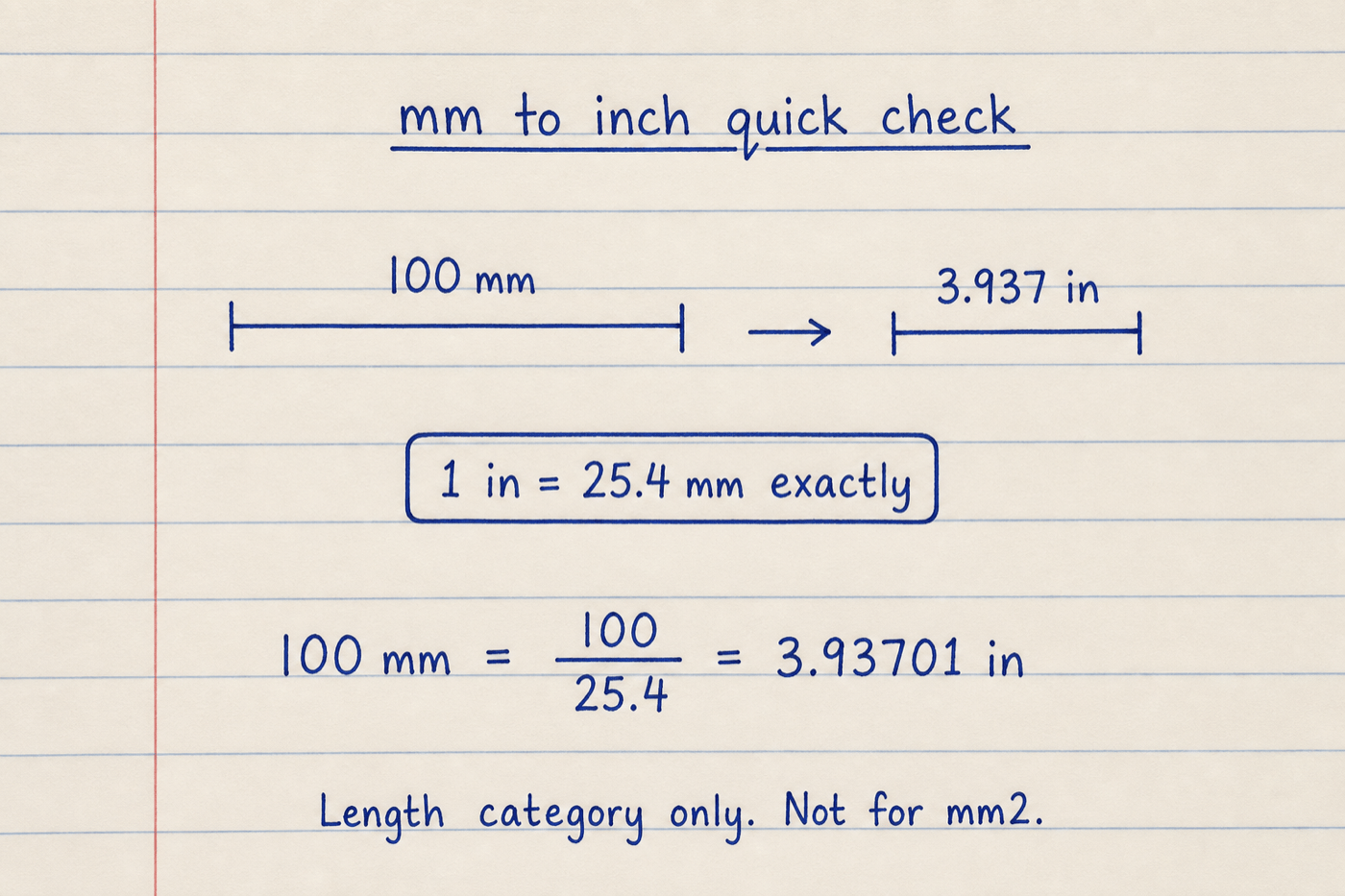
The note shows a 100 mm span mapping to about 3.937 in, with the exact definition 1 in = 25.4 mm. Divide millimetres by 25.4 when you want inches by hand.
That matches Length on this hub. Keep square or cubic millimetres in the Area or Volume categories. Length factors are linear only.
Pressure: kPa, PSI, and bar
Pneumatic and hydraulic notes mix pascal-family units with PSI. Select Pressure, keep the default kPa → PSI pair when you are reading a metric gauge against an imperial relief setting, then CALCULATE.
100 kPa is about 14.5038 PSI on this pad. Bar and atm sit in the same category. Read the From and To labels carefully so you do not convert Pa as if it were kPa.
- Default Pressure pair: Kilopascal (kPa) → PSI (lbf/in²)
- Use Swap when you need the reverse check on the same number
- Gauge vs absolute pressure is a process choice. This tool only changes units
Handy pressure checks:
| You enter | Result on this pad |
|---|---|
| 100 kPa → PSI (lbf/in²) | 14.5038 PSI |
| 1 Bar → PSI (lbf/in²) | 14.5038 PSI |
| 14.5038 PSI → Kilopascal (kPa) | 100 kPa |
Temperature is not a simple multiply
People often try °F = °C × 1.8 and skip the offset. That fails for every real temperature on the scale. The correct path is multiply by 1.8 (or 9/5), then add 32 for Fahrenheit, as summarized in NIST temperature SI notes. This hub routes every temperature pair through Celsius so °F, K, and °R stay consistent.
Example: 100 °C CALCULATE to Fahrenheit returns 212 °F. Zero Celsius is 32 °F, not zero. This UI always applies the absolute scale path. If you already have a temperature rise (a delta) in one scale, scale the interval only (×9/5 between °C and °F). Do not run that delta through the absolute °C → °F formula again.
Handy temperature checks:
| You enter | Result on this pad |
|---|---|
| 0 °C → Fahrenheit | 32 °F |
| 100 °C → Fahrenheit | 212 °F |
| 100 °C → Kelvin | 373.15 K |
| 32 °F → Celsius | 0 °C |
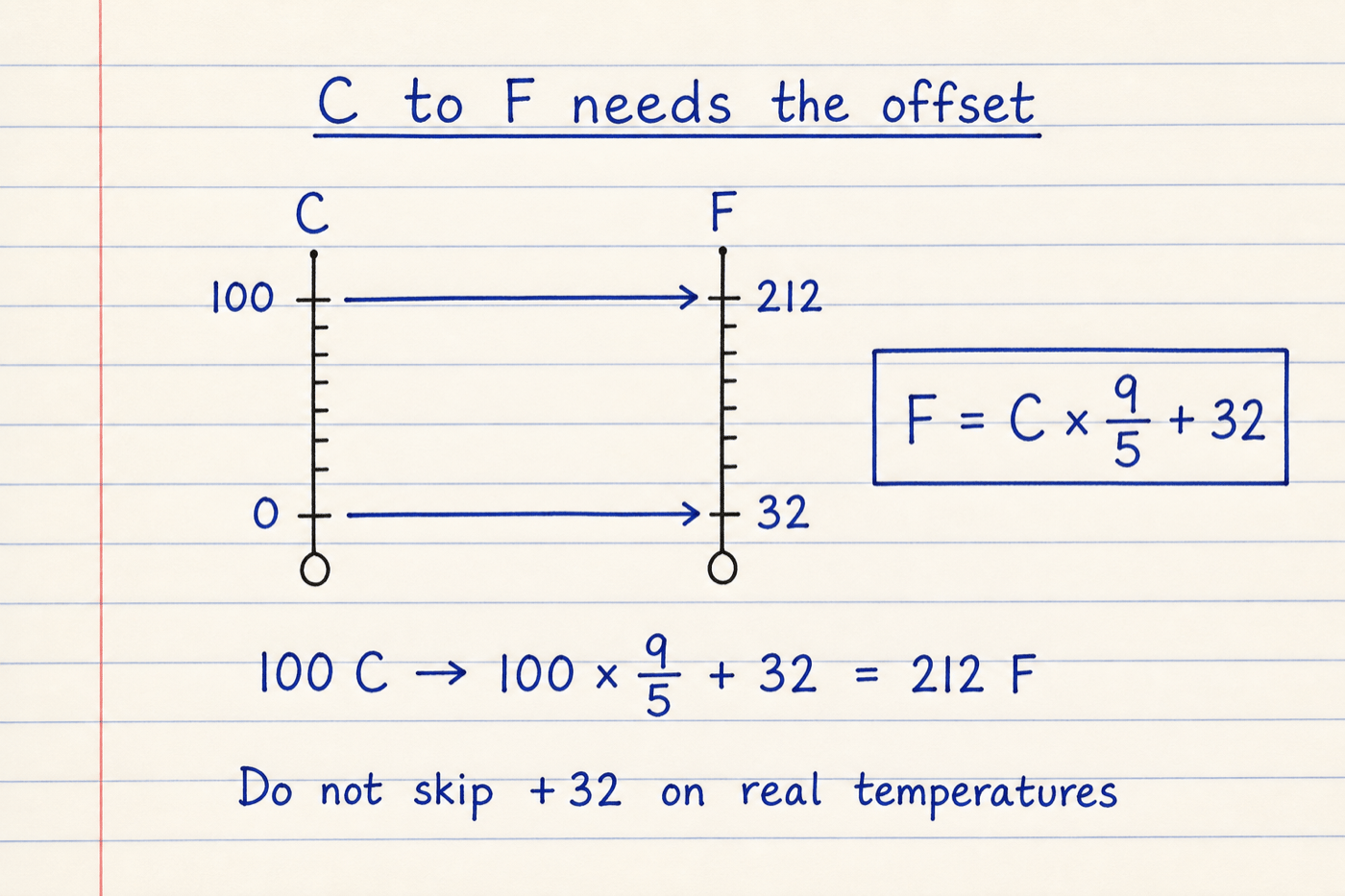
The twin scales show why the offset matters: 0 °C lines up with 32 °F, and 100 °C lines up with 212 °F. The formula on the note is F = C × 9/5 + 32.
Skipping +32 is the usual hand-calc mistake. On this hub, Temperature category CALCULATE already includes the offset for absolute readings.
Area, volume, and the wrong category
Length converts a single dimension. If the print shows mm² or in², switch to Area. If it shows cm³, litres, or gallons, switch to Volume. Using Length on an area value under-converts by a full factor of the length scale.
Volume also has two common gallons. US gallon (gal) and UK gallon (imp gal) are both listed. Pick the label that matches the datasheet region before you CALCULATE.
- Length → linear sizes only (mm, inch, foot)
- Area → mm², in², m², ft², and related units
- Volume → L, mL, US gal, UK gal, in³, and related units
Area and volume checks (not Length):
| Category | You enter | Result on this pad |
|---|---|---|
| Area | 1 m² → Square foot | 10.764 ft² |
| Volume | 1 L → US gallon | 0.2642 US gal |
| Volume | 1 L → UK gallon | 0.2200 UK gal |
| Volume | 1 US gallon → Litre | 3.785 L |
Mach and other speed caveats
Most Speed units (m/s, km/h, mph, ft/s, knot) use fixed factors. Mach is different: Mach 1 CALCULATE to Metre/second returns about 340.37 m/s on this pad (fixed sea-level factor). Real Mach depends on local speed of sound, so treat Mach results as a first-pass reference, not flight certification.
Handy speed checks:
| You enter | Result on this pad |
|---|---|
| 100 km/h → Mile/hour | 62.137 mph |
| 1 Mach → Metre/second | ≈ 340.37 m/s |
| 60 mph → Kilometre/hour | 96.560 km/h |
Digital storage: decimal vs binary
Drive labels and OS tools often disagree because marketing uses decimal gigabytes (1000-based) while many file browsers use binary gibibytes (1024-based). This hub lists both families under Digital Storage. Read the unit label before you CALCULATE.
Example: 1 GB (decimal) CALCULATE to Mebibyte returns about 0.9537 MiB on this pad. 1024 Byte CALCULATE to Kibibyte returns 1 KiB. Mixing bit and byte units without reading the label is a common off-by-eight mistake.
- Decimal: KB, MB, GB, TB use 1000-based steps
- Binary: KiB, MiB, GiB, TiB use 1024-based steps
- Data Transfer Rate is separate: bit/s and byte/s for throughput, not file size
Handy digital storage checks:
| You enter | Result on this pad |
|---|---|
| 1 GB → Mebibyte (MiB) | 0.9537 MiB |
| 1024 B → Kibibyte (KiB) | 1 KiB |
| 1000 KB → Megabyte (MB) | 1 MB |
| 8 Mbit → Megabyte (MB) | 1 MB |
Data rate, frequency, and shop timing
Data Transfer Rate covers bit/s through Gbit/s plus byte/s family units. A 1 Mbit/s link CALCULATE to KB/s returns 125 KB/s on this pad (8 bits per byte). Use this when a datasheet quotes Mbps but your logger reports KB/s.
Frequency includes Hz through GHz plus rpm and rad/s. For a 60 Hz mains or motor line, 60 Hz CALCULATE to rpm returns 3600 rpm. Plane Angle covers degrees, radians, gradians, arcminutes, and turns: 90° CALCULATE to radian returns about 1.5708 rad (π/2).
Handy data rate, frequency, angle, and time checks:
| Category | You enter | Result on this pad |
|---|---|---|
| Data Transfer Rate | 1 Mbit/s → KB/s | 125 KB/s |
| Frequency | 60 Hz → rpm | 3600 rpm |
| Plane Angle | 180° → Radian | 3.141593 rad (π) |
| Time | 1 Hour → Minute | 60 min |
| Fuel Economy | 8 L/100 km → US mpg | 29.40 US mpg |
Worked example
Convert 100 kPa to PSI the way you would check a relief setting against a metric gauge reading.
- Set Category to Pressure (defaults to Kilopascal → PSI)
- Confirm Value is 100, From is Kilopascal (kPa), To is PSI (lbf/in²)
- Click CALCULATE
- Read Converted Value ≈ 14.5038 PSI and the Expression line 100 Kilopascal (kPa) = 14.5038 PSI (lbf/in²)
Result: 100 kPa = 14.5038 PSI (lbf/in²).
When to use
- Metric print dimensions against imperial stock or hardware catalogs
- Pressure checks between kPa, PSI, bar, and atm on shop gauges
- Temperature conversion for heat-treat notes or ambient specs
- Mass and volume checks before a metal-weight or stock order
- Force, energy, and power unit alignment before a mechanical calculator
- Digital storage checks when a drive label (GB) does not match OS free space (GiB)
- Data rate checks when a network spec is in Mbit/s but logs report KB/s
- Motor and PLC timing: Hz to rpm, hours to minutes, degrees to radians
- Fuel economy comparisons between L/100 km and US or UK mpg
- Quick reverse checks with Swap after the first CALCULATE
Limitations
- From and To list units for the selected category only
- Temperature uses °C as the intermediate with exact offset formulas
- Fuel economy routes through L/100 km; lower L/100 km means better economy
- Digital storage mixes decimal (1000) and binary (1024) units; read labels carefully
- Mach uses a fixed sea-level factor (about 340.37 m/s for Mach 1). Not altitude-corrected
- Linear conversion only in Length. Area and volume need their own categories
- No currency, cooking measures, or shoe/clothing sizes. Those belong on dedicated converters
- Not a substitute for certified metrology software on safety-critical sign-off
FAQ
- Which categories are on this hub?
- Sixteen: Area, Data Transfer Rate, Digital Storage, Energy, Force, Frequency, Fuel Economy, Length, Mass, Plane Angle, Power, Pressure, Speed, Temperature, Time, and Volume. About 110 units total. Choose the category first so the unit lists stay in family.
- Do I need to click CALCULATE?
- Yes. This is a form calculator. Converted Value and Expression stay empty until you click CALCULATE or press Enter. Changing the value or units clears the last result so you do not read a stale number.
- Why is 100 kPa about 14.5 PSI?
- Pressure converts through pascals with fixed factors. 100 kPa equals 100000 Pa, and that maps to about 14.5038 PSI on this pad. That matches the common shop rule of thumb that 1 bar ≈ 14.5 PSI.
- Why can I not just multiply Celsius by 1.8?
- Fahrenheit has an offset. The correct °C → °F path is C × 9/5 + 32. This hub always goes through Celsius so Kelvin and Rankine stay consistent too. For a temperature rise already expressed as a delta, scale the interval only. Do not add 32 to a delta.
- What is the difference between US gallon and UK gallon?
- Both appear under Volume. A US gallon is about 3.785 L on this pad. A UK (imperial) gallon is about 4.546 L. One litre becomes about 0.2642 US gal or 0.2200 UK gal. Match the datasheet label before you CALCULATE.
- What is the difference between GB and GiB?
- GB (gigabyte) on this pad uses decimal 1000-based steps. GiB (gibibyte) uses binary 1024-based steps. A 1 TB drive often reports less in GiB. Pick the label that matches your datasheet or OS readout before you CALCULATE.
- What does Swap do?
- Swap exchanges the From and To units, spins the swap icon, and clears the previous Result until you CALCULATE again. Use it for reverse checks on the same numeric value.
- Is Mach accurate at altitude?
- No. Mach 1 on this pad is about 340.37 m/s from a fixed sea-level factor. Real Mach depends on local speed of sound. For altitude work, use a proper atmospheric model.
- Does this convert currency?
- No. This hub covers physical and engineering units plus digital storage and data rate. Use a bank or market rate tool for money.
Scientific Calculator
Online scientific calculator for Deg/Rad trig, powers, roots, logs, factorial, Ans, memory, and a reusable history panel.
Open calculatorMetal Weight Calculator
Bar, plate, tube, washer, and structural weight plus material cost from alloy density, shape dims, quantity, and margin. Metric or Imperial with dual kg/lb.
Open calculator