You need the undamped natural frequency of a single-degree-of-freedom system before you talk isolation mounts, shaft critical speed, or a lab pendulum. This pad covers three shop paths: spring-mass from k and m, static sag when you measured δst under gravity, and a simple pendulum from length L. Optional viscous damping and an operating RPM field add ζ, fd, and a first-pass resonance screen.
Defaults open on Metric spring-mass: k = 5000 N/m, m = 2.5 kg, undamped. CALCULATE returns fn ≈ 7.12 Hz, ωn ≈ 44.72 rad/s, period ≈ 0.140 s, static sag ≈ 4.905 mm, and critical speed ≈ 427 RPM. Math stays in your browser.
It sits under Mechanical Calculators. For shaft whirling from measured sag alone, use the critical speed calculator. Mount rate from a coil spring can start on the compression spring calculator.
Formula
- Spring-mass: ωn = √(k/m), fn = ωn/(2π), T = 1/fn.
- Static sag under self-weight: δst = mg/k (mm on this pad). Equivalent: fn = (1/2π)√(g/δst) with δst in meters.
- Simple pendulum (small angle): ωn = √(g/L), fn = ωn/(2π). Independent of mass.
- Critical speed for a 1× harmonic: Nc (RPM) = fn × 60.
- Viscous damping (spring-mass only): cc = 2√(km), ζ = c/cc, fd = fn√(1 − ζ²) when ζ < 1; otherwise fd is n/a (no oscillation).
- Resonance screen when RPM > 0: ratio r = N/Nc. Near resonance if 0.9 ≤ r ≤ 1.1; Caution if 0.75 ≤ r ≤ 1.25 outside that band; otherwise Clear.
Reproduce the default Metric spring-mass path:
| Check | Value on this pad |
|---|---|
| Inputs | k 5000 N/m, m 2.5 kg, undamped, RPM 0 |
| ωn / fn | ≈ 44.72 rad/s · ≈ 7.12 Hz |
| Period / δst | ≈ 0.1405 s · ≈ 4.905 mm |
| Critical speed | ≈ 427.1 RPM |
| Same fn via static path | δst 4.905 mm → same 7.12 Hz |
How it works
Pick spring-mass, static deflection, or simple pendulum. Angular frequency comes from √(k/m), √(g/δst), or √(g/L). Natural frequency in Hz is ωn/(2π). Optional viscous damping adds ζ and fd (underdamped only; critical/overdamped show n/a). Optional operating RPM compares N to critical speed Nc = fn×60 for a first-pass resonance screen.
Pick Metric or Imperial. Choose System: Spring-mass, Static deflection, or Simple pendulum. On spring-mass, set k and m, then Undamped or Viscous damping (enter c when damped). Optional Operating speed in RPM runs the resonance check. CALCULATE fills fn, ωn, period, critical RPM, and mode-specific extras. The live diagram follows the system type. RESET restores defaults for the active unit system.
Spring-mass ωn before anything fancy
Most vibration textbooks open with a mass on a linear spring. Angular frequency is natural frequency in rad/s: ωn = √(k/m). Divide by 2π for Hz. That is the frequency the free undamped system rings at after a bump, with no ongoing drive.
On this pad, keep System on Spring-mass, leave Damping model on Undamped, and CALCULATE the defaults. You should see ≈ 7.12 Hz. Stiffer k or lighter m raises fn. Softer mounts or heavier payloads drop it. That is the first screen before you buy rubber pads or change a shaft speed.
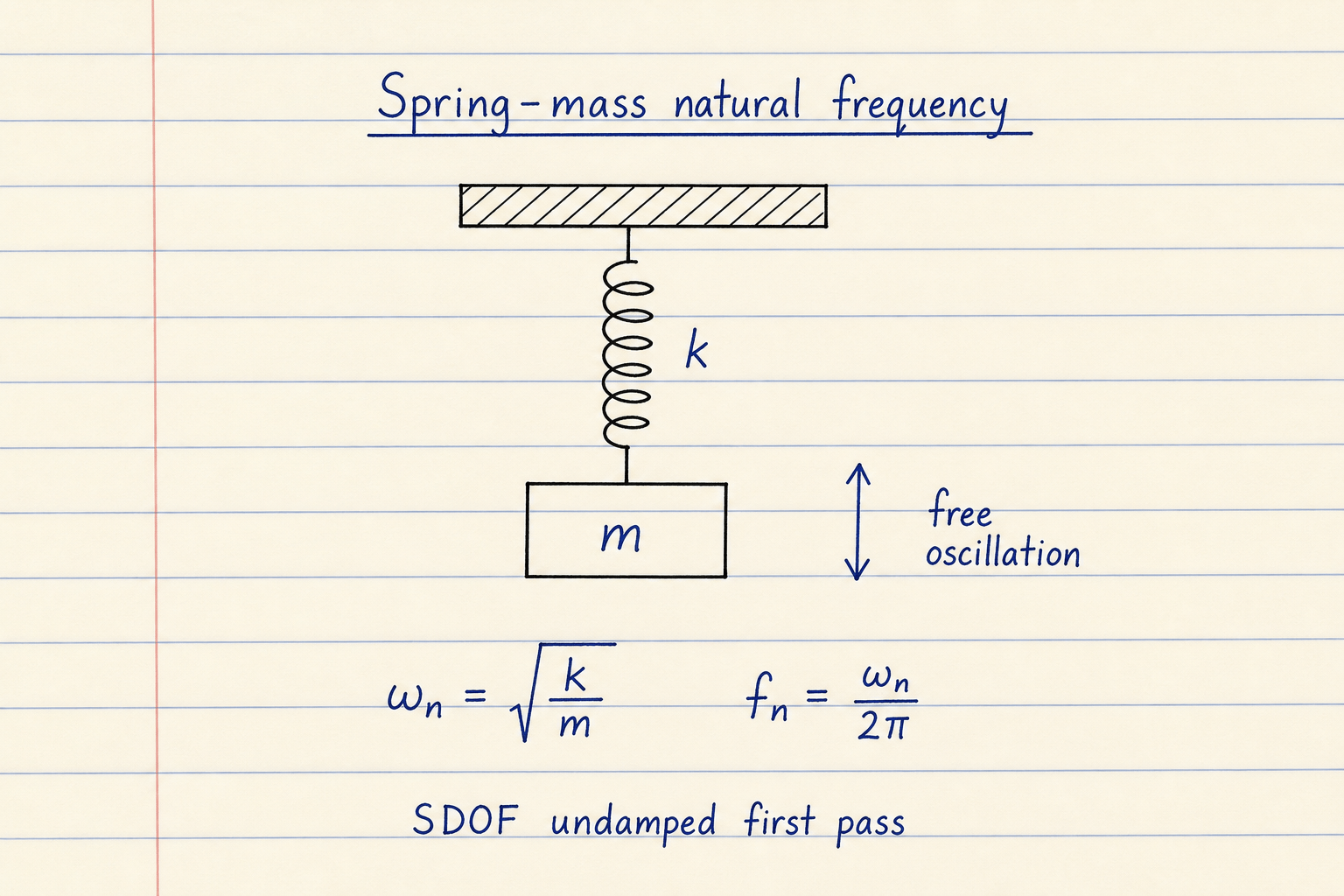
The sketch shows a ceiling-fixed spring with stiffness k and a hanging mass m. Free oscillation after a disturbance happens at ωn = √(k/m).
This pad reports both rad/s and Hz. Period T = 1/fn is the time for one free cycle on the undamped model.
Static sag when you measured deflection, not k
Shop floors often know how much a frame or mount sank under weight, not the exact N/m of every spring. Because δst = mg/k under gravity, fn = (1/2π)√(g/δst) matches √(k/m). Switch System to Static deflection, enter δst = 4.905 mm with g = 9.81 m/s², and you get the same ≈ 7.12 Hz as the default spring-mass case.
Field rules of thumb sometimes quote fn ≈ 15.76/√δmm. That is the same formula with g = 9.81 rearranged for millimeters. Use the pad for the exact value. For shaft whirling focused only on Nc from sag, use the related critical-speed tool linked in the overview.
Same system, two input paths:
| Path | Inputs | fn on this pad |
|---|---|---|
| Spring-mass | k 5000 N/m, m 2.5 kg | ≈ 7.12 Hz |
| Static deflection | δst 4.905 mm, g 9.81 | ≈ 7.12 Hz |
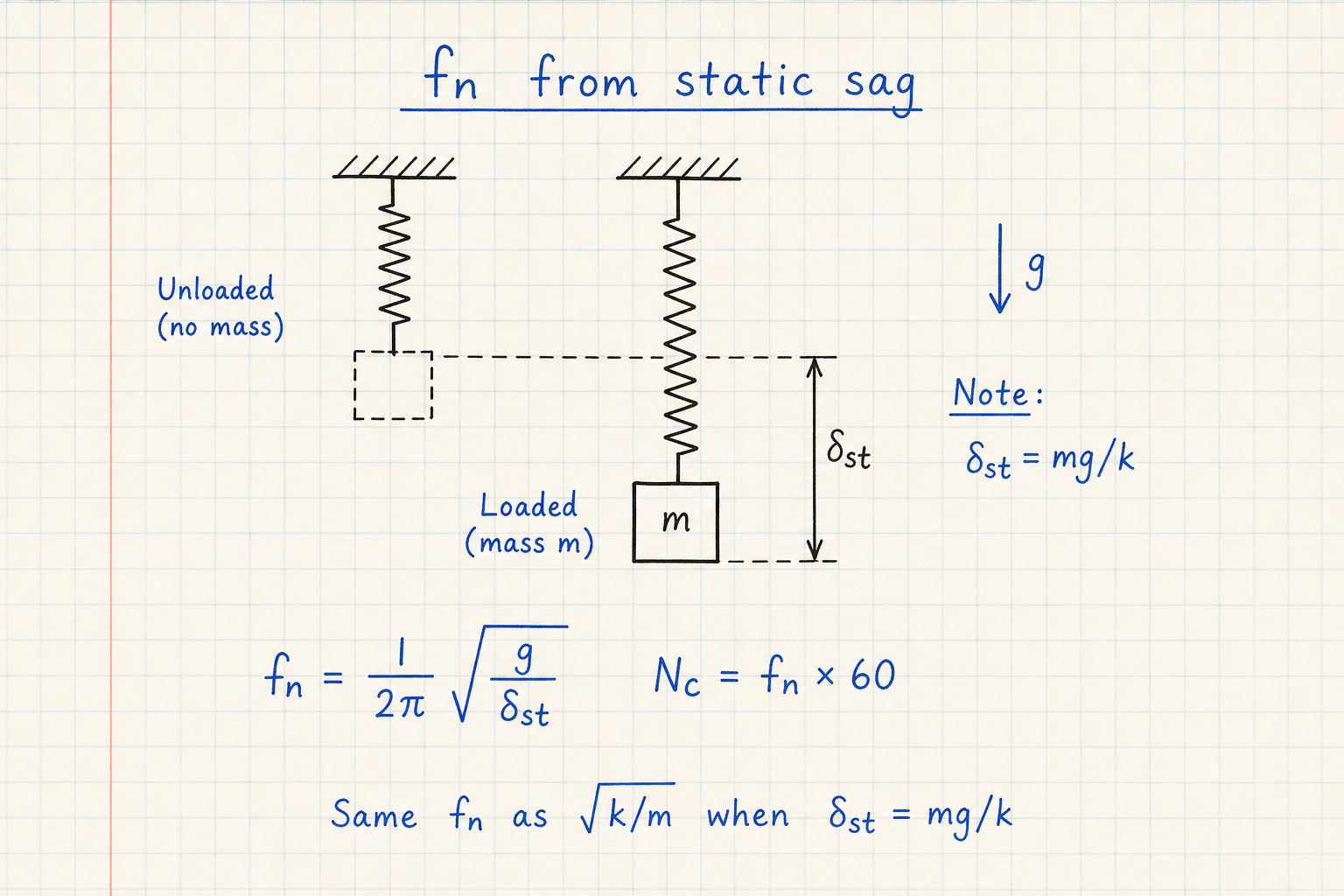
Loaded position sits δst below the unloaded spring length. Measuring that sag under known gravity recovers fn without a separate stiffness test.
Critical speed on this pad is Nc = fn × 60 for a once-per-revolution excitation. Compare your operating RPM to that value with the optional speed field.
Pendulum length, not mass
A simple pendulum at small angles has ωn = √(g/L). Mass cancels. That surprises students and is useful for a quick lab check of g or period. Set System to Simple pendulum, L = 1 m, g = 9.81 m/s²: fn ≈ 0.498 Hz and T ≈ 2.01 s.
Keep angles small (under about 15°) for the linear formula. Large swings need elliptic integrals. Physical pendulums with distributed mass need an equivalent length. Those stay out of scope here.
- fn depends on L and g only on this path
- Imperial length uses feet; gravity defaults convert with the unit tab
- Not a compound or torsional pendulum model
Viscous damping and ζ
Real mounts dissipate energy. On Spring-mass, switch Damping model to Viscous damping and enter c. Critical damping is cc = 2√(km). Damping ratio ζ = c/cc. For the default k and m with c = 40 N·s/m, ζ ≈ 0.179 (underdamped) and damped frequency fd ≈ 7.00 Hz, slightly below fn. Critical or overdamped cases show fd as n/a (no oscillatory fd).
Underdamped (ζ < 1) still oscillates. Critical (ζ = 1) returns without ringing. Overdamped (ζ > 1) creeps back without overshoot. Structural or hysteretic damping is not the same model. For control-style ζ checks see related damping ratio notes.
Damping state labels on this pad:
| ζ | Label |
|---|---|
| 0 (undamped model) | Undamped |
| 0 < ζ < 1 | Underdamped |
| ζ ≈ 1 | Critical |
| ζ > 1 | Overdamped |
Resonance check vs operating RPM
Natural frequency is not the same phrase as resonant frequency under forced drive, but they meet when excitation frequency matches fn and phase lines up. A rotating unbalance at N RPM is a drive near resonance when N ≈ Nc = fn × 60.
Enter Operating speed to compare. On the default spring-mass, Nc ≈ 427 RPM. Set 427 RPM and CALCULATE: ratio ≈ 1.0 and Resonance check reads Near resonance. Stay outside about ±10% for a hard avoid band on this screen, and treat ±25% as Caution. Real machines often want larger separation (API-style margins). This is a first pass, not a Campbell diagram.
- Clear: r < 0.75 or r > 1.25
- Caution: 0.75 ≤ r < 0.9 or 1.1 < r ≤ 1.25
- Near resonance: 0.9 ≤ r ≤ 1.1
- Leave RPM at 0 to skip the check
What beam and multi-mode tools add, and what we skip
Beam and multi-mode vibration tools add Euler-Bernoulli beams, cantilevers, distributed mass factors, and mode-shape plots. This pad stays SDOF and closed-form. No beam EI modes, no multi-mass Dunkerley sum, no transmissibility curves, and no ISO 10816 severity zones. Use FEA or a dedicated rotordynamics package when geometry is a frame, a multi-disk shaft, or a plate.
Worked example
Metric spring-mass defaults: k = 5000 N/m, m = 2.5 kg, undamped. Reproduce on CALCULATE.
- Keep System on Spring-mass and Damping model on Undamped.
- ωn = √(5000 / 2.5) = 44.721 rad/s.
- fn = 44.721 / (2π) ≈ 7.118 Hz. Period T ≈ 0.1405 s.
- δst = mg/k = 2.5 × 9.81 / 5000 = 4.905 mm. Nc = 7.118 × 60 ≈ 427.1 RPM.
- Optional check: switch System to Static deflection with δst = 4.905 mm. Same fn.
Result: Natural frequency ≈ 7.12 Hz, critical speed ≈ 427 RPM, undamped SDOF.
When to use
- First-pass fn for a spring-supported mass or isolation pad stack
- Recovering fn from a measured static sag under gravity
- Lab or teaching check of a simple pendulum period
- Screening whether an operating RPM sits near Nc = fn × 60
- Estimating ζ and fd when you know viscous damping c
Limitations
- Single degree of freedom only; no beam modes, plates, or multi-mass systems
- Viscous damping only on the spring-mass path; no structural or hysteretic models
- Pendulum path assumes small angles and a point mass on a massless rod
- Resonance bands are a teaching screen, not API 684 or ISO 10816 acceptance
- Not a substitute for modal test, FEA, or rotordynamic sign-off
FAQ
- Why do spring-mass and static deflection give the same fn?
- Under gravity, δst = mg/k, so √(k/m) equals √(g/δst). The two System options are the same physics with different knowns. Use whichever numbers you have.
- What damping states are shown?
- On viscous spring-mass mode: Undamped (ζ = 0 on the undamped model), Underdamped (ζ < 1), Critical (ζ ≈ 1), and Overdamped (ζ > 1). Underdamped shows fd below fn. Critical and overdamped show fd as n/a because there is no oscillatory damped frequency. Static and pendulum paths stay undamped.
- Is natural frequency the same as resonant frequency?
- Natural frequency is the free-vibration rate with no ongoing drive. Resonance is the large-amplitude response when a harmonic force hits that same frequency. On rotating equipment they meet when N ≈ fn × 60.
- Can I enter Imperial units?
- Yes. Use the Imperial tab. Stiffness becomes lbf/in, mass lb, deflection inches, pendulum length feet, and gravity ft/s². Outputs for fn stay in Hz; critical speed stays in RPM.
- Do you calculate beam or shaft mode shapes?
- No. Beam EI formulas, cantilevers, and mode-shape plots are out of scope. Use a structural dynamics tool or FEA for those. This pad is SDOF closed-form only.
Critical Speed Calculator
First critical whirling speed from static sag, shaft EI geometry, or screw end-fixity, with operating-speed margin.
Open calculatorSpring Calculator
Compression spring rate, Wahl stress, solid height by end type, and buckling checks. Metric or imperial; OD, ID, or mean diameter.
Open calculatorSafety Factor Calculator
Factor of safety from strength ÷ stress. Yield or ultimate basis, material presets, and reverse solve modes.
Open calculator