You need a ductile yield screen from a known stress state: plane stress (σx, σy, τxy), principal stresses (σ1, σ2, σ3), or a full 3D tensor. This pad returns the von Mises equivalent stress σ_vm, sorted principals, max shear, and optional utilization / factor of safety against tensile yield Sy.
Defaults open on Metric Plane stress: σx = 120 MPa, σy = 40 MPa, τxy = 30 MPa, Sy = 250 MPa (A36-class). CALCULATE returns σ_vm ≈ 117.9 MPa, principals 130 / 30 / 0 MPa, utilization ≈ 0.472, FOS ≈ 2.12, Pass. Switch to Principals or 3D stress tensor when that matches your FEA or Mohr output. Math stays in your browser.
It sits under Mechanical Calculators next to the Mohr's circle calculator and safety factor calculator. Use Mohr when you need angles; use this pad when you already have components or principals and want the distortion-energy check.
Formula
- Plane stress: σ_vm = √(σx² − σxσy + σy² + 3τxy²). Principals: C ± R with R = √(((σx−σy)/2)² + τxy²), σ3 = 0.
- From principals: σ_vm = √½[(σ1−σ2)² + (σ2−σ3)² + (σ3−σ1)²].
- Full 3D: σ_vm = √{ ½[(σx−σy)²+(σy−σz)²+(σz−σx)²] + 3(τxy²+τyz²+τzx²) }.
- Pure shear (σx=σy=0): σ_vm = √3 |τxy|.
- Utilization = σ_vm / Sy. Factor of safety = Sy / σ_vm. Pass when σ_vm ≤ Sy (ductile screen only).
Reproduce the default Metric plane-stress path on CALCULATE:
| Quantity | Value on this pad |
|---|---|
| σx / σy / τxy | 120 / 40 / 30 MPa |
| Sy | 250 MPa |
| σ_vm | ≈ 117.90 MPa |
| σ1 / σ2 / σ3 | 130 / 30 / 0 MPa |
| Utilization / FOS | ≈ 0.472 / 2.12 |
| Yield check | Pass |
How it works
Calculates von Mises (distortion-energy) equivalent stress from plane stress (σx, σy, τxy), principal stresses (σ1, σ2, σ3), or a full 3D stress tensor. Optional yield strength Sy returns utilization, factor of safety, and Pass/Fail for ductile metals.
Pick Metric (MPa) or Imperial (ksi). Choose Input mode: Plane stress, Principal stresses, or 3D stress tensor. Enter the active stress fields, optionally pick a material preset for Sy, then CALCULATE. Results and the yield sketch lock until you edit a field. Leave Sy blank to skip utilization, FOS, and Pass/Fail. RESET restores the 120 / 40 / 30 defaults for the active unit system.
Plane stress default path
Plane-stress analysis starts from in-plane σx, σy, and τxy with σz = 0. That is the usual sheet-metal and surface-element case. The closed form σ_vm = √(σx² − σxσy + σy² + 3τxy²) matches the principal form when σ3 = 0.
On this pad, CALCULATE the defaults. You should see σ_vm ≈ 117.9 MPa and principals 130 / 30 / 0 MPa. In-plane max shear equals the Mohr radius R = 50 MPa.
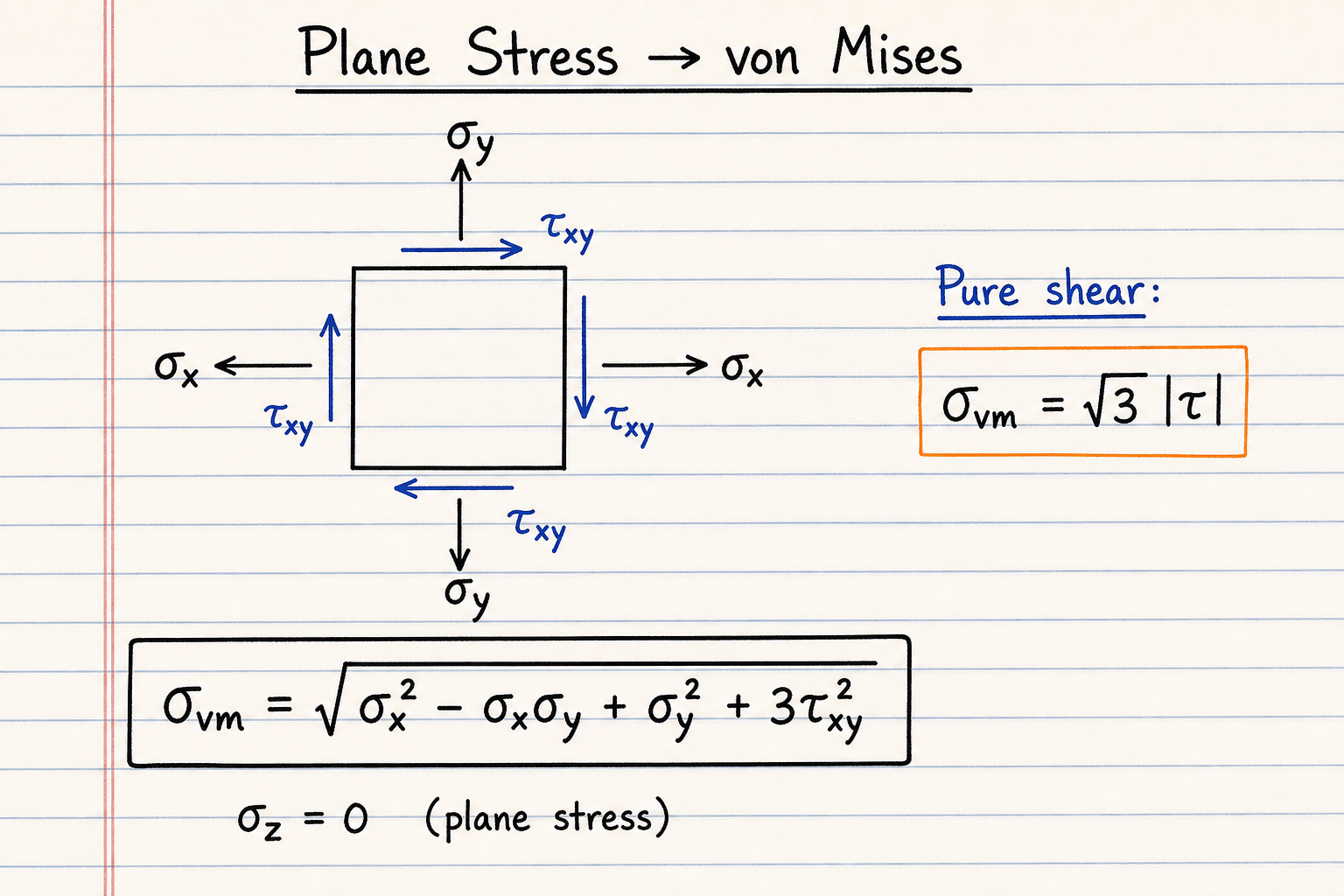
Tension is positive. Shear sign cancels in σ_vm because τ appears squared.
For pure shear with zero normal stress, σ_vm collapses to √3 |τ|.
Principals and the full 3D tensor
When FEA or a Mohr pad already gave you σ1, σ2, σ3, use Principal stresses mode. Ductile yield compares σ_vm to Sy, not to a single normal stress.
Try principals 100 / 50 / 0 MPa: σ_vm ≈ 86.60 MPa. The same numbers as a diagonal 3D tensor (σx=100, σy=50, σz=0, shears zero) return the same σ_vm and the same sorted principals. A plane-stress tensor with shear (σx=80, σy=−40, σz=0, τxy=30) recovers principals ≈ 87.08 / 0 / −47.08 MPa in 3D mode, matching plane-stress mode. Full tensor mode also accepts τyz and τzx when the stress state is not aligned.
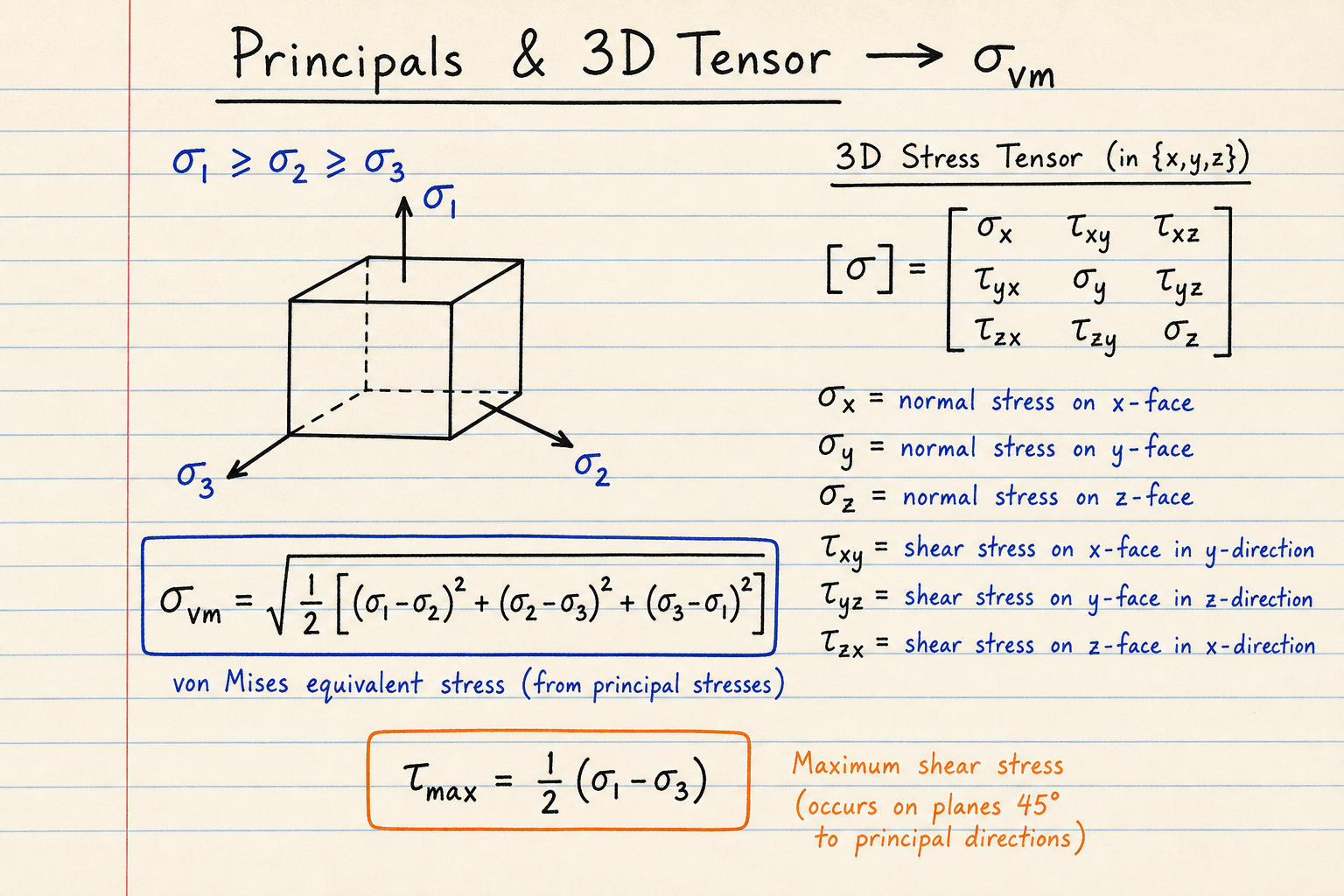
This pad sorts principals so σ1 ≥ σ2 ≥ σ3 before computing σ_vm and τ_max = ½(σ1 − σ3).
Plane stress is the special case with σz = τyz = τzx = 0; one principal is then zero when the tensor is written in those axes.
Yield check, utilization, and FOS
Many tools stop at σ_vm. Design work also needs margin. This pad reports utilization σ_vm/Sy, FOS = Sy/σ_vm, and Pass when σ_vm ≤ Sy. Pair a deeper margin story with the safety factor calculator when you are sizing from a target design factor rather than checking a known stress state.
Default Sy = 250 MPa gives utilization ≈ 0.472 and FOS ≈ 2.12 (Pass). Clear Sy to compute σ_vm alone without a Pass/Fail claim. Cast iron and brittle materials are outside this ductile distortion-energy screen.
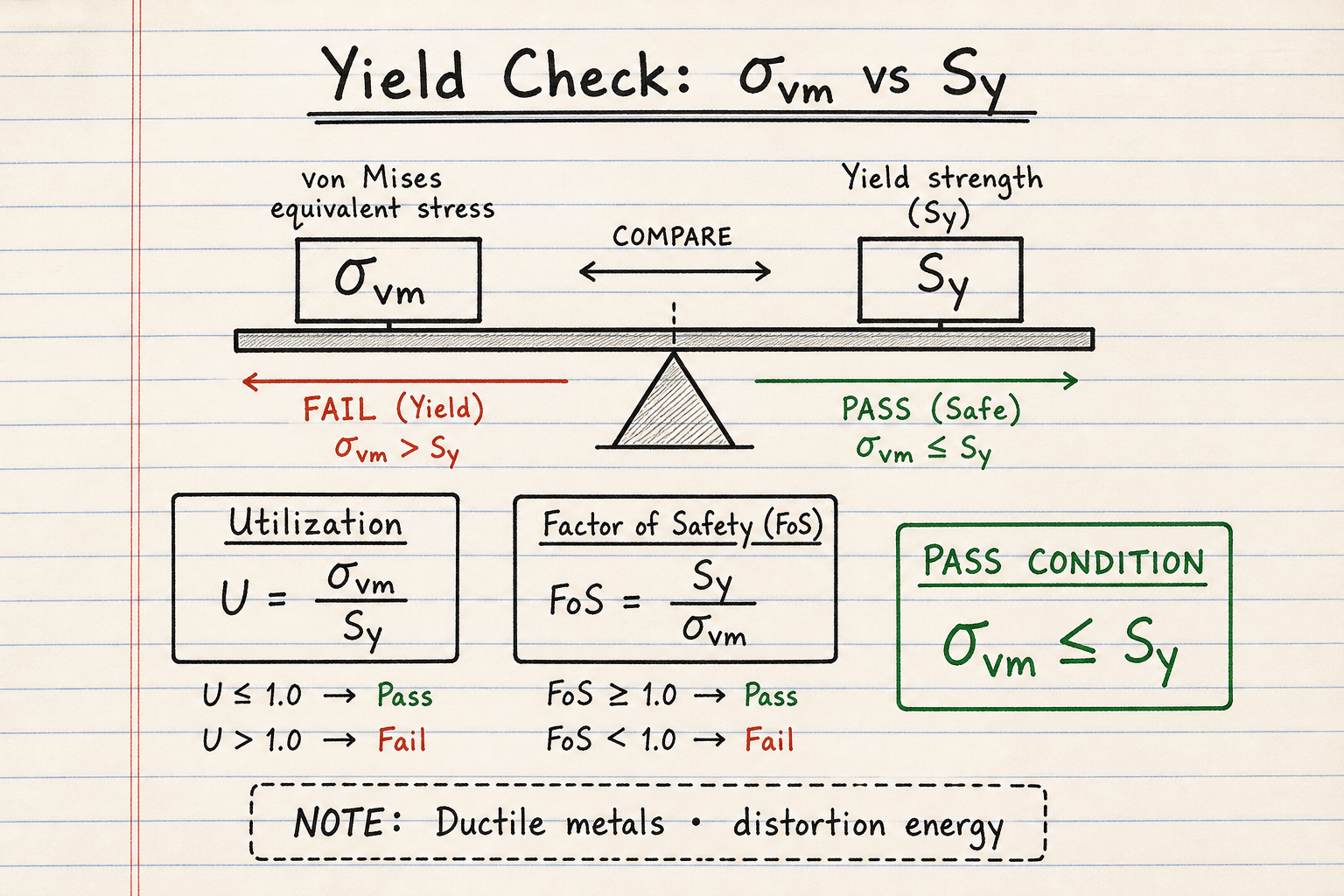
Pass/Fail here is a ductile yield screen, not a code allowable or fatigue check.
Material presets fill Sy; edit the number when your certificate differs from the table.
Worked example
Default Metric plane stress: σx = 120 MPa, σy = 40 MPa, τxy = 30 MPa, Sy = 250 MPa. Reproduce on CALCULATE.
- Leave Input mode on Plane stress (σx, σy, τxy) and Metric units.
- CALCULATE → σ_vm ≈ 117.90 MPa, σ1/σ2/σ3 = 130/30/0 MPa, FOS ≈ 2.12, Pass.
- Switch to Principal stresses with 100 / 50 / 0 → σ_vm ≈ 86.60 MPa.
- Pure-shear example: σx=σy=0, τxy=6.5 → σ_vm = √3×6.5 ≈ 11.26 MPa.
- 3D diagonal example: σx=100, σy=50, σz=0, shears 0 → same 86.60 MPa as principals.
- 3D with shear example: σx=80, σy=−40, σz=0, τxy=30 → σ_vm ≈ 117.9 MPa and principals ≈ 87.08 / 0 / −47.08 MPa (same as plane-stress mode).
Result: Default: σ_vm ≈ 117.9 MPa, Pass at Sy = 250 MPa (FOS ≈ 2.12).
When to use
- Quick ductile yield screen from plane-stress components
- Converting FEA principals into σ_vm and margin vs Sy
- Checking a general 3D stress tensor before a longer report
- Teaching pure shear σ_vm = √3 |τ|
- Pairing Mohr principals with a distortion-energy check
Limitations
- Ductile metals only. Not Tresca, Mohr-Coulomb, or brittle fracture.
- Static yield screen. No fatigue, fracture toughness, or temperature knockdown.
- No stress concentration Kt or notch factors (enter local stresses if you already have them).
- Plane-stress mode forces σz = τyz = τzx = 0 and reports in-plane Mohr radius as max shear.
- Pass/Fail uses tensile Sy, not a code allowable S.
- Sy blank or zero skips utilization, FOS, and Pass/Fail. Negative Sy is rejected.
FAQ
- Is von Mises the same as Tresca?
- No. Tresca uses max shear (½(σ1−σ3)) and is usually more conservative. Von Mises (distortion energy) matches ductile metal yield data better and is the default in most FEA packages.
- Why does pure shear give √3 |τ|?
- With σx = σy = 0 the plane-stress formula collapses to √(3τ²) = √3 |τ|. Principals are +τ and −τ (and 0 out of plane for plane stress), which returns the same number.
- When should I use principals vs the 3D tensor?
- Use principals when Mohr or FEA already sorted σ1, σ2, σ3. Use 3D tensor when you still have σx through τzx in the original axes. Both paths share the same σ_vm definition. For a plane-stress tensor (σz=τyz=τzx=0), 3D mode recovers the same principals as plane-stress mode.
- What if I leave Sy blank?
- σ_vm, principals, and max shear still calculate. Utilization, FOS, and Pass/Fail show n/a because there is no yield to compare against. Entering Sy = 0 is treated the same way; a negative Sy is rejected.
- Does this replace Mohr's circle?
- No. Mohr finds principals, max shear, and transformed stresses with angles. This pad takes components or principals and focuses on the ductile equivalent-stress check.
Mohr's Circle Calculator
Plane-stress principals, max shear, principal angle, stress transformation, and von Mises from σx, σy, τxy.
Open calculatorSafety Factor Calculator
Factor of safety from strength ÷ stress. Yield or ultimate basis, material presets, and reverse solve modes.
Open calculatorPressure Vessel Calculator
Thin/thick wall stresses, Lamé inner hoop, and required thickness with joint efficiency.
Open calculatorBeam Stress and Deflection Calculator
Six textbook beam cases: max moment, shear, stress, deflection, slope, and L/360 check with animated 2D sketches.
Open calculator