Heat input sketch
EN ISO applies η = 0.80
- Arc
- n/a V · n/a A
- Travel
- n/a mm/min
- HI (metric)
- n/a kJ/mm
- HI (imperial)
- n/a kJ/in
- Heat input
- n/akJ/mm
- Arc energy (η = 1)
- n/akJ/mm
- Arc power
- n/akW
- η used
- n/a
- Travel speed
- n/amm/min
- Min travel for WPS max
- n/amm/min
- WPS status
- n/a
Heat input ties volts, amps, and travel speed to the energy put into each millimetre (or inch) of weld. Procedure writers and inspectors use it to stay inside a WPS window and to compare runs on the same definition.
This pad opens on EN ISO SMAW at 25 V, 150 A, 300 mm/min, η = 0.8. CALCULATE returns heat input 0.600 kJ/mm (15.24 kJ/in), arc energy 0.750 kJ/mm, and arc power 3.75 kW. Switch Standard to ASME / AWS to force η = 1 and get 0.750 kJ/mm on the same parameters. You can also derive travel speed from bead length and arc time.
It lives under Manufacturing Calculators. Pair capacity and FoS checks on the weld joint strength calculator. For punched parts that later get welded, see the punch and die calculator.
Formula
- Travel speed v (length/min) = bead length / arc time × 60 when you measure a timed bead.
- ASME / AWS heat input: HI = (V × I × 60) / (v × 1000). Thermal efficiency is treated as 1.
- EN ISO 1011 heat input: HI = (η × V × I × 60) / (v × 1000), with η from the process (editable).
- With v in mm/min, HI is kJ/mm. With v in in/min, HI is kJ/in. Conversion: kJ/in = kJ/mm × 25.4.
- Arc power (kW) = V × I / 1000. Arc energy on this pad is the η = 1 metric value in kJ/mm.
- Optional WPS max: status is Above / Within when a limit is entered. Min travel for that max is (η × V × I × 60) / (HI_max × 1000).
Reproduce these paths on CALCULATE:
| Path | Inputs | Result |
|---|---|---|
| EN SMAW default | 25 V, 150 A, 300 mm/min, η 0.8 | HI 0.600 kJ/mm · P 3.75 kW |
| ASME same params | Standard ASME, same V/I/v | HI 0.750 kJ/mm (η = 1) |
| ASME worked example | 25 V, 200 A, 600 mm/min (10 mm/s) | HI 0.500 kJ/mm |
| Bead + time | L 100 mm, t 20 s, then EN defaults | v 300 mm/min · HI 0.600 |
| Imperial ASME | 12 in/min, 25 V, 150 A | HI 18.75 kJ/in |
How it works
Calculate welding heat input with ASME/AWS (η = 1) or EN ISO 1011 (process thermal efficiency). Enter travel speed, or derive it from bead length and arc time. Results show kJ/mm and kJ/in, arc power, and an optional WPS max check.
Pick Standard (ASME locks η = 1; EN ISO uses process η). Choose Metric or Imperial, then process and whether travel speed is typed or derived from bead length and time. Enter volts and amps. Optionally enter a WPS max in the active HI unit. CALCULATE fills Results and the sketch. Editing a field clears Results. RESET restores EN SMAW metric defaults.
ASME / AWS arc energy vs EN ISO heat input
American practice in heat-input documentation often reports HI = V × I × 60 / (v × 1000) with no separate efficiency factor. European EN ISO 1011-1 style calculations multiply by a process thermal efficiency η so TIG and SAW are not treated the same.
Both camps still call the result heat input, which causes WPS arguments. On this pad, ASME / AWS locks η = 1 and still shows Arc energy (η = 1) for comparison. EN ISO fills η from the process table and lets you edit it to match your procedure note.
EN ISO-style thermal efficiency presets on this pad:
| Process | η |
|---|---|
| SMAW / MMA (stick) | 0.8 |
| GMAW (MIG/MAG) | 0.8 |
| FCAW / MCAW (cored) | 0.8 |
| GTAW (TIG) | 0.6 |
| PAW (plasma) | 0.6 |
| SAW (submerged arc) | 1.0 |
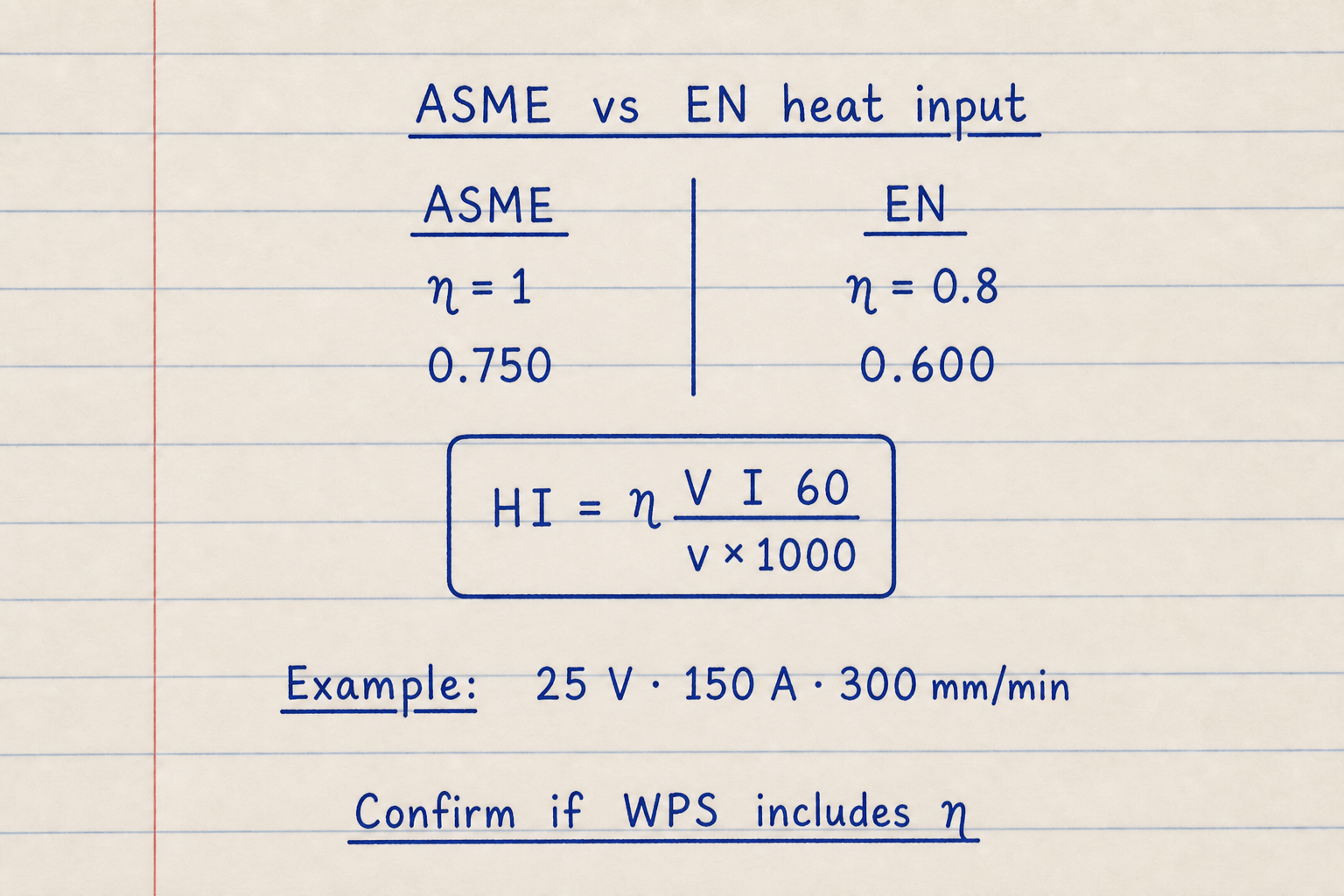
Defaults 25 V · 150 A · 300 mm/min: ASME 0.750 kJ/mm · EN SMAW η 0.8 → 0.600 kJ/mm.
Confirm whether your WPS number was written with or without η before you accept or reject a reading.
Travel speed from a marked bead and a stopwatch
Travel speed is often the weakest field input. Operators guess IPM; robots drift as fixtures wear. The reliable shop check is to mark a known bead length, time the arc, then convert to length per minute.
On Metric: v (mm/min) = L (mm) / t (s) × 60. A 100 mm bead in 20 s is 300 mm/min, the same as the typed default. Imperial uses inches the same way. Heat input then uses that derived speed with your volts and amps.
Timed-bead examples (Metric):
| Bead L | Arc time | Travel speed |
|---|---|---|
| 100 mm | 20 s | 300 mm/min |
| 150 mm | 30 s | 300 mm/min |
| 100 mm | 15 s | 400 mm/min |
| 50 mm | 10 s | 300 mm/min |
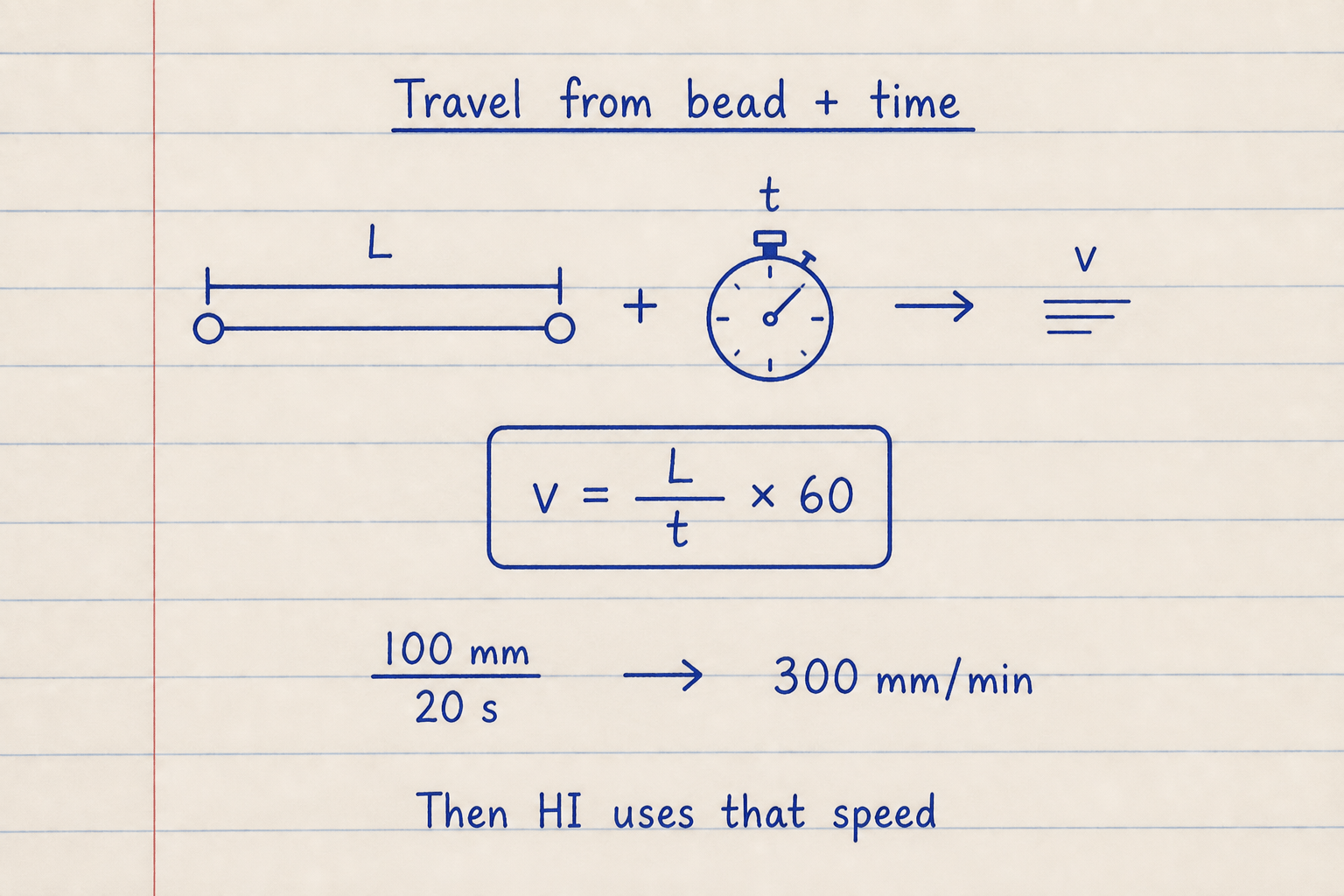
v = L / t × 60. Pick Travel speed source = From bead length and time, then CALCULATE.
100 mm in 20 s → 300 mm/min. Raising travel speed is usually the fastest HI lever.
kJ/mm, kJ/in, and optional WPS max
Metric WPS sheets usually quote kJ/mm. North American sheets often quote kJ/in. This pad always computes both. Primary Results follow your Unit system; the secondary line shows the other unit.
Optional WPS max compares the primary HI to your typed limit and reports min travel speed to stay under that max. It is a screening check only. Heat input affects cooling and toughness in the weld zone; governing limits still come from your project WPS/PQR, not this browser pad.
Unit map on this pad:
| Control | Metric | Imperial |
|---|---|---|
| Travel speed | mm/min | in/min |
| Bead length | mm | in |
| Primary HI | kJ/mm | kJ/in |
| WPS max field | kJ/mm | kJ/in |
| Always shown | both HI units + arc energy kJ/mm | both HI units + arc energy kJ/mm |
What this pad does not replace for pulsed welding
Average volts times average amps is fine for steady DC and many AC cases with balanced polarity. Waveform-controlled and pulsed processes can need instantaneous energy or instantaneous power from a high-sample meter, then HI = energy / bead length.
This calculator does not ingest waveform logs, multi-pass heat stacking, or CE-based preheat tables. Use it for the classical V-I-v path and for teaching the ASME vs EN definition split. Send pulsed or critical toughness work back to the WPS method statement.
Worked example
EN ISO SMAW defaults: 25 V, 150 A, 300 mm/min, η = 0.8. Reproduce on CALCULATE.
- Leave Standard on EN ISO 1011, Unit system Metric, process SMAW, Travel speed source = Enter travel speed.
- Confirm 25 V, 150 A, 300 mm/min, η = 0.8. CALCULATE.
- HI = 0.8 × 25 × 150 × 60 / (300 × 1000) = 0.600 kJ/mm. Arc energy (η = 1) = 0.750 kJ/mm. Arc power = 3.75 kW.
- Optional: switch Standard to ASME / AWS, CALCULATE again. HI becomes 0.750 kJ/mm with η used = 1.
- Optional: set Travel speed source to bead length and time, L = 100 mm, t = 20 s. Travel returns 300 mm/min and the same EN HI.
Result: Default EN path: 0.600 kJ/mm (15.24 kJ/in), arc energy 0.750 kJ/mm, power 3.75 kW. ASME path on the same inputs: 0.750 kJ/mm.
When to use
- Logging heat input for a WPS or traveler in kJ/mm or kJ/in
- Comparing ASME-style arc energy to an EN ISO η-based value
- Converting a timed bead into travel speed before the HI check
- Finding the minimum travel speed that stays under a typed WPS max
- Teaching why TIG and SAW should not share the same η
Limitations
- Not a substitute for the governing WPS/PQR or code edition.
- ASME path forces η = 1. EN path uses ISO-style process η presets; your procedure may differ.
- No pulsed / waveform instantaneous energy or instantaneous power method.
- No multi-pass heat stacking, interpass temperature model, or t8/5 FEA.
- No CE-based preheat recommendation. Preheat belongs in the procedure and material standard.
- Optional WPS max is a simple numeric compare, not a toughness qualification.
- Steady travel assumed. Starts, stops, and weave path length are on you to measure.
FAQ
- Why does ASME give a higher HI than EN on the same amps?
- ASME / AWS on this pad uses η = 1. EN ISO multiplies by process efficiency (0.8 for SMAW by default), so the reported HI is lower for the same V, I, and travel speed.
- Which η should I use for stick welding?
- EN ISO-style tables commonly use 0.8 for SMAW/MMA. If your WPS states another factor, type it. For ASME-style documentation, switch Standard to ASME / AWS so η stays 1.
- How do I get travel speed without a wire feeder readout?
- Set Travel speed source to From bead length and time. Mark a known length, time the arc in seconds, and CALCULATE. Metric uses mm; Imperial uses inches.
- What does Arc energy (η = 1) mean when I am in EN mode?
- It is the ASME-style metric value with efficiency removed, shown beside the EN heat input so you can see both definitions without flipping Standard.
- When does WPS status say Above WPS max?
- Only when you typed a WPS max greater than zero and the primary heat input exceeds it. Leave the field blank to skip the check. A typed zero is rejected. Min travel for WPS max is the speed that would put HI exactly on that limit.
- Can I use this for pulsed MIG?
- Only as a rough average V × I estimate. Pulsed and waveform-controlled welding may require instantaneous energy or power from a high-sample meter. Follow the method in your WPS.
- Does this calculator recommend preheat?
- No. Earlier heuristic preheat and t8/5 estimates were removed so the pad stays honest about classical heat input only.
Weld Joint Strength Calculator
Fillet and groove weld capacity for tee, lap, corner, edge, and butt joints — throat, stress, and factor of safety.
Open calculatorPunch and Die Design Calculator
Die clearance, cutting force, stripper, tonnage, and punch or die size for blanking, piercing, notching, cutoff, lancing, trimming, shaving, and perforating.
Open calculator