- Swept Area
- n/am²
- Tip Speed
- n/am/s
- Available Wind Power
- n/akW
- Power Coefficient Cp
- n/a
- Shaft Torque (est.)
- n/aN·m
You need tip-speed ratio and power coefficient from a known rotor point, or a first-pass electrical power estimate before you dig into a manufacturer curve. This pad has two modes: Measure Cp from wind, RPM, diameter, and actual power; or Estimate power from Cp and drivetrain efficiency. Both use the kinetic flux through the swept disk and report how close Cp sits to the Betz limit.
Defaults open on Measure Cp: 10 m/s, 20 m rotor, 60 rpm, 50 kW, sea-level ρ = 1.225 kg/m³. That path gives tip speed about 62.83 m/s, λ ≈ 6.28, swept area about 314.2 m², available wind power about 192.42 kW, Cp ≈ 0.260 (about 43.8% of Betz), and shaft torque about 7958 N·m. Switch Metric or Imperial. Math stays in your browser.
It lives under EV & Renewable Calculators. Pair it with the solar panel tilt calculator or the EV battery pack sizing calculator when you move from rotor screening to site or storage checks.
Formula
- Swept area A = π D² / 4.
- Tip speed v_tip = π D N / 60. Tip speed ratio λ = v_tip / v_wind.
- Available wind power P_avail = ½ ρ A v³ (default ρ = 1.225 kg/m³ at sea level).
- Measure mode: Cp = P_actual / P_avail. Shaft torque ≈ 9550 × P(kW) / N(rpm).
- Estimate mode: P_elec = P_avail × Cp × (η/100).
- Betz limit Cp_max = 16/27 ≈ 0.593. Percent of Betz = Cp / Cp_max × 100.
Reproduce the default Measure Cp path:
| Check | Value on this pad |
|---|---|
| Inputs | 10 m/s, 20 m, 60 rpm, 50 kW, 1.225 kg/m³ |
| Tip speed / TSR | ≈ 62.83 m/s · λ ≈ 6.28 |
| Swept area / P_avail | ≈ 314.2 m² · ≈ 192.42 kW |
| Cp / % Betz | ≈ 0.260 · ≈ 43.8% of Betz |
How it works
Pick Metric or Imperial, then Measure Cp or Estimate power. Measure mode uses tip speed = π D N / 60, λ = tip / wind, available power = ½ ρ A v³, and Cp = P_actual / P_avail. Estimate mode multiplies available power by Cp and drivetrain efficiency. Both modes report percent of the Betz limit (16/27 ≈ 0.593). Optional RPM in Estimate mode adds tip speed, TSR, and shaft torque. CALCULATE updates the rotor sketch. RESET restores 10 m/s / 20 m / 60 rpm / 50 kW / 1.225 kg/m³ with Estimate defaults Cp 0.35 and η 90% (or Imperial equivalents).
Pick Metric (m/s, m, kW, kg/m³) or Imperial (mph, ft, hp, lb/ft³). Choose Measure Cp to back-calculate Cp from actual power, or Estimate power to forward-calculate electrical output from Cp and drivetrain efficiency. Edit air density for altitude. In Estimate mode, leave Rotor Speed blank to hide tip speed and torque; enter RPM to fill those cards. CALCULATE fills the result cards and updates the rotor sketch. Changing mode or units clears results until you CALCULATE again. RESET restores 10 m/s / 20 m / 60 rpm / 50 kW / 1.225 kg/m³, plus Estimate defaults Cp 0.35 and η 90% (or Imperial equivalents).
Tip speed ratio is tip over wind
Tip speed ratio λ compares how fast the blade tip moves to how fast the wind approaches. For a horizontal-axis rotor, tip speed is π D N / 60. Divide by wind speed to get λ. Modern three-blade machines often land near λ = 6–8 near rated wind.
On the default path, a 20 m rotor at 60 rpm in 10 m/s wind has tip speed about 62.83 m/s and λ ≈ 6.28. That is a sensible screening band for a small HAWT, not a certified operating map.
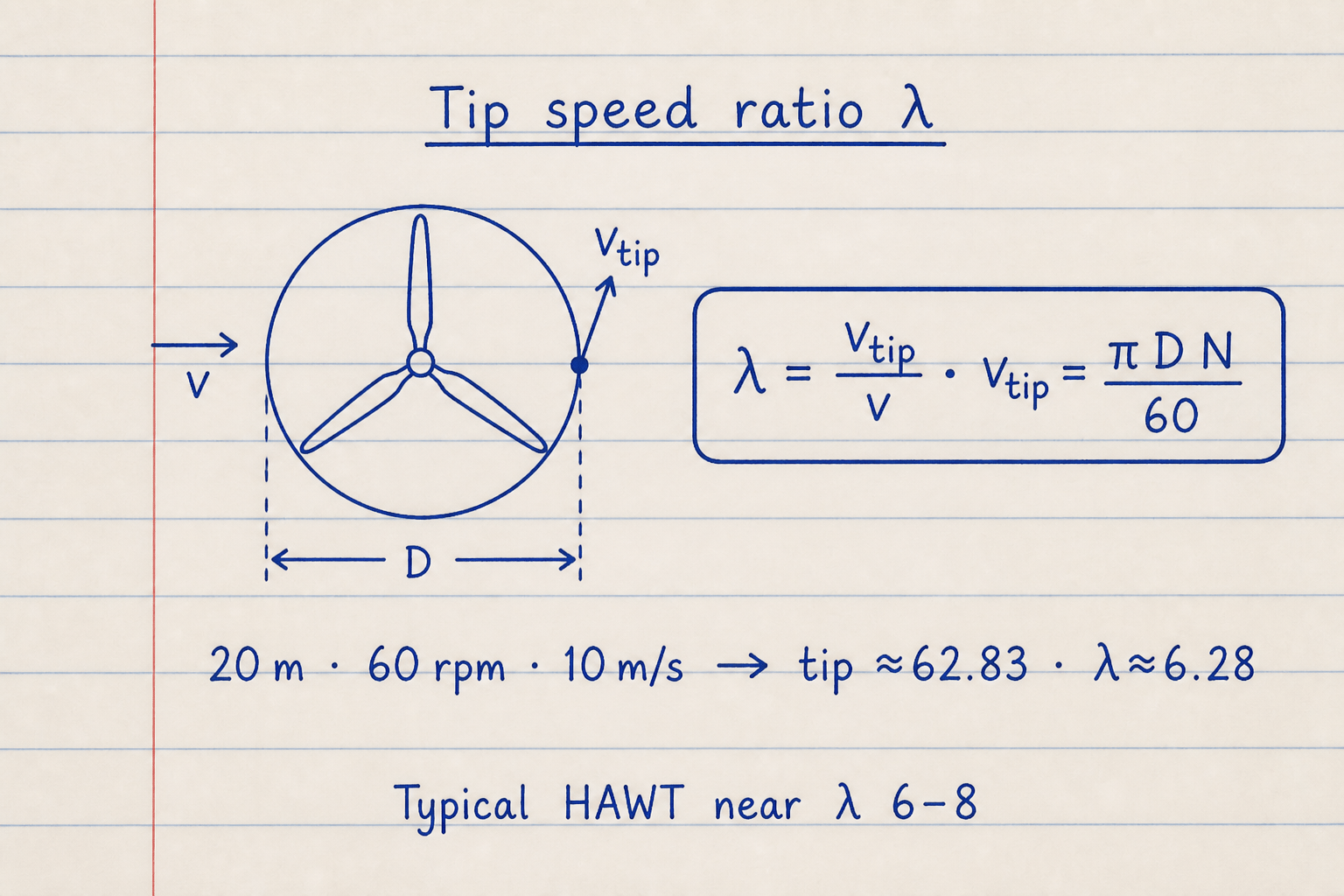
λ = v_tip / v with v_tip = π D N / 60.
Default Measure path: 20 m · 60 rpm · 10 m/s → tip ≈62.83 m/s · λ ≈6.28.
Why power scales with the cube of wind speed
Kinetic power through the disk is ½ ρ A v³. Mass flow brings one factor of v; kinetic energy per mass brings v². Together you get v³. Doubling wind speed multiplies available power by eight.
That is why site wind data dominates sizing. A small error in hub-height speed swamps a careful Cp assumption. This pad shows available power before Cp so you can see the cube effect with your own numbers.
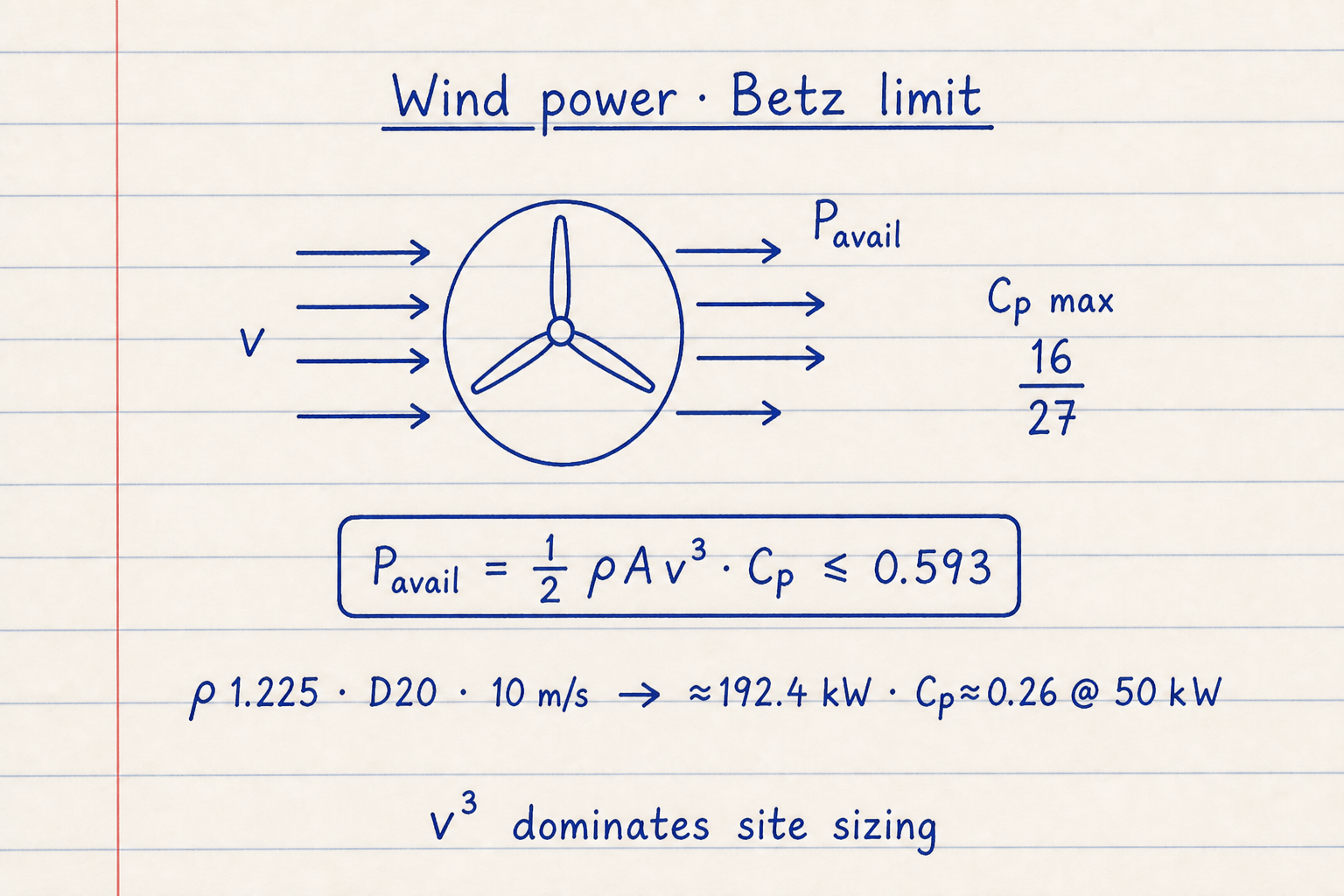
P_avail = ½ ρ A v³. Cp cannot exceed 16/27 ≈ 0.593 (Betz).
Default Measure: ≈192.4 kW available · 50 kW actual → Cp ≈0.26 (~43.8% of Betz).
Measure Cp versus estimate power
Measure Cp is for a known operating point: you have wind, RPM, diameter, and measured electrical or shaft power. The pad backs out Cp and shows percent of Betz. If Cp exceeds 0.593, the amber warning means the inputs are inconsistent.
Estimate power flips the job: you assume Cp and drivetrain efficiency, then get electrical power. That matches screening pads that start from Betz’s law and a generator efficiency. It is still not annual energy. Capacity factor and wind distributions stay out of scope.
Worked example
10 m/s, 20 m rotor, 60 rpm, 50 kW, ρ = 1.225 kg/m³ (Measure Cp, Metric).
- A = π × 20² / 4 = 314.159 m².
- v_tip = π × 20 × 60 / 60 = 62.832 m/s. λ = 62.832 / 10 = 6.283.
- P_avail = ½ × 1.225 × 314.159 × 10³ / 1000 ≈ 192.42 kW.
- Cp = 50 / 192.42 ≈ 0.260 (≈ 26%). Percent of Betz ≈ 43.8%.
- Torque ≈ 9550 × 50 / 60 ≈ 7958 N·m.
Result: λ ≈ 6.28, Cp ≈ 0.260, P_avail ≈ 192.42 kW, about 43.8% of Betz.
When to use
- Screening tip speed ratio for a small HAWT operating point
- Backing out Cp from measured power and site wind
- First-pass electrical power from assumed Cp and η
- Checking whether a claimed Cp beats the Betz limit
Limitations
- Steady uniform wind only; no shear, yaw error, or turbulence
- Not a manufacturer power curve, cut-in/cut-out, or rated-power clip
- No annual energy production or capacity-factor model
- HAWT disk model; not a VAWT area formula
- Shaft torque from the 9550 rule is a screening estimate
FAQ
- What is the Betz limit?
- No open rotor can extract more than 16/27 ≈ 59.3% of the kinetic power in the stream tube, because the air must keep some exit velocity. This pad flags Cp above 0.593. Real machines often peak near 0.35–0.50.
- What tip speed ratio should I target?
- Modern three-blade horizontal-axis turbines often run near λ = 6–8 around rated wind. Very low λ suits high-torque slow rotors. Very high λ raises noise and tip losses. Use the Measure path to see where your RPM and diameter land.
- Why does wind speed matter so much?
- Available power scales with v³. Going from 8 m/s to 10 m/s raises available power by about (10/8)³ ≈ 1.95×, nearly double. Site measurements beat optimistic brochure wind speeds.
- When should I use Estimate power?
- Use it when you do not have measured output yet. Enter a realistic Cp (often 0.25–0.45) and drivetrain efficiency (often 85–95%), then read electrical power. On the default rotor (10 m/s, 20 m, ρ 1.225) with Cp 0.35 and 90% η, electrical power is about 60.61 kW. Switch back to Measure Cp once you have a dyno or inverter reading.
- Can I change air density?
- Yes. Default 1.225 kg/m³ is sea-level standard. Hot or high sites run thinner air and lower available power. Imperial mode accepts lb/ft³ (about 0.0765 at sea level).
- Why is shaft torque only an estimate?
- Torque uses the shop 9550 rule from mechanical power and RPM (same identity as motor pads). It ignores gearbox ratio and generator poles. Treat it as a screening number, not a certified shaft load.
- Is this annual energy?
- No. The pad returns instantaneous power at the wind speed you enter. Annual energy needs a wind-speed distribution, capacity factor, and downtime. Do not multiply the result by 8760 without those corrections.
Solar Panel Tilt Optimizer
Year-round, winter, and summer panel tilt from latitude with Landau mid-latitude forms, plus facing azimuth. Browser-local.
Open calculatorEV Battery Pack Sizing Calculator
Usable and installed pack energy, Ns×Np cell layout, pack Ah, and discharge power from range, efficiency, and cell specs.
Open calculator