You need a high-cycle fatigue screen before you trust a shaft, actuator rod, or fillet under repeated load: Marin-corrected endurance limit Se, fatigue stress concentration Kf, Goodman / Soderberg / Gerber factors of safety, and a Basquin cycles estimate when the equivalent reversed stress sits above Se.
Defaults open on Metric AISI 4140: σm = 50 MPa, σa = 150 MPa, machined surface, d = 30 mm, bending, 90% reliability, Kt = 1.5, q = 0.8, target FOS = 2. CALCULATE returns Se′ = 510 MPa, Se ≈ 282 MPa, Kf = 1.4, Goodman n ≈ 1.26 (Fail vs target 2), and an infinite-life screen on σar ≤ Se. Switch to Ideal Se′ only to match textbook all-k=1 checks. Math stays in your browser.
It sits under Mechanical Calculators next to the stress concentration calculator and safety factor calculator. Pull Kt from a notch chart, then finish the fatigue check here.
Formula
- Specimen endurance (steel rule): Se′ = min(0.5 Sut, 700 MPa). Or use database / custom Se′.
- Marin: Se = ka · kb · kc · kd · ke · Se′. Surface ka = a·Sut^b (Shigley MPa constants). Size kb from diameter (axial kb = 1). Load kc: bending 1, axial 0.85, torsion 0.59. Reliability ke: 50%→1, 90%→0.897, 99%→0.814, 99.9%→0.753.
- Fatigue concentration: Kf = 1 + q(Kt − 1). Effective alternating stress σa,eff = Kf · σa. Stress range Δσ = 2σa.
- Goodman: σa,eff/Se + σm/Sut = 1/n. Soderberg uses Sy. Gerber: σa,eff/Se + (σm/Sut)² = 1/n.
- Equivalent reversed: σar = σa,eff / (1 − σm/Sut) for tensile mean. If σar ≤ Se → infinite-life screen. Else Basquin / Shigley N between ~10³ and 10⁶.
Reproduce the default Metric 4140 path on CALCULATE:
| Quantity | Value on this pad |
|---|---|
| σm / σa / Kt / q | 50 / 150 MPa · 1.5 · 0.8 |
| Sut / Sy / Se′ | 1020 / 655 / 510 MPa |
| Se (Marin) | ≈ 281.7 MPa |
| Kf / σa,eff | 1.40 / 210 MPa |
| Goodman / Soderberg / Gerber n | ≈ 1.26 / 1.22 / 1.34 |
| Check vs target 2 | Fail · infinite-life screen on σar |
How it works
Screens high-cycle fatigue with a Marin-corrected endurance limit Se, fatigue stress concentration Kf, and Goodman / Soderberg / Gerber factors of safety. Estimates cycles to failure with a Basquin / Shigley finite-life curve when the equivalent reversed stress exceeds Se. Metric or Imperial.
Pick Metric (MPa) or Imperial (ksi). Choose stress input as mean+alternating or max/min. Select a material preset (fills Sut, Sy, Se′), Se′ source, and whether to apply Marin factors. Enter diameter, surface, load type, temperature, reliability, Kt, q, and target FOS. CALCULATE locks Results and the Goodman sketch. Editing a field clears Results. RESET restores the 4140 defaults for the active unit system.
Marin factors turn lab Se′ into a real Se
Fatigue screening starts from Se′ ≈ 0.5 Sut for steels, then multiplies surface, size, load, temperature, and reliability factors. That is the Marin equation used on this pad when Marin correction is on.
Try Ideal Se′ only with σa = 200 MPa, custom Se′ = 300 MPa, Kt = 1: then Se = 300 MPa and σa < Se, so the infinite-life screen passes (textbook-style). Turn Marin back on for a machined 30 mm part and watch Se drop.
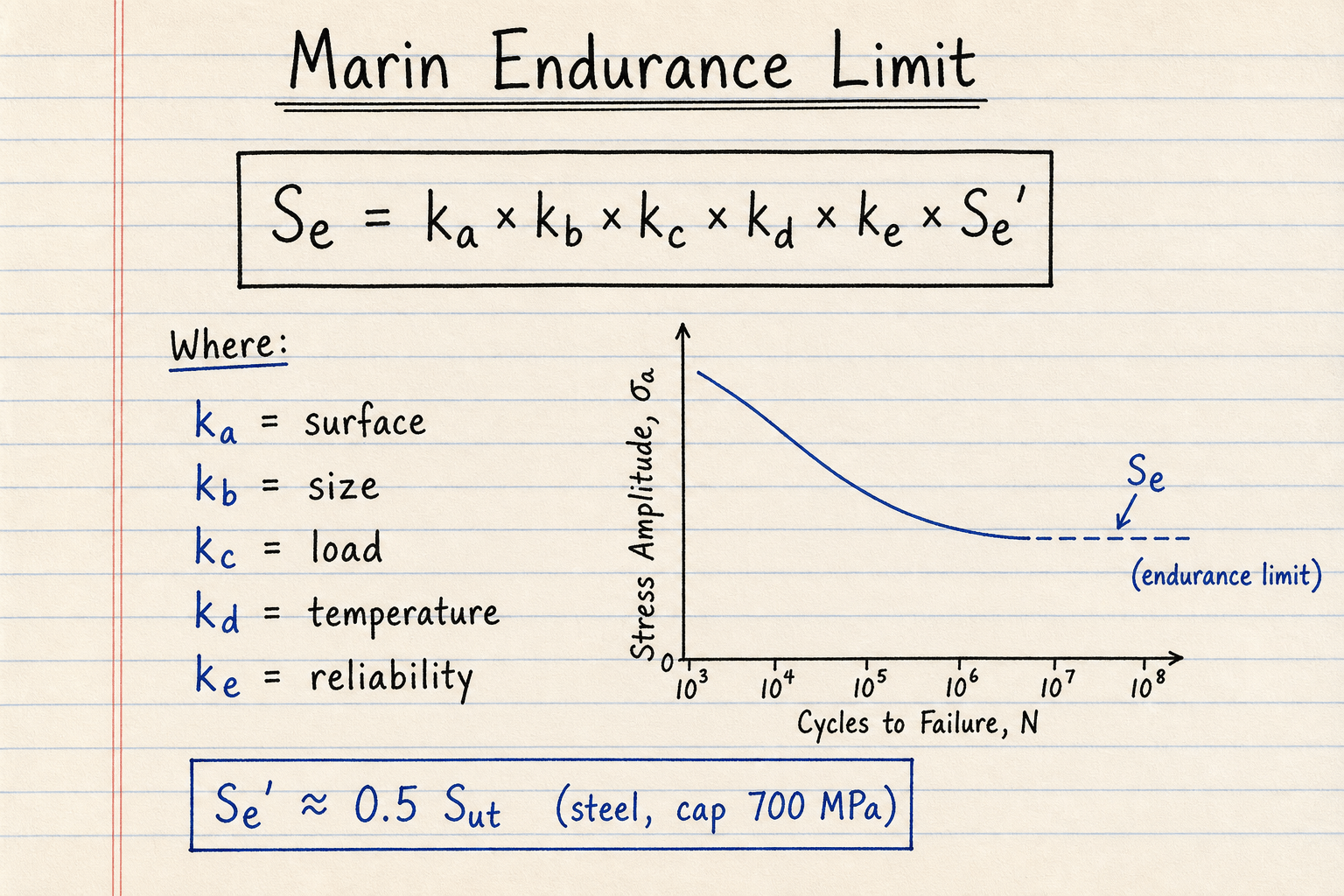
Ground finishes keep ka near 1; as-forged surfaces cut Se hard.
Axial loading uses kb = 1; bending and torsion use the diameter-based size factor.
Goodman, Soderberg, and Gerber on one operating point
Mean stress matters. This pad reports Goodman, Soderberg, and Gerber n together. Design Pass/Fail uses Goodman against your target FOS.
On the defaults, σa,eff = 210 MPa and Se ≈ 282 MPa with σm = 50 MPa give Goodman n ≈ 1.26. That clears a crude infinite-life amplitude check after mean-stress conversion, but it fails a target FOS of 2. Raise fillet radius (lower Kt), improve finish, or grow the section.
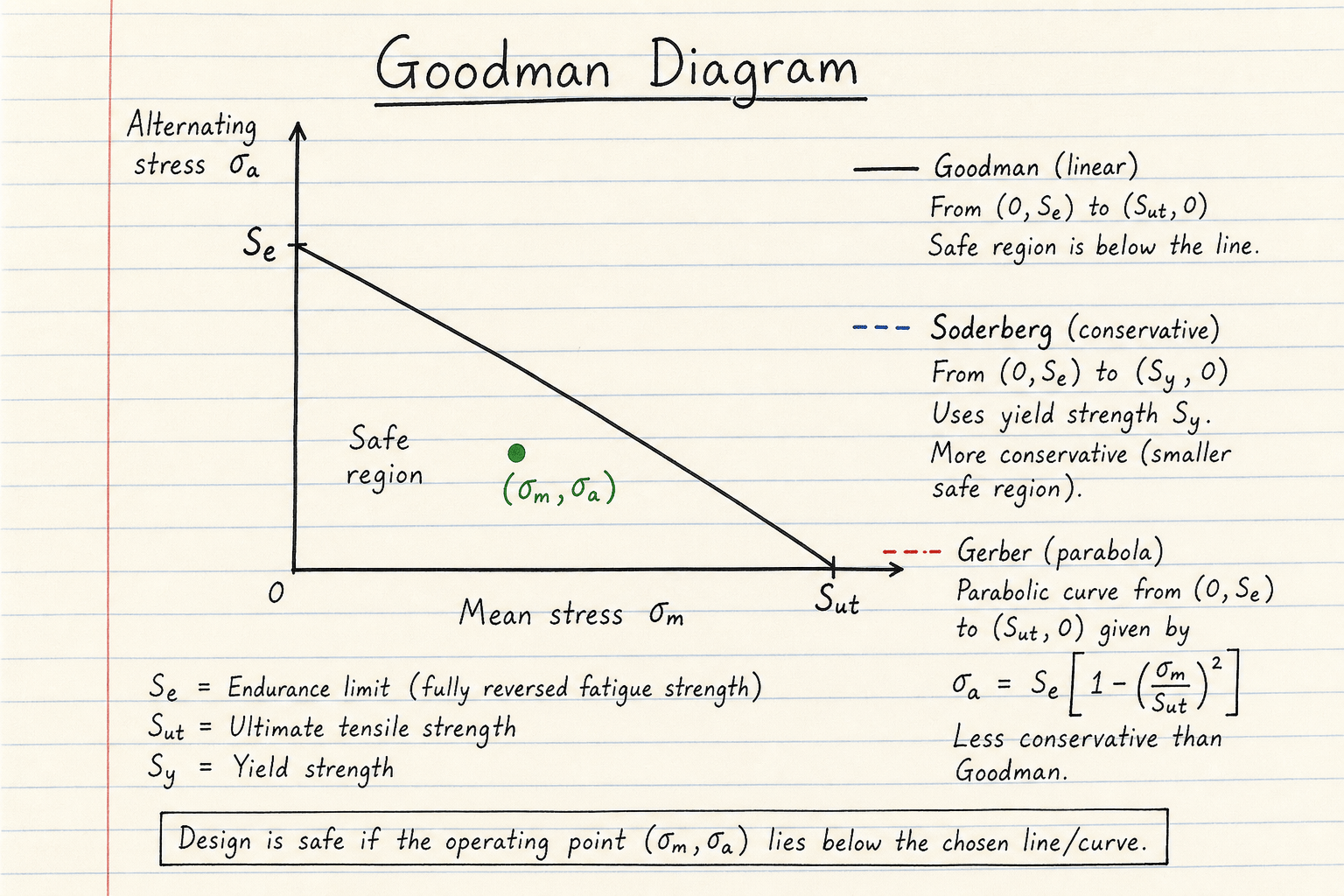
Soderberg is more conservative (uses Sy). Gerber is usually less conservative for ductile metals.
Compression mean is treated as zero mean for these ductile screens.
Amplitude vs range, and finite-life N
FEA and solver docs often store S-N data on stress range. Range = 2 × amplitude. Enter σa here, not Δσ, or you will cut predicted life roughly in half.
When σar > Se, the pad estimates N with a Shigley-style Basquin segment between about 10³ and 10⁶ cycles. Example example: Ideal Se′ = 300 MPa, σa = 400 MPa, σm = 0 → N ≈ 2.9×10⁴ cycles. Below Se, N shows as an infinite-life screen (> 1e6), not a proven forever part.
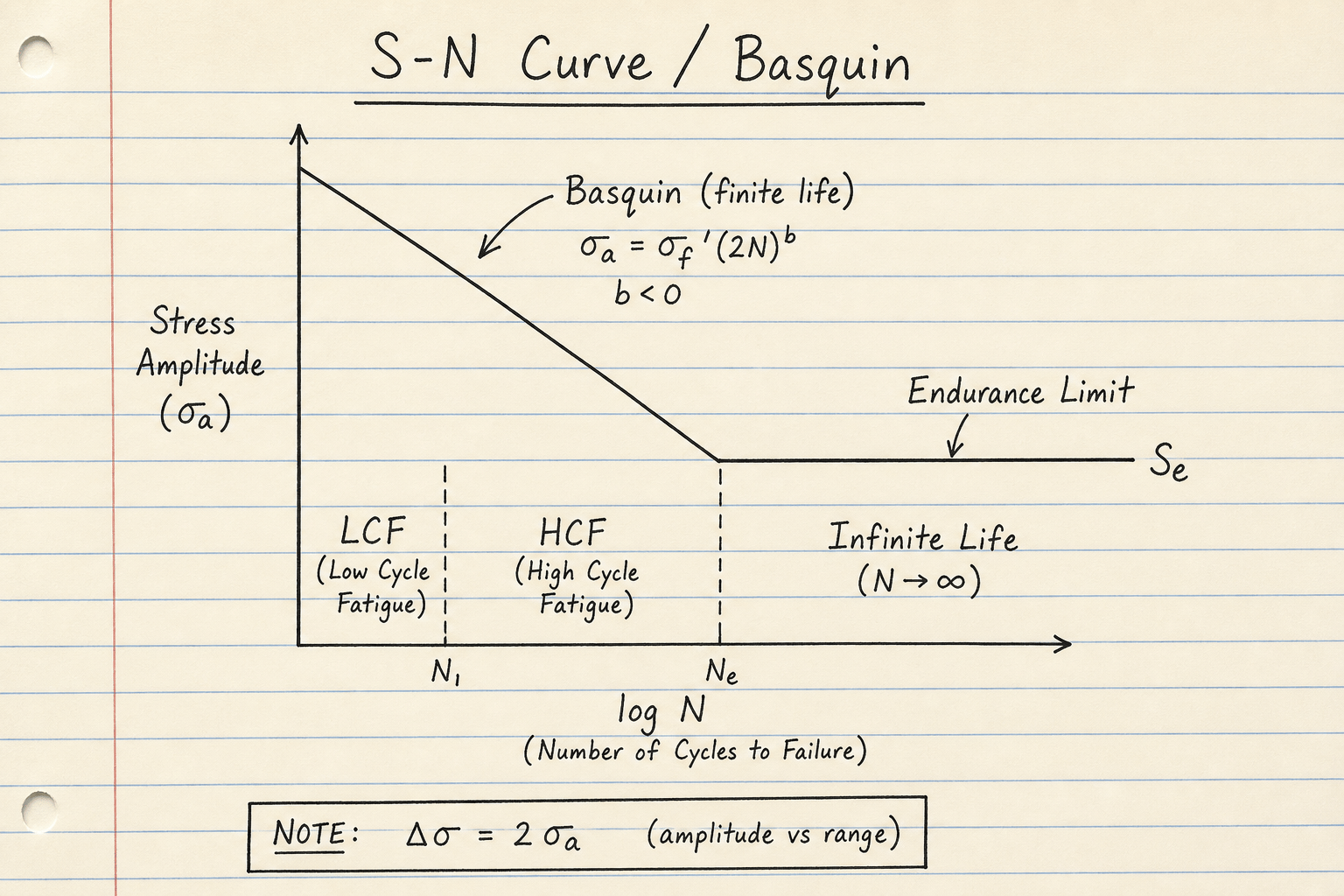
Aluminum alloys lack a true steel-like knee; long-life Se is a screening stand-in.
Variable-amplitude Miner damage and crack-growth (Paris) are out of scope on this pad.
Worked example
Default Metric 4140: σm = 50 MPa, σa = 150 MPa, machined, d = 30 mm, bending, 90% reliability, Kt = 1.5, q = 0.8, target FOS = 2.
- Leave Se′ on 0.5×Sut and Marin on. CALCULATE.
- Se′ = 510 MPa, Se ≈ 281.7 MPa, Kf = 1.4, σa,eff = 210 MPa.
- Goodman n ≈ 1.26 (Fail vs target 2). Infinite-life flag on because σar ≤ Se.
- Ideal Se′ example: Se′ = 300, σa = 200, all k = 1, Kt = 1, target 1.5 → Se = 300, Goodman n = 1.5, Pass.
- Finite-life example: Ideal Se′ = 300, σa = 400 → N ≈ 2.9×10⁴ cycles.
Result: Default: Goodman n ≈ 1.26, Fail at target 2, infinite-life screen on σar.
When to use
- First-pass high-cycle fatigue FOS on a shaft or rod
- Seeing how surface finish, size, and reliability cut Se
- Comparing Goodman vs Soderberg vs Gerber on one (σm, σa) point
- Converting σmax/σmin into amplitude and mean
- Rough Basquin life when amplitude exceeds Se
Limitations
- Constant-amplitude screening only. No Miner spectrum damage summation.
- No crack-growth / Paris-law remaining life.
- No multiaxial critical-plane methods (Findley, Fatemi-Socie).
- Aluminum / nonferrous long-life Se is approximate (no true knee).
- Marin constants are Shigley-style textbook values, not a material certificate.
- Pass/Fail uses Goodman vs your target FOS, not a code allowable.
FAQ
- Should I enter stress amplitude or stress range?
- Amplitude σa. Stress range Δσ = 2σa. Some FEA S-N curves are written on range; converting wrong by a factor of two wrecks N and FOS.
- What is the difference between Goodman and Soderberg?
- Both plot alternating vs mean stress. Goodman uses Sut on the mean axis; Soderberg uses Sy and is usually more conservative. Gerber uses a parabola in mean stress and often sits between them for ductile metals.
- Why can infinite life still Fail the check?
- Infinite-life means the Goodman-equivalent reversed stress is at or below Se. Your target FOS can still demand more margin. The default 4140 case is in that band: infinite screen on, Fail vs target 2.
- When should I use Ideal Se′ only?
- To reproduce textbook examples with all Marin factors = 1. For real parts, leave Marin on and set surface, size, load, temperature, and reliability.
- Does this replace a full fatigue FEA?
- No. It is a transparent screening pad. Variable spectra, residual stress, corrosion, and layout-critical notches need FEA, testing, or a code method.
Safety Factor Calculator
Factor of safety from strength ÷ stress. Yield or ultimate basis, material presets, and reverse solve modes.
Open calculatorStress Concentration Factor (Kt) Calculator
Peterson / Pilkey Kt for holes, flat-bar and shaft fillets, plus optional σmax and fatigue Kf.
Open calculatorVon Mises Stress Calculator
Distortion-energy equivalent stress from plane stress, principals, or a 3D tensor, with yield check.
Open calculatorMohr's Circle Calculator
Plane-stress principals, max shear, principal angle, stress transformation, and von Mises from σx, σy, τxy.
Open calculator