Property profile · live
AISI 1018 carbon steel
Cold drawn / typical
Yield / dens
47.0
- Material
- AISI 1018 carbon steel
- Condition
- Cold drawn / typical
- Yield strength
- 370 MPa
- Tensile strength (UTS)
- 440 MPa
- Density
- 7.87 g/cm³
- Elastic modulus E
- 200.0 GPa
- Shear modulus G
- 77.5 GPa
- Poisson's ratio ν
- 0.29
- Hardness
- 126 HB
- Thermal conductivity k
- 51.9 W/m·K
- Specific heat Cp
- 486 J/(kg·K)
- CTE (linear)
- 11.5 µm/(m·K)
- Thermal diffusivity α
- 13.57 mm²/s
- Yield / density
- 47.0 MPa/(g/cm³)
0.2% proof / typical
G = E / [2(1+ν)]
Brinell when listed
Thermal property set
α = k / (ρ · Cp)
Strength-to-weight screen · always MPa/(g/cm³)
Preview updates as you change material. Press CALCULATE to lock Results.
You need typical mechanical and thermal properties for a shop or design grade — yield, UTS, density, moduli, Poisson ratio, hardness, thermal conductivity, specific heat, CTE, and diffusivity — without digging through a full handbook. This pad looks up a curated set of steels, aluminum, copper alloys, titanium, polymers, and a few ceramics, with Metric or Imperial units and an optional side-by-side compare.
Defaults open on AISI 1018 carbon steel: yield 370 MPa, UTS 440 MPa, density 7.87 g/cm³, E = 200 GPa, k ≈ 51.9 W/m·K. CALCULATE locks Results; the live preview updates as you change category or grade. Compare mode pairs 1018 against Aluminum 6061-T6 by default so strength-to-weight jumps stand out. Math stays in your browser.
It sits under Mechanical Calculators next to the metal weight calculator and safety factor calculator. This is a curated lookup table — not a full manufacturer datasheet library, NASA TPSX ablators, or a mill certificate.
Formula
- Lookup: property values from the curated material table for the selected index.
- Shear modulus G = E / [2(1 + ν)].
- Thermal diffusivity α = k / (ρ · Cp) with ρ in kg/m³ → mm²/s.
- Yield/density = Sy / ρ (MPa per g/cm³) — strength-to-weight screen.
- Imperial: MPa→ksi, GPa→Msi, g/cm³→lb/in³, W/m·K→BTU/(h·ft·°F), Cp and CTE converted accordingly.
Reproduce the default AISI 1018 path on CALCULATE:
| Quantity | Value |
|---|---|
| Material | AISI 1018 carbon steel (cold drawn / typical) |
| Yield / UTS | 370 / 440 MPa |
| Density / E | 7.87 g/cm³ / 200 GPa |
| G / ν | ≈ 77.5 GPa / 0.29 |
| k / Cp / α | 51.9 W/m·K · 486 J/(kg·K) · ≈ 13.6 mm²/s |
| Yield / density | ≈ 47.0 MPa per g/cm³ |
| 6061-T6 example | Sy 276 · k 167 · α ≈ 69 mm²/s · Sy/ρ ≈ 102 |
How it works
Pick a curated engineering grade (or compare two) to view typical yield, UTS, density, moduli, Poisson ratio, hardness, thermal conductivity, specific heat, CTE, and diffusivity. Metric or Imperial units. Reference data for preliminary design — confirm temper and mill certificates for production.
Pick Metric or Imperial. Choose Lookup or Compare. Filter by category, then select a material (and a different Material B in Compare). The right column shows a live property profile and preview cards or a side-by-side table. CALCULATE locks Results; editing clears the lock. RESET restores AISI 1018 lookup defaults. Yield and yield/density show — when the grade has no useful tensile yield (grey cast iron, alumina).
What this pad is (and is not)
This TaskJunction pad follows the curated comparison path: internationally recognized generic grades with typical room-temperature values, easy Metric/Imperial switching, and optional side-by-side compare — not hundreds of thousands of trade-name sheets.
NASA TPSX focuses on thermal-protection and aerospace specialty materials (emissivity, absorptivity, ablators). Those categories are out of scope here. Use this pad for common fixture, machine, and product grades.
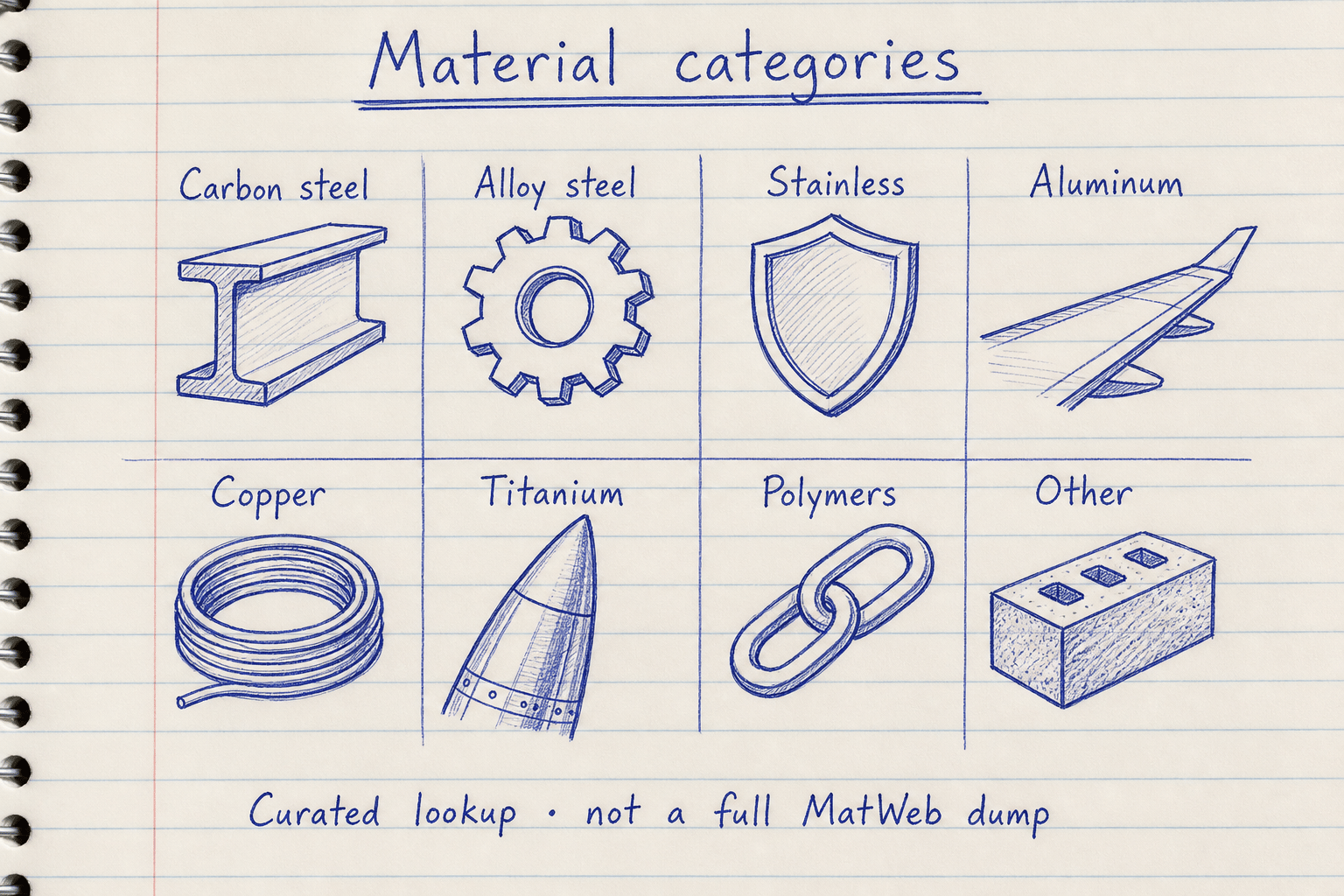
Filter by carbon/alloy steel, stainless, aluminum, copper, titanium, polymers, or other.
Default CALCULATE path stays on AISI 1018 so batch verify and old bookmarks keep the same numbers.
Mechanical set vs thermal set
Material datasheets split physical / mechanical / thermal. Thermal databases highlight k, diffusivity α, specific heat Cp, and density together. This pad returns both stacks: Sy, UTS, E, G, ν, hardness, plus k, Cp, CTE, and α = k/(ρ·Cp).
Yield/density is a quick strength-to-weight screen. Aluminum 6061-T6 (~102) beats 1018 (~47) on that metric even though absolute yield is lower — useful when mass matters more than raw MPa.
Property groups on this pad:
| Group | Fields |
|---|---|
| Mechanical | Yield, UTS, E, G, ν, hardness (HB when listed) |
| Physical | Density (g/cm³ or lb/in³) |
| Thermal | k, Cp, CTE, α |
| Derived | G from E,ν · α from k,ρ,Cp · Sy/ρ |
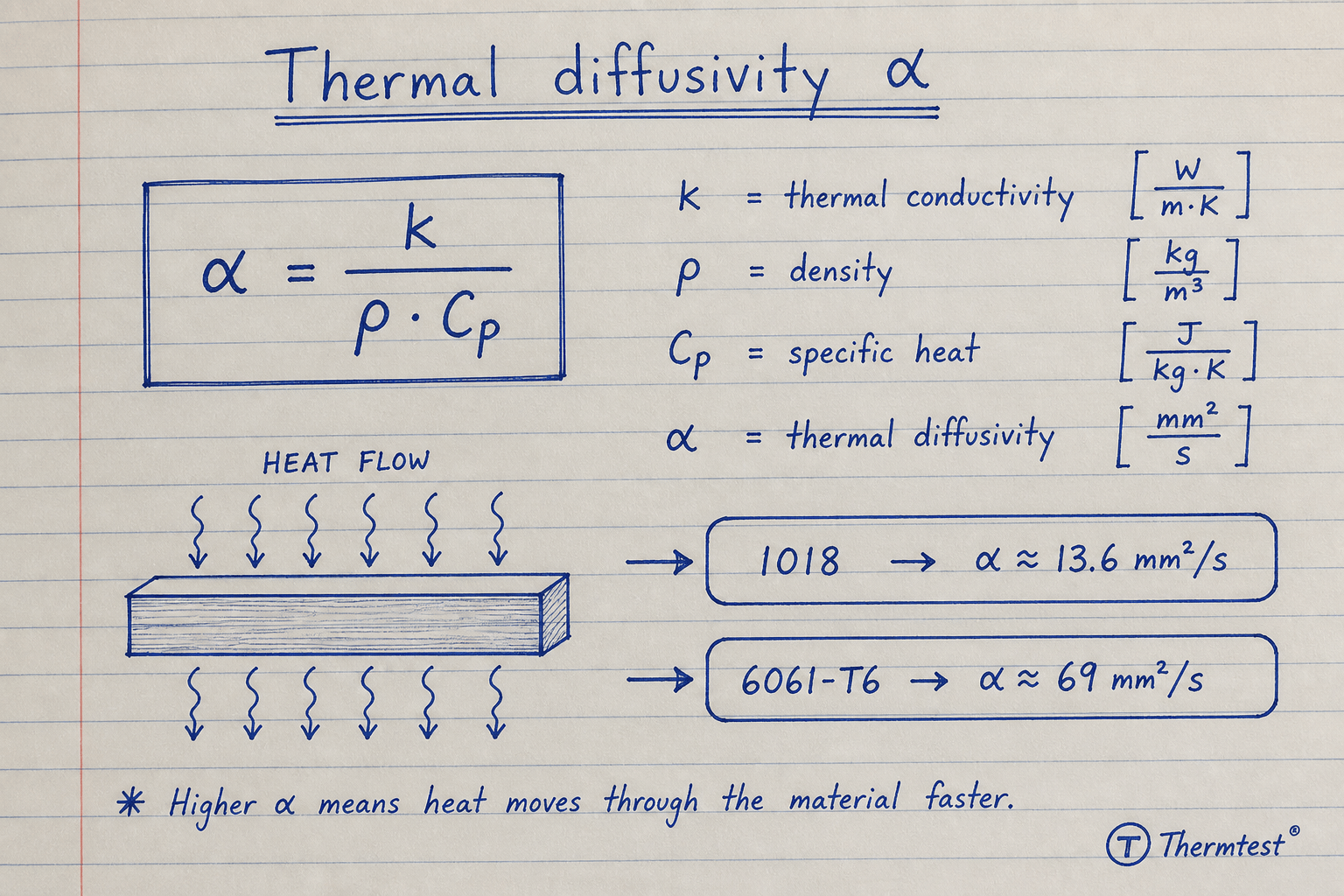
1018: α ≈ 13.6 mm²/s. 6061-T6: α ≈ 69 mm²/s — heat spreads faster in the aluminum.
Copper C110 sits near the top of the k bar; polymers sit near the bottom.
Compare mode and unit systems
Switch to Compare to put Material A and B on one table. Imperial converts strengths to ksi, moduli to Msi, density to lb/in³, and thermal units to common US customary forms.
Always note the condition line (annealed, T6, Q&T). The same alloy number with a different temper can double the yield — this table stores one typical condition per entry.
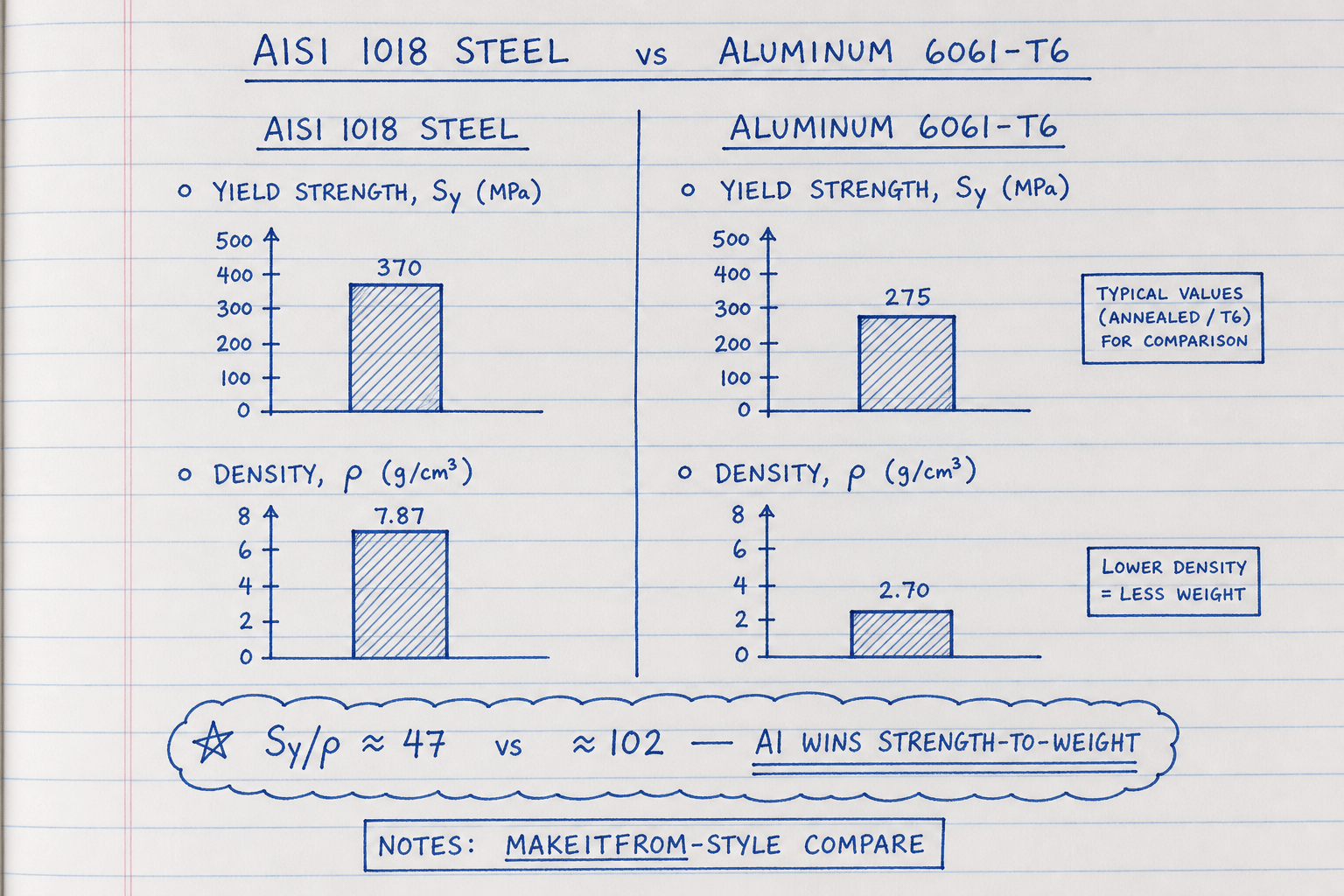
Default compare pair: AISI 1018 vs Aluminum 6061-T6.
Sy/ρ ≈ 47 vs ≈ 102 — aluminum wins the strength-to-weight screen; steel wins absolute stiffness E.
Worked example
Default Metric lookup — AISI 1018 carbon steel.
- Select AISI 1018 (or leave the default).
- Read yield 370 MPa, UTS 440 MPa, density 7.87 g/cm³, E = 200 GPa.
- G = 200 / [2(1.29)] ≈ 77.5 GPa; α = 51.9 / (7870 × 486) → ≈ 13.6 mm²/s.
- Yield/density ≈ 370 / 7.87 ≈ 47.0.
Result: Typical cold-drawn 1018 properties for preliminary design and weight/stress screens.
When to use
- Quick property lookup while sizing a part or fixture
- Comparing steel vs aluminum on strength-to-weight
- Grabbing density for the metal weight calculator
- Checking thermal k / Cp / α for a first-pass heat estimate
Limitations
- Curated table (~19 grades) — not a full online datasheet library or NASA TPSX specialty materials
- One typical condition per grade; temper and form change real numbers
- Hardness omitted (—) for polymers/ceramics without HB listing
- Grey cast iron yield shown as 0 (no useful tensile yield in usual sense)
- Always verify from mill test certificate / datasheet for production
FAQ
- Which materials are included?
- Carbon and alloy steels (1018, 1045, 4140 annealed/Q&T, 4340, A36), stainless 304/316, aluminum 1100/6061-T6/7075-T6, copper C110, brass C360, Ti-6Al-4V, grey cast iron, nylon 6/6, acetal, acrylic, and alumina ceramic.
- How is this different from large online material databases?
- Large online databases list thousands of trade-name sheets. This pad is a fast in-browser curated subset with compare and unit switching — good for first-pass work, not a substitute for full datasheets.
- What is thermal diffusivity α?
- α = k / (ρ · Cp). It tells you how quickly a temperature front moves through the solid. Thermal handbooks list it alongside k, Cp, and density for the same reason.
- Why is cast iron yield shown as —?
- Grey cast iron is usually specified by tensile strength, not a ductile yield point. The table stores Sy = 0 and the UI shows — for yield and yield/density. Use UTS and the application standard for allowable stress.
- Why does yield/density stay in MPa/(g/cm³) on Imperial?
- The strength-to-weight screen is kept on one unit system so Metric and Imperial compares stay numerically identical. Absolute Sy, UTS, density, E, and thermal fields still switch with the unit tab.
Metal Weight Calculator
Bar, plate, tube, washer, and structural weight plus material cost from alloy density, shape dims, quantity, and margin. Metric or Imperial with dual kg/lb.
Open calculatorSafety Factor Calculator
Factor of safety from strength ÷ stress. Yield or ultimate basis, material presets, and reverse solve modes.
Open calculatorBeam Stress and Deflection Calculator
Six textbook beam cases: max moment, shear, stress, deflection, slope, and L/360 check with animated 2D sketches.
Open calculatorHeat Transfer Calculator (Conduction)
Conduction heat rate, thermal resistance, and heat flux through a plane wall.
Open calculatorUnit Converter
Convert area, data rate, digital storage, energy, force, frequency, fuel economy, length, mass, angle, power, pressure, speed, temperature, time, and volume.
Open calculator