- R/t Ratio
- n/a
- Min Inside Radius
- n/amm
- Outside Radius
- n/amm
- Springback
- n/adeg
- Overbend Target
- n/adeg
- R/t Class
- n/a
- Desired vs Min
- n/a
Before you lock a print radius or pick a punch tip, check whether the inside bend is safe for the alloy and temper. This pad returns a starting minimum inside radius from material R/t, bending method, grain direction, and thickness, plus a heuristic springback and overbend target.
Pick Metric or Imperial, choose material and temper (or Custom R/t), set air / bottom / coin, grain across or with, enter thickness and formed bend angle, then CALCULATE. Optional desired inside radius reports OK or Too tight against R_min. Math stays in your browser.
It sits under Sheet Metal Calculators. After the radius clears, develop the blank on the sheet metal bend allowance calculator. For plate mass before you order stock, use the metal weight calculator.
Formula
- Base R/t from material × temper table (Custom uses your R/t factor).
- Effective R/t = base × method multiplier × grain multiplier. Method: air 1.0, bottom 0.85, coin 0.7. Grain: across 1.0, with grain 1.25.
- R_min = (R/t) × T. Outside radius Rₒ = R_min + T.
- Springback ≈ method base × (θ / 90°). Overbend target ≈ θ + springback.
- Desired check (optional): OK when desired R ≥ R_min; margin = desired − R_min.
Default Metric path (Stainless 304, annealed, air, across grain, T = 2 mm, θ = 90°):
| Quantity | Value |
|---|---|
| Base R/t (SS304 annealed) | 0.5 |
| Method × grain | 1.0 × 1.0 |
| Effective R/t | 0.500 |
| Min inside radius R_min | 1.000 mm |
| Outside radius | 3.000 mm |
| Springback / overbend | 3.00° / 93.00° |
| R/t class | Typical |
How it works
Pick Metric or Imperial. Choose material, temper, bending method (air / bottom / coin), and grain direction. Enter thickness and formed bend angle. Optional desired inside radius checks OK when it clears R_min. CALCULATE returns R/t, min and outside radii, springback, overbend target, and R/t class (Tight / Typical / Generous). Custom R/t factor appears when you pick Custom. RESET restores Stainless 304 annealed air-bend defaults for the active unit tab.
Choose Metric or Imperial. Select Material (Stainless 304 default), Temper, Bending method, and Grain direction. Enter Thickness and Bend angle (1° to 179°). Optional Desired inside radius compares to R_min (OK when desired ≥ R_min). Custom R/t factor is editable only when Material is Custom R/t factor. CALCULATE fills Results and animates the radius sketch. Editing a field or switching units clears Results. RESET restores Stainless 304 annealed air-bend defaults for the active unit tab.
R/t is the sheet-metal rule of thumb
Minimum inside bend radius is usually written as a multiple of thickness: R_min = (R/t) × T. Soft annealed stock can take a tighter multiple than full-hard or high-strength tempers. This pad stores starting R/t values by alloy and temper, then scales them for method and grain.
Industry bend-radius tables also publish family-level multiples that grow with thickness band (for example aluminium near 1×T in thin gauge and higher in thick plate). Treat those charts and this pad as first-pass screens, then confirm with your mill chart or a coupon.
For background on how sheet forming stretches the outer fiber of a sheet metal bend, see the bending overview on Wikipedia. That page is context only. Your shop table still wins for production R/t.
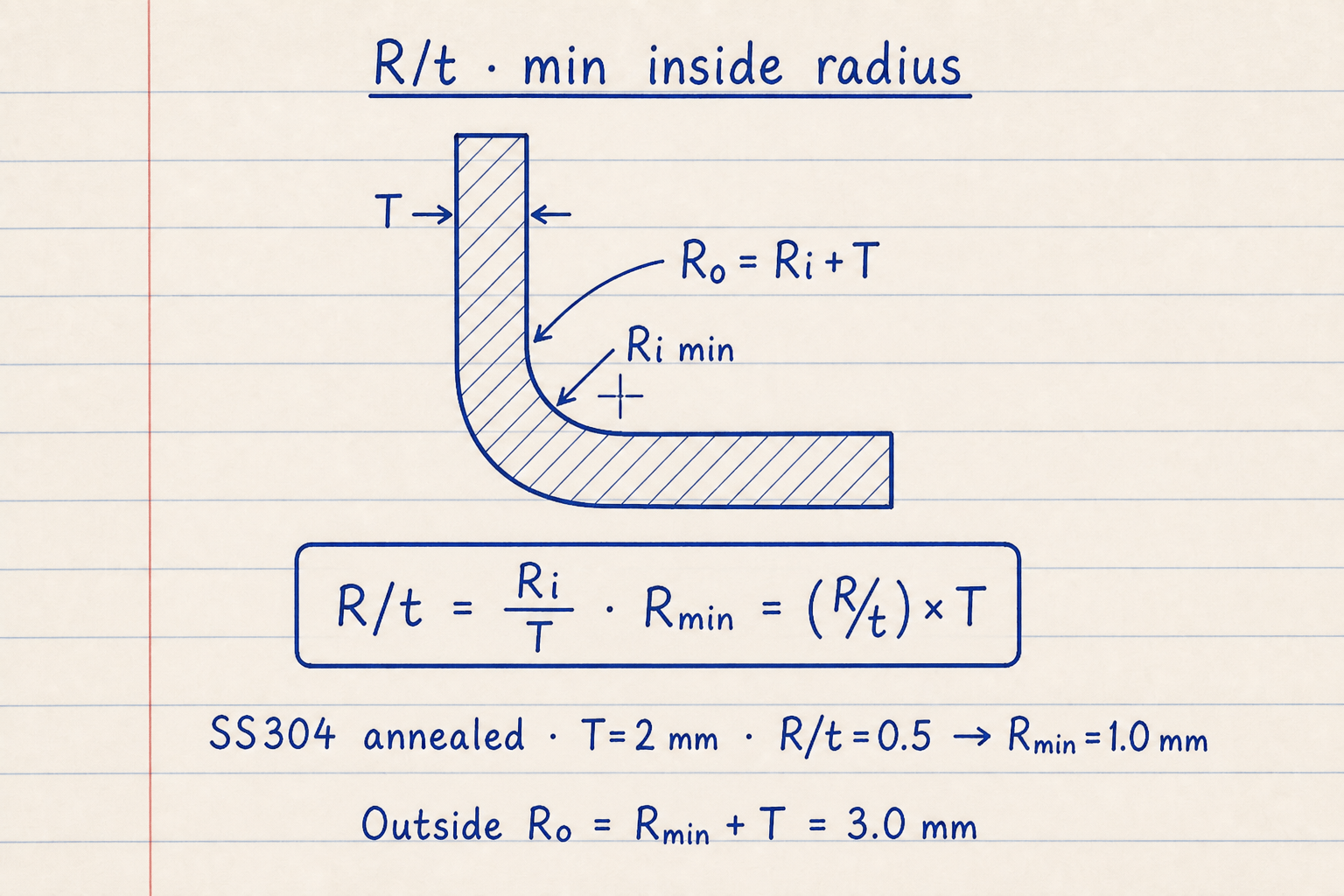
The note shows an L-bend: thickness T, inside radius Ri min, outside Ro = Ri + T. R/t = Ri / T and R_min = (R/t) × T.
Metric defaults (SS304 annealed, air bend, T = 2 mm): R/t = 0.5 → R_min = 1.0 mm · Ro = 3.0 mm after CALCULATE.
Grain direction changes the safe radius
Sheet has a rolling grain. Across grain means the bend line is perpendicular to the rolling direction — usually a tighter inside radius. With grain means the bend line runs parallel to rolling — the outer fiber stretches along the hard direction and often needs more radius.
This pad multiplies R/t by 1.25 when you select With grain. That is a screening bump, not a mill guarantee. Edge condition, coating, and prior cold work can move the limit further.
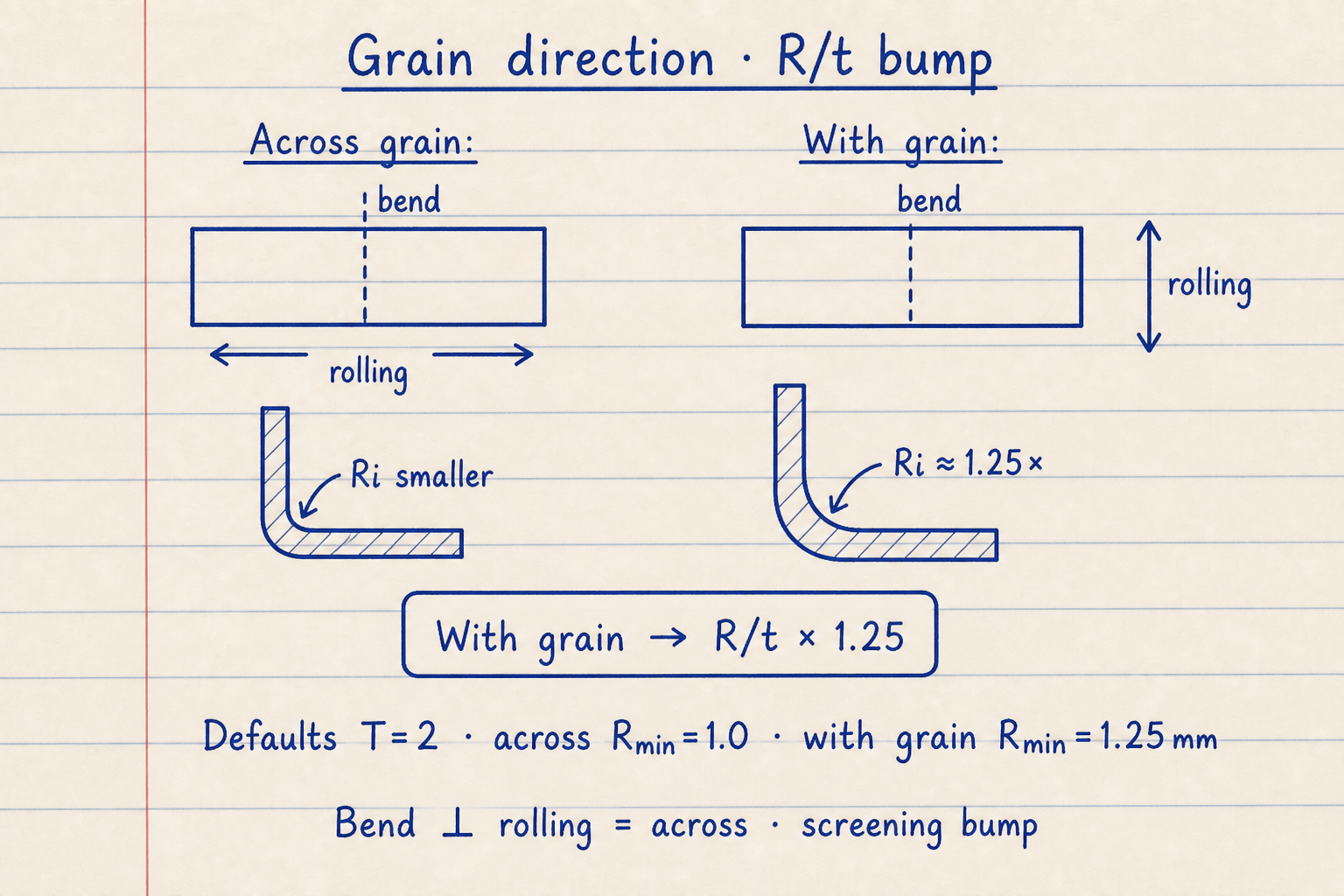
Across grain: bend ⊥ rolling → smaller Ri. With grain: bend ∥ rolling → R/t × 1.25 on this pad (screening bump, not a mill guarantee).
Defaults T = 2 mm: across R_min = 1.0 mm · with grain R_min = 1.25 mm. Switch Grain direction and CALCULATE to reproduce.
Air bend, bottoming, and coining
Air bend leaves the sheet spanning the V-die; the punch tip largely sets the inside radius and force stays moderate. Bottoming presses deeper into the die. Coining forces the sheet into the tool with high tonnage and can support a smaller effective R/t at the cost of tool wear and press load.
Method multipliers here are 1.0 (air), 0.85 (bottom), and 0.7 (coin) on the base R/t. Springback baselines are 3°, 1.5°, and 0.5° at 90°, then scaled by θ/90. Use them to plan overbend, not to skip a tryout bend.
Method multipliers on this pad:
| Method | R/t multiplier | 90° springback base |
|---|---|---|
| Air bend | 1.00 | 3.0° |
| Bottom bend | 0.85 | 1.5° |
| Coining | 0.70 | 0.5° |
What this calculator is not
Many online tools titled minimum bend radius solve different products entirely. Cable guides multiply outer diameter by a code factor. Aluminium extrusion shops publish profile-size tables. Wood tools size steam or laminate curves. None of those replace a sheet-metal R/t check.
Stay on this pad for press-brake sheet and plate screening. If you are routing cable, rolling window profiles, or steam-bending timber, use the matching specialty chart instead.
Starting R/t table (annealed / half hard / full hard)
These are the base factors before method and grain multipliers. Custom R/t bypasses the table. Values are indicative handbook-style starters for air-bend screening.
Base R/t factors used by this pad:
| Material | Annealed / soft | Half hard | Full hard |
|---|---|---|---|
| Cold rolled steel (CRS) | 0.0 | 0.5 | 1.0 |
| Hot rolled steel (HRS) | 1.5 | 2.5 | 4.0 |
| Stainless 304 | 0.5 | 1.0 | 1.5 |
| Stainless 316 | 2.0 | 3.0 | 5.0 |
| Aluminium 5052 | 1.0 | 1.5 | 2.5 |
| Aluminium 6061 | 1.0 | 1.5 | 2.5 |
| Copper | 0.0 | 0.5 | 1.0 |
| Brass | 0.0 | 0.5 | 1.0 |
| Titanium | 2.5 | 3.5 | 6.0 |
Worked example
Metric defaults: Stainless 304, annealed / soft, air bend, across grain, T = 2 mm, θ = 90°, no desired radius.
- Leave Metric selected. Confirm Stainless 304, Annealed / soft, Air bend, Across grain, thickness 2, angle 90.
- Base R/t = 0.5. Method × grain = 1.0 × 1.0. Effective R/t = 0.500.
- R_min = 0.5 × 2 = 1.000 mm. Outside = 1 + 2 = 3.000 mm.
- Springback = 3.0 × (90/90) = 3.00°. Overbend target = 93.00°. R/t class = Typical.
- Optional: enter Desired inside radius 0.5 mm and CALCULATE again. Status becomes Too tight with margin −0.500 mm.
Result: Min inside radius 1.000 mm, outside 3.000 mm, springback 3.00°, overbend 93.00°, R/t class Typical.
When to use
- Screening a print inside radius before brake programming
- Comparing air vs bottom vs coin starting R/t
- Checking whether a desired radius clears R_min
- Estimating springback and overbend for a first tryout
Limitations
- Material R/t table is indicative. Prefer mill bend charts or coupon tests for production.
- Does not model V-die opening, punch tip radius, coating crack, or FEA strain.
- Thickness-band charts (thicker plate needing larger multiples) are guidance in the article, not automatic factors here.
- Not for cable OD multipliers, aluminium extrusion profiles, or wood steam/laminate bends.
- Springback is a method heuristic scaled by angle, not a measured brake correction.
FAQ
- What does R/t class mean?
- It describes how aggressive the recommended minimum is. Tight means effective R/t under 0.3 (very sharp). Typical is 0.3 to under 1.5. Generous is 1.5 and above. It is not a FEA crack probability.
- Why did Desired vs Min say Too tight?
- Your optional desired inside radius is smaller than R_min for the current material, temper, method, grain, and thickness. Increase the design radius or change process inputs, then CALCULATE again.
- Air bend vs coining on this pad?
- Air bend multiplies R/t by 1.0 with a 3° springback base at 90°. Bottom uses 0.85 and 1.5°. Coin uses 0.7 and 0.5°. Coining can support a smaller R/t but needs much higher tonnage.
- How does with-grain change the answer?
- With grain multiplies R/t by 1.25. On the SS304 annealed air defaults, R_min rises from 1.000 mm to 1.250 mm.
- Why scale springback by bend angle?
- The method base is defined at 90°. Springback ≈ base × (θ / 90°). A 45° coin bend on aluminium half-hard uses base 0.5°, so springback ≈ 0.25°.
- Is this the same as a cable or wood bend-radius tool?
- No. Cable tools multiply cable OD by a code factor. Wood tools size steam or laminate curves. Extrusion shops publish profile tables. This calculator is for sheet metal press-brake R/t screening only.
Sheet Metal Bend Allowance Calculator
Bend allowance, bend deduction, outside setback, and flat blank from thickness, inside radius, K-factor, and flange measure mode. Metric or Imperial.
Open calculatorMetal Weight Calculator
Bar, plate, tube, washer, and structural weight plus material cost from alloy density, shape dims, quantity, and margin. Metric or Imperial with dual kg/lb.
Open calculator