You need to know how hard a shop-air cylinder will push and pull before you pick a bore. This pad takes supply pressure, bore, rod (for double-acting), optional friction loss, and an optional spring return for single-acting cylinders, then returns theoretical and practical extend/retract force, piston and annulus areas, and the retract/extend ratio.
Defaults open on a double-acting shop-air path: 6 bar, 50 mm bore, 20 mm rod, 0% friction. That path gives about 1,178 N extend (120.1 kgf), 990 N retract (100.9 kgf), and a ratio of 0.84. Switch Metric or Imperial first. Math stays in your browser.
It lives under Fluid Power Calculators. For oil cylinders use the hydraulic cylinder force calculator. For pump displacement and drive power use the hydraulic pump selector.
Formula
- Extend (outward): F = P × (π/4) × D² with full bore area.
- Retract (double-acting): F = P × (π/4) × (D² − d²) on the annulus.
- P in pascals (bar × 10⁵ or psi converted), diameters in metres (mm or in converted).
- Practical force = theoretical × (1 − friction%/100). Single-acting also subtracts spring return on extend.
- Single-acting air retract force is 0 on this pad; return shows the spring force you enter.
- Shortcut with bar and mm: F (N) = π × D² × P / 40 for extend.
Reproduce the default Metric double-acting path:
| Check | Value on this pad |
|---|---|
| Inputs | 6 bar, bore 50 mm, rod 20 mm, friction 0%, double-acting |
| Piston area | ≈ 19.63 cm² |
| Extend | ≈ 1,178 N (≈ 120.1 kgf) |
| Retract | ≈ 990 N (≈ 100.9 kgf) |
| Ratio | ≈ 0.840 |
How it works
Pick Metric or Imperial, then choose double-acting or single-acting. The cutaway diagram follows the type. Enter supply pressure at the cylinder port, bore, and (for double-acting) rod diameter. Optional friction loss (typical 10–25%) scales theoretical force down to a practical estimate. Single-acting can subtract spring return from the extend stroke. CALCULATE returns theoretical and practical push/pull, areas, and retract/extend ratio, then animates the stroke.
Pick Metric (bar, mm, N/kgf) or Imperial (psi, in, lbf). Choose Double-acting or Single-acting; the cutaway diagram switches with the type (two ports vs blind port + spring/vent). Enter port pressure, bore, and rod when double-acting. Friction loss defaults to 0% so theoretical equals practical; try 10–25% for a shop estimate. On single-acting, enter spring return if you know it. CALCULATE fills the force cards and animates the stroke. RESET restores the 6 bar / 50 mm defaults.
Bore, rod, and why retract is weaker
Air force follows Pascal's law: pressure times the area the gas can push. On extend that area is the full bore face. On retract the rod takes a bite out of the face, so the pressurized annulus is smaller and pull force drops.
On the default 50 mm / 20 mm path the annulus is about 84% of the bore area, which is why the ratio lands near 0.84. If your fixture needs pull force, size on the retract number, not the extend headline.
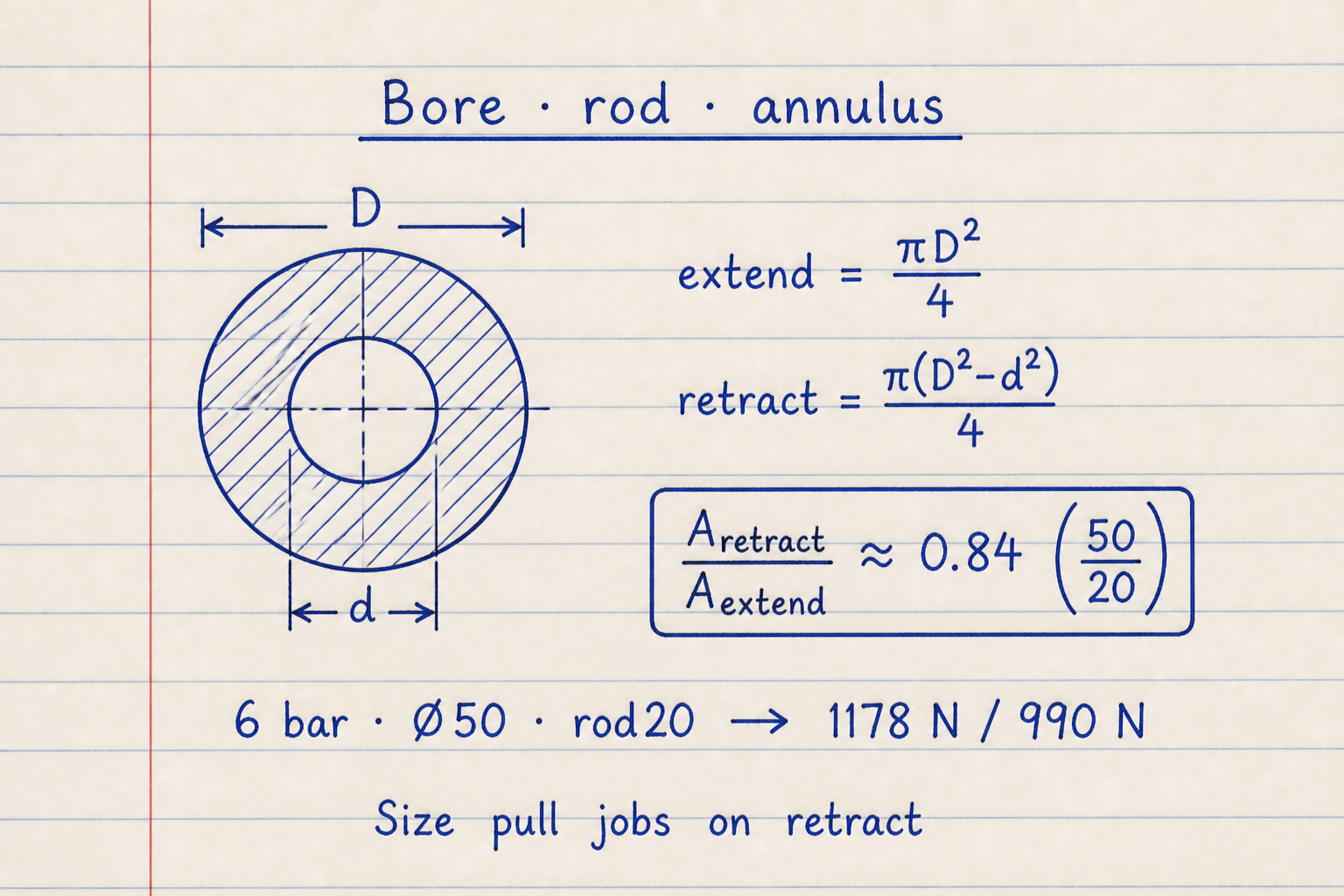
Full bore area for extend; hatched annulus for retract. Rod d never equals bore D on a working cylinder.
Default CALCULATE: 6 bar · Ø50 · rod 20 → ≈1,178 N extend / ≈990 N retract (ratio ≈0.84).
Theoretical force vs friction loss
Catalog tables and the theoretical cards on this pad ignore seal drag, guide friction, and exhaust back-pressure. Shop practice often knocks 10–25% off for standard ISO 15552 cylinders. Low-friction seals sit nearer 5–15%. Guided or dirty rods can lose more.
Enter Friction loss as a percent. Practical extend and retract then equal theoretical × (1 − friction/100). Leave friction at 0% when you want a clean Pascal check that matches hand calc and datasheet theory columns.
- Typical shop estimate: 10–15% for a clean, well-lubricated cylinder
- Conservative fixture sizing: 20–25% when seals, guides, and back-pressure all matter
- This percent is a lumped estimate, not a measured seal model
Default path with friction examples (6 bar, 50 mm, 20 mm):
| Friction | Extend practical | Retract practical |
|---|---|---|
| 0% | 1,178 N | 990 N |
| 10% | 1,060 N | 891 N |
| 25% | 884 N | 742 N |
Single-acting vs double-acting on this pad
Double-acting uses air for both strokes. You enter rod diameter and get both extend and retract air forces, plus annulus area and retract/extend ratio. Single-acting uses air on the blind end only. Return is a spring (or an external load), so air retract force shows as 0. The spring return field becomes the return force card when you enter a value. Annulus and ratio cards stay hidden in single-acting mode.
For single-acting, practical extend subtracts the spring force after the friction factor. That matches the usual Feff = P×A − Ff − Fs teaching form without pretending the spring is a precise Hooke model.
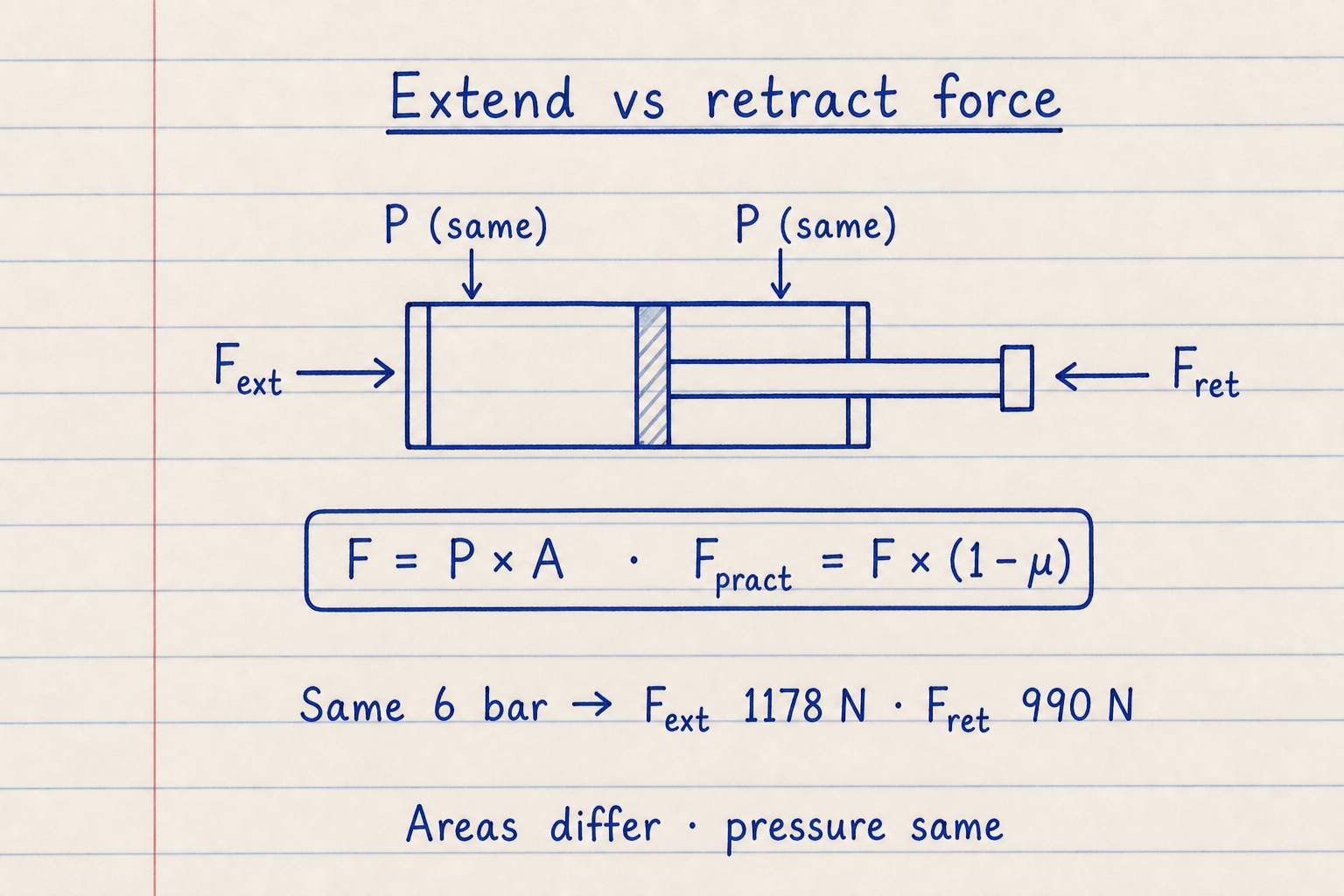
Same supply pressure still yields different forces because the areas differ. Size critical pull jobs on F_retract.
F = P × A · practical = F × (1 − friction%). Live cutaway animates after CALCULATE.
Shop pressure, kgf, and ISO bore checks
Use the regulated pressure at the cylinder port, not compressor tank pressure. Many plants run 5–7 bar at the machine. Metric results show N and kgf (1 kgf ≈ 9.807 N) so you can compare against common ISO 15552 catalog columns.
At 6 bar, a 63 mm bore with a 20 mm rod is about 1,870 N extend (≈ 190.7 kgf) and 1,682 N retract (≈ 171.5 kgf) before friction. Scale any 6 bar table by (your bar ÷ 6) for a quick line-pressure change.
Theoretical push/pull at 6 bar (common bores, 0% friction):
| Bore mm | Rod mm | Extend N | Retract N |
|---|---|---|---|
| 32 | 12 | 483 | 415 |
| 40 | 16 | 754 | 633 |
| 50 | 20 | 1,178 | 990 |
| 63 | 20 | 1,870 | 1,682 |
| 80 | 25 | 3,016 | 2,721 |
What this pad covers, and what we skip
Stroke length does not change static force, and a fixed friction deduction rarely matches your cylinder. This pad stays a first-pass force check: dual units, double/single or single-acting mode, your friction percent, bore and annulus areas, and the retract/extend ratio.
Stroke time, air consumption, buckling, cushioning, and valve Cv stay out of scope. Confirm critical loads with the manufacturer force chart after you pick a bore.
- No dynamic acceleration or cycle-time force sizing
- No rod buckling or mount strength check
- Not a substitute for ISO catalog certification or manufacturer selection software
Worked example
Double-acting, 6 bar, 50 mm bore, 20 mm rod, friction 0%. Reproduce on CALCULATE.
- Keep Metric and Double-acting. Pressure 6, bore 50, rod 20, friction 0.
- P = 6 × 10⁵ = 600,000 Pa. Bore area = π/4 × 0.05² ≈ 0.0019635 m².
- F_extend = 600,000 × 0.0019635 ≈ 1,178 N (≈ 120.1 kgf).
- Annulus = π/4 × (0.05² − 0.02²) ≈ 0.0016493 m² → F_retract ≈ 990 N (ratio ≈ 0.840).
Result: Extend ≈ 1,178 N, retract ≈ 990 N, piston area ≈ 19.63 cm², ratio ≈ 0.840. Set friction to 10% to see practical 1,060 N / 891 N.
When to use
- First-pass push/pull force at a known shop pressure and bore
- Checking whether retract force is enough on a single-rod cylinder
- Comparing Metric catalog kgf columns with Imperial psi/in checks
- Applying a friction percent before you lock a fixture design
- Single-acting cases where spring return eats into extend force
Limitations
- Static force at the pressure you enter; no hose drop, valve Cv, or cushion effects
- Friction percent is a lumped estimate, not a seal friction model
- Single-acting spring is a constant force you enter, not a stroke-dependent Hooke curve
- No rod buckling, mount strength, or air consumption
- Not a substitute for manufacturer force charts or certified selection software
FAQ
- Why is retract force lower than extend force?
- On extend, pressure acts on the full piston area. On retract, the rod occupies part of the bore, so the annulus area is smaller. On the default 50/20 mm path the ratio is about 0.84.
- What friction loss should I enter?
- Use 0% for a clean theoretical check. For shop estimates, 10–15% is common on clean ISO cylinders. Use 20–25% when you want margin for seals, guides, and exhaust back-pressure. Practical cards appear when friction is above 0%.
- What pressure should I use?
- Use the regulated pressure at the cylinder port, not compressor tank pressure. Typical plant air is about 5–7 bar (roughly 70–100 psi). Imperial mode accepts psi directly.
- How do single-acting cylinders work here?
- Air drives the extend stroke on the full bore. Air retract force is 0. Enter spring return force if you know it; practical extend subtracts that spring after the friction factor, and the return card shows the spring force. Annulus area and retract/extend ratio are hidden because there is no air-driven retract.
- Why show kgf as well as N?
- Many Metric catalogs and shop notes still quote cylinder force in kilogram-force. This pad shows both: divide newtons by 9.80665 for kgf. Imperial results use lbf only.
- Can I use Imperial units?
- Yes. Use the Imperial tab. Pressure becomes psi, lengths inches, and forces lbf. Friction loss, cylinder type, and the cutaway animation stay the same.
- Can rod diameter equal bore diameter?
- No. Rod must be smaller than bore on a double-acting cylinder. As rod approaches bore size, retract force approaches zero and the pad rejects rod ≥ bore.
Hydraulic Cylinder Force Calculator
Extend and retract force, areas, and optional stroke speed from pressure, bore, rod, and oil flow. Metric or Imperial.
Open calculatorHydraulic Pump Selector Calculator
Size a positive-displacement hydraulic pump: drive power, output flow, or required displacement.
Open calculatorClamping Force Calculator
Clamping force for woodworking, metalworking, fast-action, hose/beam, and Destaco toggle/pneumatic clamps — with rated-capacity SF.
Open calculator