- Joint capacity
- n/akN
- Effective throat
- n/amm
- Throat area
- n/amm²
- Weld stress
- n/aMPa
- Factor of safety
- n/a
- Load / capacity
- n/a
- Weld status
- n/a
You need a first-pass weld capacity and a stress check before you send a joint to code review. This pad covers the common joint families — tee, lap, corner, edge, and groove butt — with single or double fillets, combined U fillets, and square / single-V / single-bevel / double-V groove butts.
Defaults open on Tee — single fillet, 8 mm leg, 100 mm long, 50 kN axial load, FoS allowable 94 MPa. CALCULATE returns throat ≈ 5.66 mm, area ≈ 565.6 mm², stress ≈ 88.4 MPa, FoS ≈ 1.06 (Marginal), and capacity ≈ 39.6 kN at σt = 70 MPa. Switch to leg 5 mm and σt = 70 MPa with zero applied force to reproduce the standard teaching capacity of 24.745 kN. Math stays in your browser.
It lives under Manufacturing Calculators. Pair ASME or EN ISO heat input on the welding heat input calculator. For punched blanks that later get welded, see the punch and die calculator.
Formula
- Fillet throat a = 0.707 × leg size s (equal-leg).
- Tee / corner single fillet: P = 0.707 × s × σt × L. Double: ×2.
- Lap double parallel: P = 2 × 0.707 × s × τ × L. Lap / edge single: P = 0.707 × s × τ × L.
- Combined U fillet: P = 0.707 × s × σt × L1 + 2 × 0.707 × s × τ × L2.
- Groove butts (square, single-V, single-bevel): P = t × L × σt. Double groove: P = (t1 + t2) × L × σt.
- Axial/shear stress = F / throat area. Bending: σ = M × c / I with I = a × L³ / 12, c = L/2.
- FoS = FoS allowable / weld stress. Status: Fail < 1, Marginal 1–2, Pass ≥ 2. Screening only — not a full code weld-group check.
Default Tee — single fillet (s = 8 mm, L = 100 mm, F = 50 kN, FoS allowable 94 MPa, σt = 70 MPa):
| Quantity | Value on this pad |
|---|---|
| Throat a = 0.707 × 8 | 5.656 mm |
| Throat area | 565.6 mm² |
| Weld stress F / A | 88.40 MPa |
| Factor of safety | 1.06 (Marginal) |
| Capacity at σt = 70 MPa | 39.59 kN |
| Teaching check: s = 5, σt = 70 | P = 24.745 kN |
How it works
Pick tee, lap, corner, edge, or groove-butt layout. Fillet throat is 0.707 × leg. Capacity uses σt or τ by joint family; groove butts use throat × length × σt. Applied-load stress and FoS are screening checks — not a full AWS D1.1 weld-group design.
Choose a joint type (tee, lap, corner, edge, or groove butt). Enter fillet leg or groove throat, lengths, load type, and applied force or moment. Allowable presets fill tensile, shear, and FoS allowables. CALCULATE fills Results and updates the joint sketch for that mode. Editing a field clears Results. RESET restores the 8 mm tee-fillet defaults.
Equal-leg fillet throat is 0.707 times the leg
The smallest shear plane through an equal-leg fillet sits at 45° to the legs. Effective throat a = s / √2 ≈ 0.707 × s. Throat area for one weld line is a × L. Double-sided modes use two of those lines.
On the defaults, a = 0.707 × 8 = 5.656 mm and area = 565.6 mm². That is the area used for the 50 kN stress check.
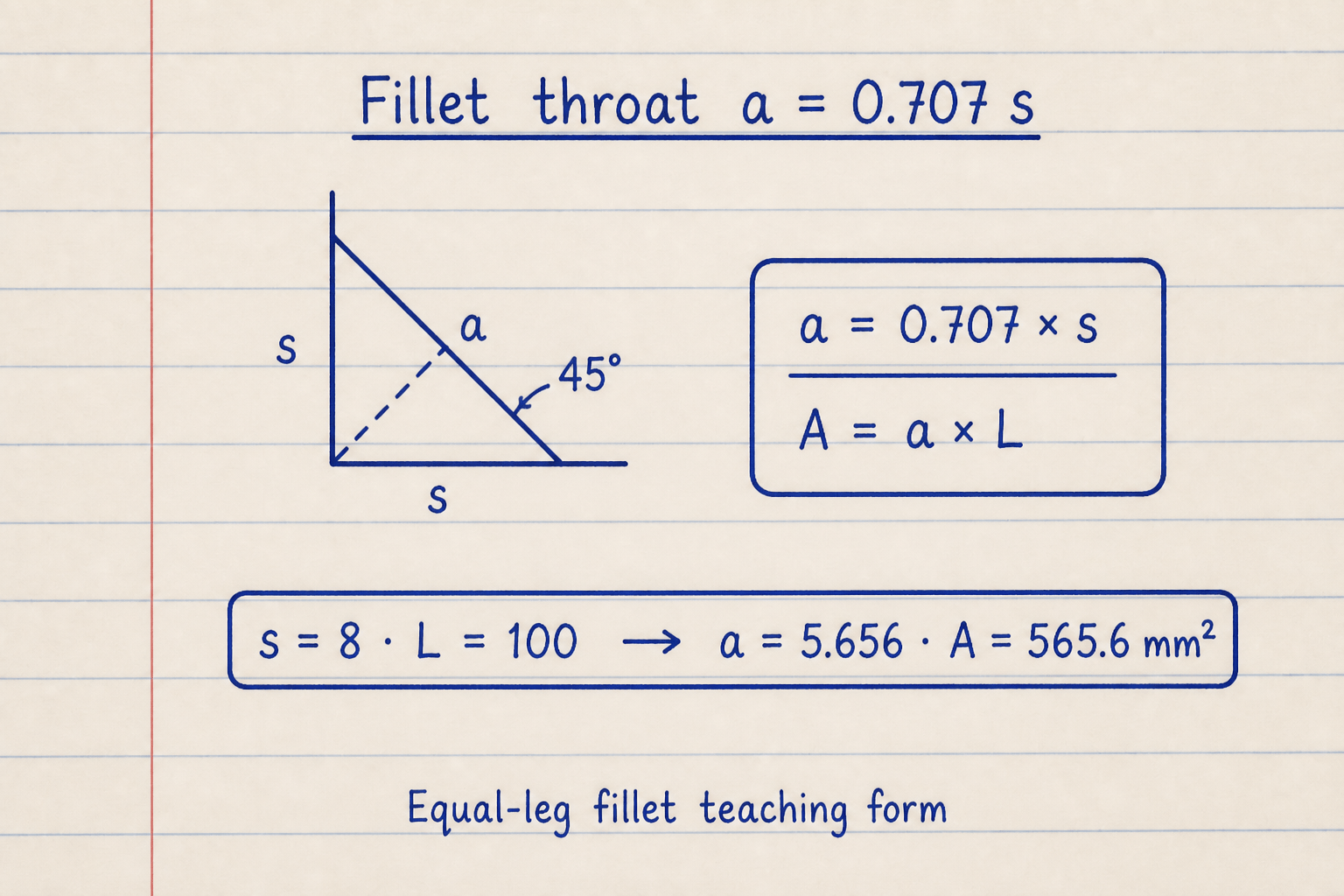
Equal-leg fillet throat a = 0.707 × s. Throat area for one weld line is a × L.
Defaults: s = 8 mm · L = 100 mm → a = 5.656 mm · A = 565.6 mm² after CALCULATE.
Joint types: fillet families and groove butts
Shop drawings group welds into fillet and groove joint types — tee, lap, corner, edge, and butt. This pad maps those layouts to screening capacity formulas. Transverse tee/corner fillets use allowable tensile σt; lap parallel and edge fillets use shear τ. Groove butts (square, single-V, single-bevel, double-V) use throat × length × σt.
Use this pad for first-pass size and FoS only — not as a substitute for the applicable welding code, WPS, or stamped design. Compare the FoS result with a general screening check on the safety factor calculator, or size bolted alternatives on the bolt strength calculator.
Teaching check: Tee — single fillet, s = 5 mm, L = 100 mm, σt = 70 MPa → P = 24.745 kN. Double tee fillet doubles to 49.49 kN. Lap single fillet at τ = 56 MPa on the same size returns ≈ 19.8 kN.
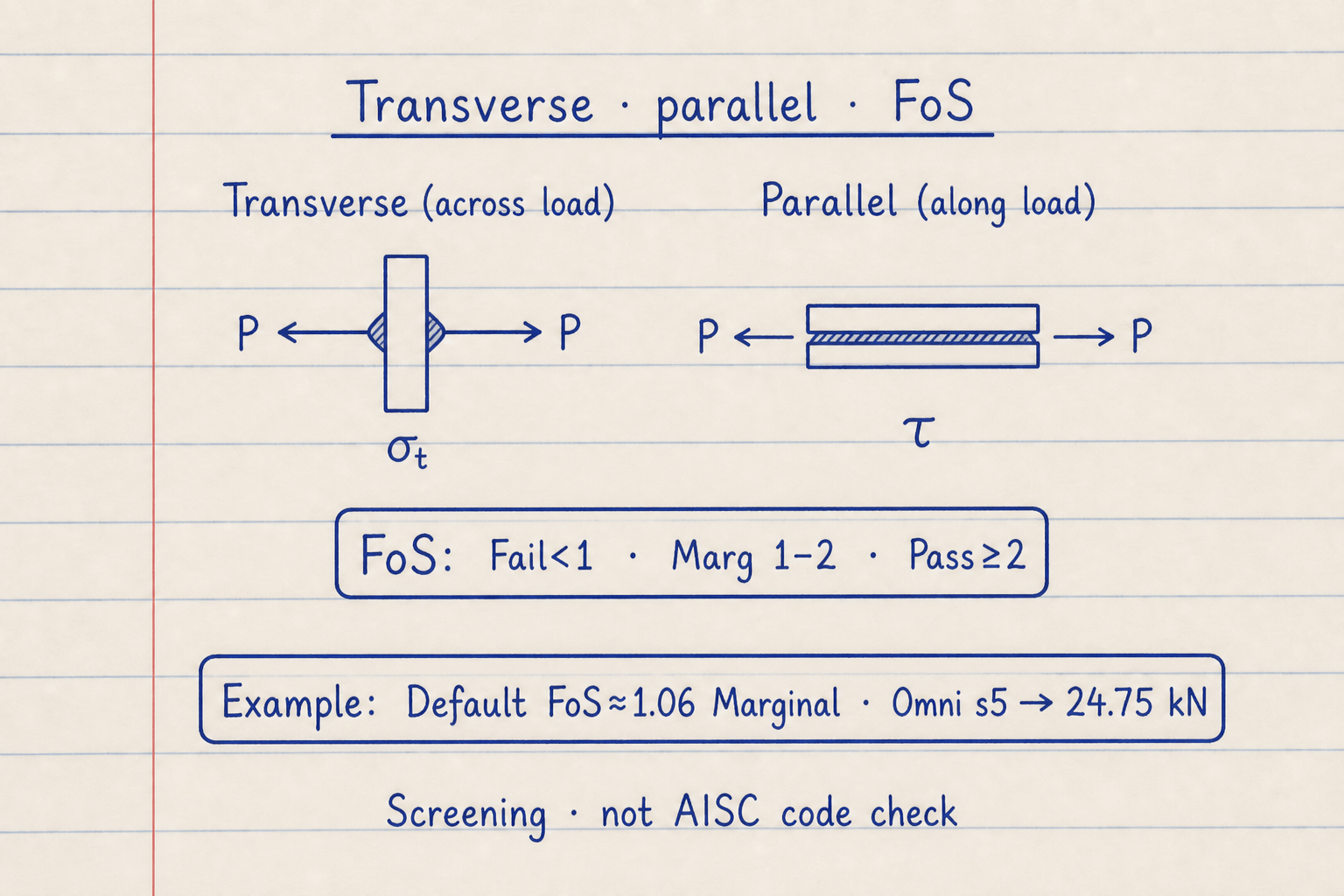
Tee / corner fillets → σt. Lap parallel / edge → τ. Groove butts → t × L × σt.
FoS: Fail < 1 · Marginal 1–2 · Pass ≥ 2. Default tee path is Marginal (≈1.06).
Capacity and FoS answer different questions
Capacity P is the theoretical joint strength from size and allowables before you apply a working load. FoS compares the stress from your applied force (or simple bending model) to the FoS allowable you enter. Utilization is applied force divided by capacity for axial and shear cases.
Defaults keep FoS allowable at 94 MPa (E70-style shear teaching value) while capacity tensile defaults to 70 MPa so you can see both cards at once. Override either field to match your drawing or code basis.
What this calculator is not
It is not an AISC, Eurocode, AS 4100, or NZS weld-group checker. It does not treat weld groups as Blodgett line patterns under torsion, and it does not apply LRFD ϕ or ASD Ω factors. Base metal, HAZ, and fatigue detail categories are out of scope.
Use this pad for screening. Final size still needs the applicable structural welding code, WPS, and responsible review. For formed blanks that later get welded, check bend allowances on the sheet metal bend calculator.
Worked example
Tee — single fillet defaults: s = 8 mm, L = 100 mm, F = 50 kN, FoS allowable 94 MPa, σt = 70 MPa. Reproduce on CALCULATE.
- Leave Joint mode on Tee — single fillet and Load type on Axial. Confirm leg 8, length 100, force 50000, FoS allowable 94.
- CALCULATE. Throat a = 0.707 × 8 = 5.656 mm. Area = 5.656 × 100 = 565.6 mm².
- Stress = 50,000 / 565.6 ≈ 88.40 MPa. FoS = 94 / 88.40 ≈ 1.06 → Marginal.
- Capacity at σt = 70 MPa = 0.707 × 8 × 70 × 100 / 1000 ≈ 39.59 kN.
- Optional teaching check: set leg 5, force 0, tensile 70. Capacity = 24.745 kN. FoS shows n/a with no applied load.
- Optional: switch to Lap — single fillet with τ = 56 MPa, s = 5, L = 100 → P ≈ 19.8 kN (shear path).
Result: Default tee path: stress 88.4 MPa, FoS 1.06 (Marginal), capacity 39.59 kN. s = 5 mm teaching path: capacity 24.745 kN.
When to use
- First-pass fillet or groove-butt capacity from size and allowables
- Screening FoS for an applied axial, shear, or simple bending load
- Comparing tee, lap, corner, edge, and combined fillet layouts
- Homework checks of P = 0.707 × s × σ × L
- Quick groove throat area and stress before code software
Limitations
- Teaching formulas only. Not AISC / EN / AS / NZS LRFD or ASD capacity.
- No Blodgett weld-group torsion or bracket tables.
- Bending model is a single-line beam idealization (I = a L³ / 12).
- FoS and status need an applied force or moment. Capacity-only runs (F = 0) show No load.
- Does not check base metal, HAZ, undercut, or weld quality.
- Not a fatigue detail or cyclic S-N check.
- Metric inputs (mm, N or N·mm, MPa). Confirm electrode allowables from your code.
- Not a substitute for stamped structural design or WPS acceptance.
- Results sketch is a teaching diagram only — not AWS welding-symbol notation.
FAQ
- Why is fillet throat 0.707 times the leg?
- For an equal-leg fillet the minimum throat sits on the 45° plane through the root, so a = s / √2 ≈ 0.707 × s. That throat times length is the shear area used here.
- When does capacity use tensile versus shear allowable?
- Tee and corner fillets, plus groove butts, use allowable tensile σt. Lap parallel, lap single, and edge fillets use allowable shear τ. Combined U uses σt on L1 and τ on the two L2 sides.
- What joint types can I pick?
- Tee, lap, corner, and edge fillets (single or double where listed), combined U, and groove butts (square, single-V, single-bevel, double-V). Each mode updates the Results sketch. Screening only — not a full AWS D1.1 weld-group design.
- What do Fail, Marginal, and Pass mean?
- FoS below 1.0 is Fail, from 1.0 up to 2.0 is Marginal, and 2.0 or above is Pass. Those bands are screening labels on this pad, not a code acceptance criterion.
- How do I match the 24.745 kN teaching example?
- Choose Tee — single fillet, set leg 5 mm, length 100 mm, tensile allowable 70 MPa, and CALCULATE. Capacity reads 24.745 kN.
- Does double fillet always double the strength?
- For equal double tee, corner, or lap-parallel modes on this pad, yes: capacity and throat area both use a factor of two. Real joints still need fit-up, access, and code minimum sizes.
- Can I check an eccentric weld group?
- No. Eccentric loads, torsion on rectangular or circular weld groups, and code interaction equations need dedicated structural software or hand methods beyond this pad.
- Is FoS allowable the same as capacity stress?
- Not necessarily. Capacity uses σt or τ by joint mode. FoS divides that stress into a separate FoS allowable you can set (defaults keep 94 MPa for the E70-style fillet check).
Welding Heat Input Calculator
ASME or EN ISO heat input in kJ/mm and kJ/in from volts, amps, and travel speed.
Open calculatorPunch and Die Design Calculator
Die clearance, cutting force, stripper, tonnage, and punch or die size for blanking, piercing, notching, cutoff, lancing, trimming, shaving, and perforating.
Open calculator